





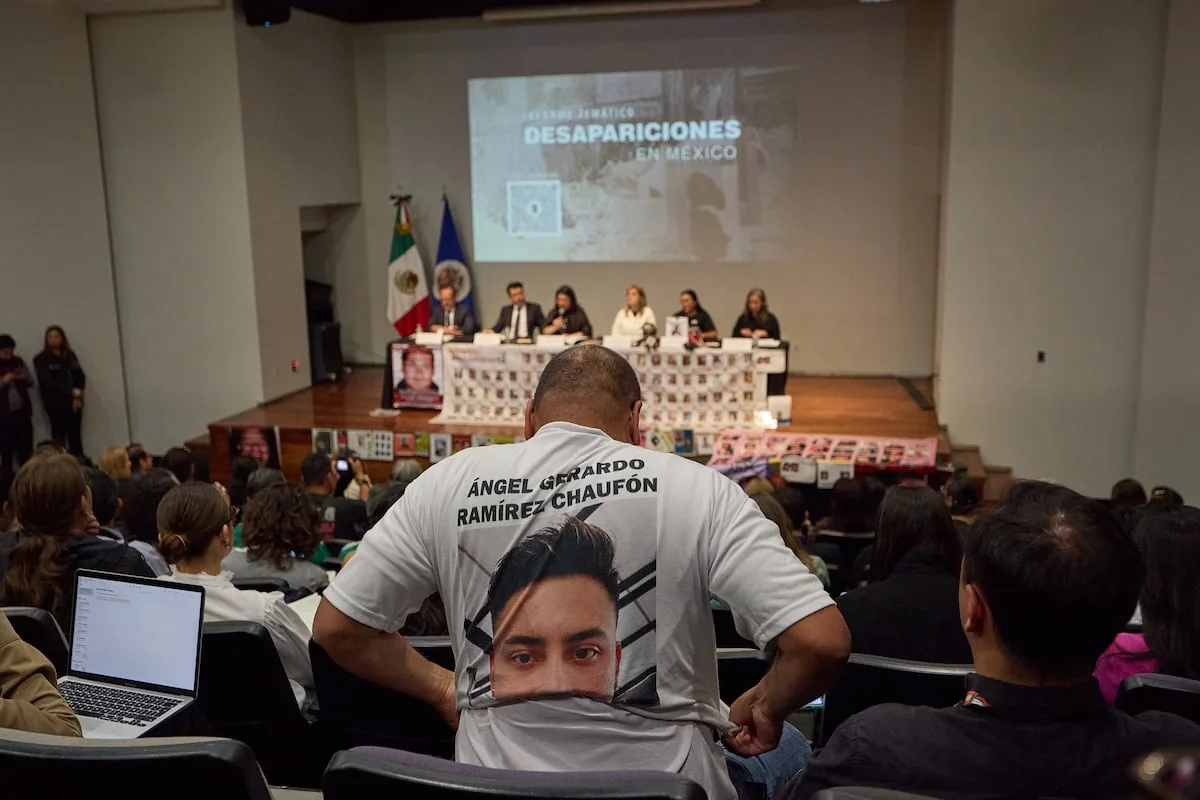
The image is unusual: sitting at the same table, at one end, Arturo Medina and Enrique Ochoa, two senior human rights officials from Claudia Sheinbaum’s Government, and at the other, Bibiana Mendoza, spokesperson for the Guanajuato Hasta Encontrarte collective, who has been searching for her brother Manuel for eight years. In the center, the vice president of the Inter-American Commission on Human Rights (IACHR), Andrea Pochak, trying to serve as a bridge. Opposite, the mothers, fathers, aunts, and sisters, wearing their search T-shirts so often used, with their painful slogans, with their tired but firm voices: “I have been searching for my daughter for 21 years, what hope can any victim in this country have?” Silvia Ortiz asks the officials. The presentation of the latest IACHR report on disappearances in Mexico, which recognizes the “humanitarian crisis” in the country, has become the latest battleground between victims and the Government.
The international body published its document this Monday, called , in which it states that in the country disappearance is “widespread,” “indiscriminate,” “can affect anyone,” “does not depend on dissenting opinions or political opposition,” and “is mostly committed by members of organized crime, as well as by state agents.” A thesis that expands on what the UN Committee on Enforced Disappearances (CED) had already advanced since last year, and which sparked a clash with Sheinbaum’s Government. Unlike the UN body, the IACHR has managed to bring Government representatives face to face with the victims. “Having officials sitting at the table during the presentation of a very harsh report is a first step to feeling some hope,” said Andrea Pochak, who is also the Commission’s rapporteur for Mexico. The IACHR has made 40 recommendations to the Government to address the emergency.
Inside the Museum of Memory and Tolerance in the capital, the two Mexicos have met and confronted each other this Monday over their great crisis: what is being done to find the tens of thousands of missing persons in the country? On the surface, the Government and the collectives do not agree on anything. On one side, Sheinbaum’s Executive presented a reinterpretation of the figures a couple of months ago, to reduce the 132,000 cases of missing persons recorded in the national registry to 43,000 people who would actually be unlocated, and defends its set of legislative changes as necessary for the search. On the opposite side, the searchers consider that reduction of the figures outrageous, feel unprotected by a State that allows them to be killed and disappear just for searching for their families, and demand a real strategy from the Government.
With that scenario, this Monday’s meeting was not easy. Arturo Medina told the searchers “that the Mexican State recognizes their pain and bravery and reiterates its unwavering commitment to work jointly.” “Sheinbaum instructed us to treat the disappearance of persons as a national priority,” said the Undersecretary of Human Rights of the Ministry of the Interior: “For the Government of Mexico, talking about the disappearance of persons represents a wound.” Enrique Ochoa, Undersecretary for Multilateral Affairs and Human Rights at the Ministry of Foreign Affairs, pointed out that “the report represents an opportunity to refine existing strategies”: “We recognize the magnitude of this scourge, there may be different approaches, but this is neither denied nor minimized. Only within a framework of genuine cooperation will we be able to move forward.”
The officials’ words were received “like a blow to the liver” by the families. “It is a State that has never listened to us, it is shameful to hear now that they want to collaborate with the victims when they have been in charge of covering up all the missing persons’ files to host a World Cup,” said Bibiana Mendoza, “it is unworthy to boast any progress when they have not had the dignity to receive us even for five minutes in more than one six-year term.”
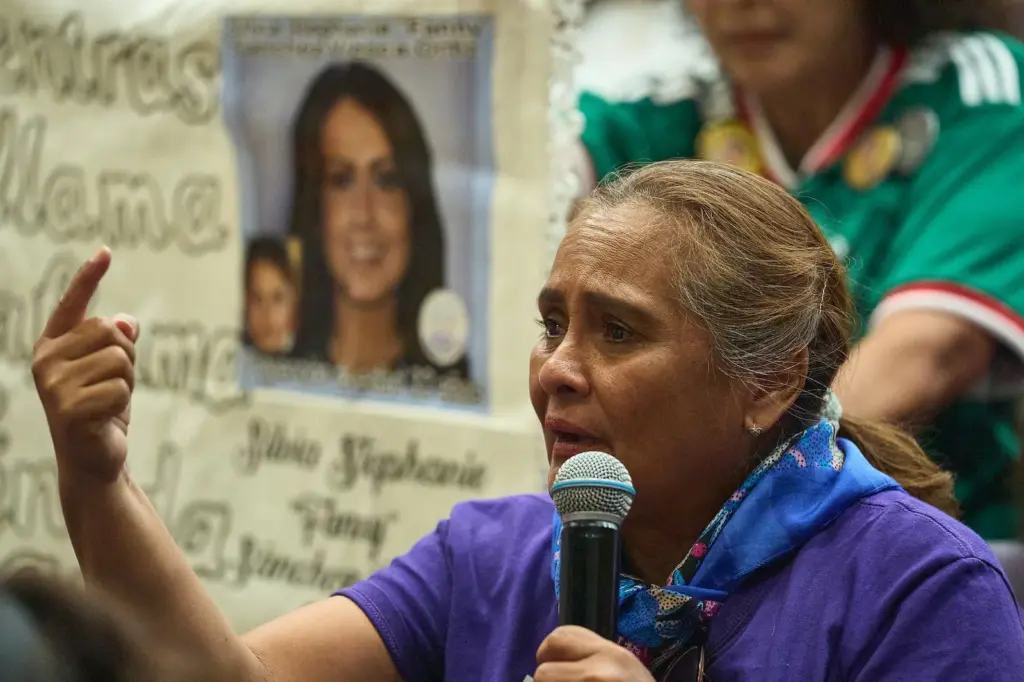
Grace Fernández, who is searching for her brother Dan Jeremeel, who disappeared in Coahuila in 2008, has asked the IACHR to verify that the 40 recommendations made are being fulfilled. “Really, do you think there is a real possibility that they can comply when they have not even fulfilled something binding like the Inter-American Court of Human Rights ruling?” replied activist Eliane García, who recalled that most of the search recommendations are many years old: “There is no prevention and no public policy.” “I have been hearing for 21 years that they will achieve it, that they will listen to us… will they really do it? Believe me, I am already tired and I keep going out to the field,” said Silvia Ortiz, who has been searching for her daughter Stephanie Sánchez since 2004: “Enough already, because we are dying.”
The report
In its more than 230 pages, the Commission’s document reviews “the magnitude, complexity, and structural nature” of this crisis in the country. It identifies the main victims as children and young men recruited by organized crime, women and girls victims of gender violence, migrants affected by trafficking for labor and sexual exploitation, and journalists and defenders who disappeared for denouncing abuses. The document focuses on disappearances from 2018 onwards and for its preparation, the IACHR studied 19 previous reports, 16 hearings, conducted questionnaires with 18 civil organizations and the Mexican State, collected 50 testimonies, and also interviewed senior officials from the National Search Commission. All this supported by academic research and journalistic articles.
The report recognizes “institutional and normative advances promoted in recent years by the State, especially in terms of search,” but defines them as “insufficient.” The IACHR emphasizes the “lack of effectiveness of prevention measures, the persistence of high levels of violence, distrust in authorities, and structural impunity,” which leads to 95% of cases never being resolved. The Commission, which offers its technical assistance to the Government, warns that overcoming the crisis requires “strengthening institutions” and dismantling “networks of collusion with organized crime.”
The international body points out that “disappearance affects entire families in Mexico, several of which have lost almost all their members to this crime” and cites the case of Veracruz native María Herrera, who has four missing children, or the Barajas family in Guanajuato, whose daughter Lupita disappeared in 2020 and whose son Javier was murdered a year later after finding her in a clandestine grave with 80 other bodies. The stories serve in the report to illustrate the Government’s negligence. For example, the document notes that there are “tens of thousands of bodies under State custody awaiting identification” and recounts the case of Braulio Caballero, 13 years old, whom his family searched for six years and whose body was buried all that time in a common grave after being run over.
The Government of Sheinbaum’s narrative battle against this crisis began last year, when the UN Committee on Enforced Disappearances declared that disappearance in the country was a “systematic and widespread” practice, thus triggering the so-called article 34, a mechanism that allows the issue to be escalated to the United Nations General Assembly. That measure was rejected en bloc by the Government and by Morena, the party to which the president belongs. The president even accused the committee of “having an orientation” aimed at “criticizing the Government of Mexico” and the Foreign Ministry discredited the report as “biased,” lacking “legal rigor,” “partial,” and “skewed.”
Disappearances have become the thorn in the side of Sheinbaum’s security strategy. While the Government has been able to boast of reducing most crime figures in the country (homicides have decreased by more than 40%), the trend of disappearances continues to rise. This has led the Executive to announce that it is trying to find a more effective way to register them in order to address them. However, families demand less concern from the Government about numbers and more search actions.
“The Inter-American Commission on Human Rights presents this document today, with the conviction that these conclusions and recommendations will translate into verifiable, urgent, and above all coordinated actions between authorities and organizations and collectives,” concluded vice president Pochak in her appearance: “Because we, from the Inter-American Commission, also decided because they were taken alive, we want them alive.”