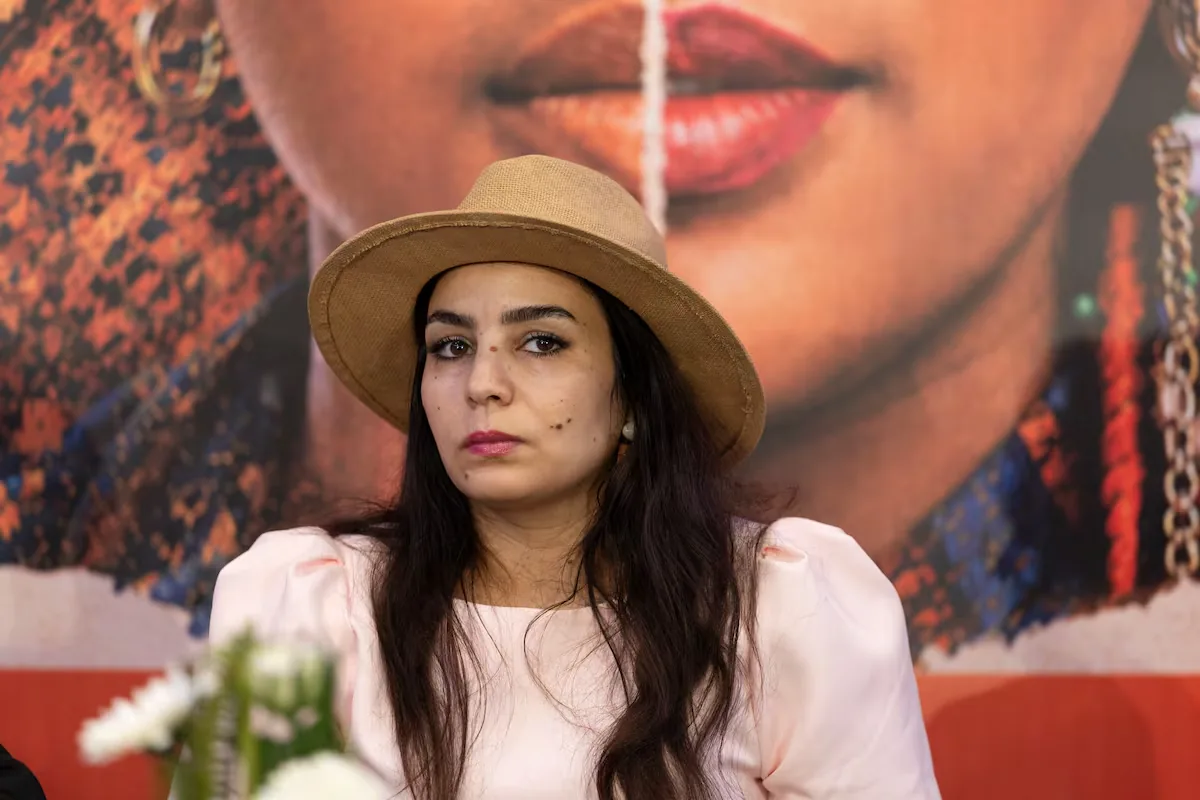
A documentary can tell pieces of a country’s big, public history. Or it can narrate what happens behind closed doors in a home, when repression intensifies on the street and neighbors end up dead, their bodies disappear without photos to record them, and only scattered stones remain. Telling the inside of the silence is what Moroccan filmmaker Asmae El Moudir (36 years old, Salé) did in The Mother of All Lies (Kadhib Abyad/The mother of all lies, 2023). The film, awarded at the Cannes Festival in 2023, was the way El Moudir found to approach the so-called June 1981 Bread Riots in Casablanca, based on the memories left in her grandmother, who did not speak about that fateful episode that left hundreds dead and marked the country’s history. Because even in the most isolated of rooms, the walls listened, even if the sirens had gone silent and the beatings had stopped.
The director has spoken about this feature film, and other projects related to Morocco’s memory and family stories at the Essaouira Gnaoua et Musiques du Monde Festival 2026, held this summer. “I thank absence, because it is due to that void of images that I was able to make The Mother of All Lies,” she said during the “Creating to Exist” debate panel of the Human Rights forum held within the festival. “When I shot it,” she explained in an interview with this newspaper, “my grandmother tried to understand why I needed to create those images, which are a mirror, because with them I cannot transform reality.”
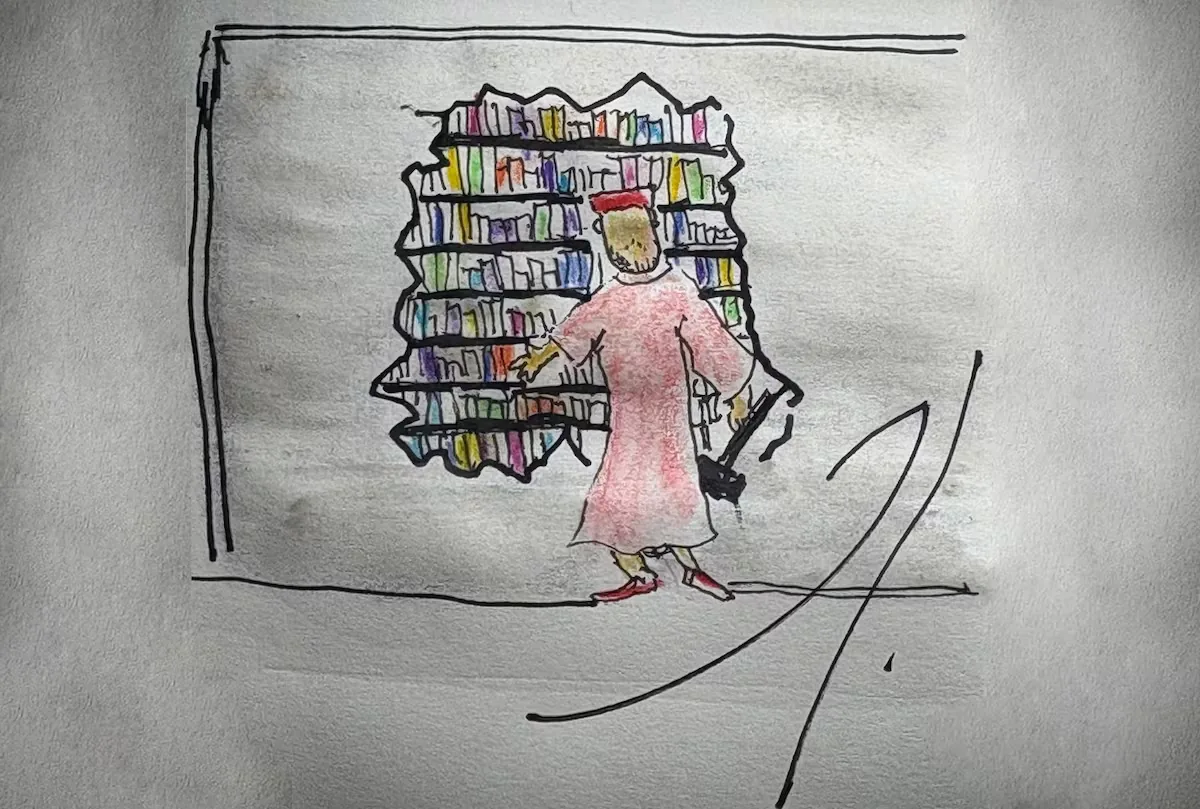
Based on her grandmother’s memories, the filmmaker created a visual narrative with clay figurines made by her father, and a miniature home setting, with which her family members interact. She thus exposed the family dynamics brought about by persecution, combined with ancestral customs of respect as a synonym for lack of communication. The film can currently be seen on platforms like Filmin.
The filmmaker shows how that silence is strictly maintained over several generations, when a grandmother is in charge of reminding every day the strict order to keep quiet.
For the filmmaker, stories always start from childhood, because “that is where everything happens.” As an example, she recalls that when she was six years old, the electricity was cut off because her father had not been able to pay for it. She looked at the stickers placed on the screen and imagined they were cartoons. “That lack of images left me with a great thirst until I started making films, around 20 years old; today it would be a betrayal not to leave testimony for future generations,” she argues. That is why she felt she had to reopen the conversation about Morocco’s history and “address that lack.”
Question. After shooting The Mother of All Lies, have you managed to understand your grandmother’s bitterness, whom the viewer perceives as a permanently angry woman?
Answer. [For my grandmother] It was a way to protect herself. We grew up in a somewhat conservative society, in which, although grandparents are firm and strict, we respect them very much. Your grandmother can kick you out of the house or slap you, but it is something sacred, a very respected maternal figure in Moroccan families. So, to protect her children and grandchildren, she adopts a severe attitude. She has never gone to school and does not know how to do it any other way. Maybe she fears that if she is kind, the children will become ill-mannered. From our perspective as grandchildren, we have the right to say that we do not like being controlled so much, but we do not dare to confront her face to face to say: “I don’t like what you do.” That is why the film was a form of liberation, or confrontation, but without crossing the limits. I maintain respect for the grandmother so as not to present her as a victim or offer a negative image of her.
Q. It is a way to get to know and understand her.
A. Yes, and that also happened to her. When I shot the film, my grandmother tried to understand why I needed to create those images, which are a mirror, because with them I cannot transform reality.
After Cannes, my grandmother has become tremendously interesting
Q. What did she think when she saw herself in the film?
A. She — who did not like photos and had almost never been photographed — suddenly found herself at such an important festival as Cannes under the spotlight. I had prepared her beforehand so that she would be aware of what we were going to do. But even so, it meant a radical change in her personality; that is, little by little, she is becoming another person, whom I appreciate a lot today. After Cannes, my grandmother has become tremendously interesting and engages in healthy conversations without getting angry immediately. She starts watching series and movies. She is still a bit protective and conservative, of course, but not like before.
Q. Has the family allowed you to reach Cannes, and has Cannes meant the possibility of reaching your family?
A. Cannes and other festivals have allowed me to reconcile with my history and my family. After three years, I am beginning to realize how important it was to make this film.
Q. You even seem transformed compared to previous national festivals, in your short film era.
A. Yes. I remain very attached to my culture and I love speaking my mother tongue [dariya, Moroccan dialectal Arabic], because I think magic is created when we talk about our identity in our own language. But today it has become necessary to open up and share the experience internationally, because recognition also comes from there. Presenting the film in Venice, Cannes, Toronto, Sundance, Karlovy Vary (Czech Republic) or Sydney (Australia) I have realized that cinema is a universal language, in which the important thing is to let the image speak… and also the grandmother.
Q. How do you maintain that connection with your own country after achieving so much recognition abroad?
A. Normally, the approach I always take starts here, in Morocco. I still live here [between Rabat, Bouznika, and Casablanca], so I continue to draw my ideas from here. You also have to think that cinema is entertainment and you should not take the audience hostage. When I make a film, I do not make it only for the Moroccan audience, but for a universal audience.
Q. Why do you choose to express yourself through dolls and miniature objects?
A. I don’t like being rushed and I find the relationship with actors a bit difficult to manage at first. For example, shooting a short film in five days doesn’t mean anything to me. I have to create my sets and my characters and keep them as long as I want. I need total freedom. I do the editing, shoot and reshoot when necessary. And I keep the dolls.
Q. When building your characters and sets, do you feel you value artisanal work?
A. Yes, everything is handmade. It is about having total control of the set, without daily pressure. When I want, I shoot, turn on the lights and there are the miniatures that don’t ask for food. I also go to work with actors. That is clear, but I need privacy and time with my characters. To work with real actors I had to be known and have a budget. Until now, that had not happened, because I produced the films myself. So, I relied on my ideas.
It is about having total control of the set and without daily pressure. When I want, I shoot, turn on the lights and there are the miniatures that don’t ask for food
Q. Do you now have producers for your next project?
A. Yes, of course, I work with Haut et Court Doc, which is a production company in France; my next film is with them. The success of The Mother of All Lies was important for my career. That changes everything. While shooting it, I already had ideas saved and these grew with me. I started the next film in 2017.
Q. What is the next project?
A. I am working on Children of the Moon, which talks about people [with xeroderma pigmentosum] who can never see the sun because it harms them. They are not albinos, but they have intolerance to UV rays. In this case, it is about a meeting with a father and characters who dream of seeing the northern lights. I still have to shoot a part in Norway, at the end of the year. I won’t reveal much, I will just say that it is also a “hybrid” film [between documentary and fiction], because I love exploring cinematic forms and not taking things for granted. I try to create my own way, if I manage to.
Read more September starts with full summer heat: 43 degrees in the southern half and 40 in the northern half