









I believe it is in The Sea, The Sea where Iris Murdoch asserts with great force that the first experience of maturity for every human being is the experience of heartbreak. Whether that is true or simply ben trovato, what seems indisputable is that people who take a long time to reach it are prey to a stupidity as irritating as that sometimes found in people of iron health. Wisdom (not to mention empathy) necessarily crosses the experience of fragility. To abandon/To be abandoned.
Martín Kohan, probably one of the two or three best active Argentine writers —and a gem yet to be discovered by many Spanish readers— presents this separation as a kind of triptych: on the outer panels is the journey, the mobile; on the central panel, the pain, the static. The story is very simple, as is usual with Martín Kohan (simpler plots, alongside an increasingly meticulous and detailed style, as if they were divergent curves): a lawyer from Buenos Aires takes a bus trip to a small town in the province of Córdoba to visit his brother, who has just separated from his wife, in a context where he himself also does not seem to be going through the best moment in his relationship with his own.
The journey is posed from the start as a visit to the ghost of future Christmases. The Separation is a novel of atmosphere, of texture, because the intention to reproduce the “death” energy that a separation always generates in its environment is evident, but also “of life,” due to the opening to the inevitable mystery: what happened, who was to blame, who is responsible. It is also a travel novel: because all heartbreak inevitably is. The journey toward a new creature, the one born from the ashes of the relationship. Everyone abandoned is an Odysseus.
Obviously —as in life—, in Kohan’s novel heartbreak is infected with the same mystery as its opposite. And not only because we stop loving for reasons as indistinguishable as those that led us to love, but because Kohan here boldly presents heartbreak as a new formula of romantic love, of surrendered and impossible love. “True impossible love is not the one that could never be in the future, but the love that already was and was exhausted in the past. Impossible love is heartbreak.”
A cynic once commented that one is never as alive as when contemplating someone else’s misfortune, a statement that is both completely false and painfully clever. This novel is the slow contemplation —at the pace of a bus journey— of the motionless anguish of someone who does not know why they have been abandoned and the worry of someone who does not know if they will ever be. A contemplation from which one emerges comforted, not so much because it ends better or worse for the lovers, or because luck makes us feel temporarily safe from misfortune, but because of the humanity without answers, without good or bad, without likes, that great literature always offers.
Read more Iran closes the Strait of Hormuz again until Trump lifts his own blockade
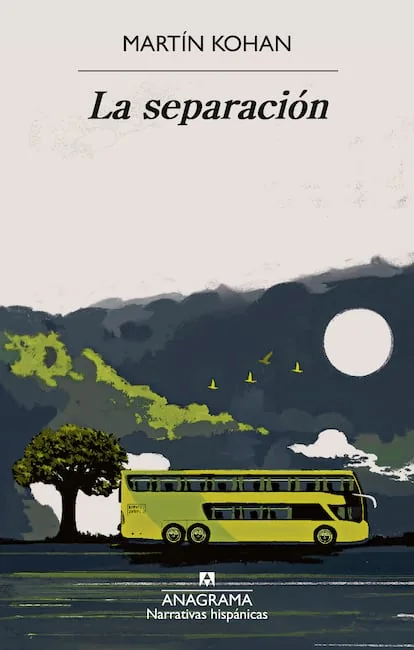
The Separation
Anagrama, 2026
232 pages. 18.90 euros