







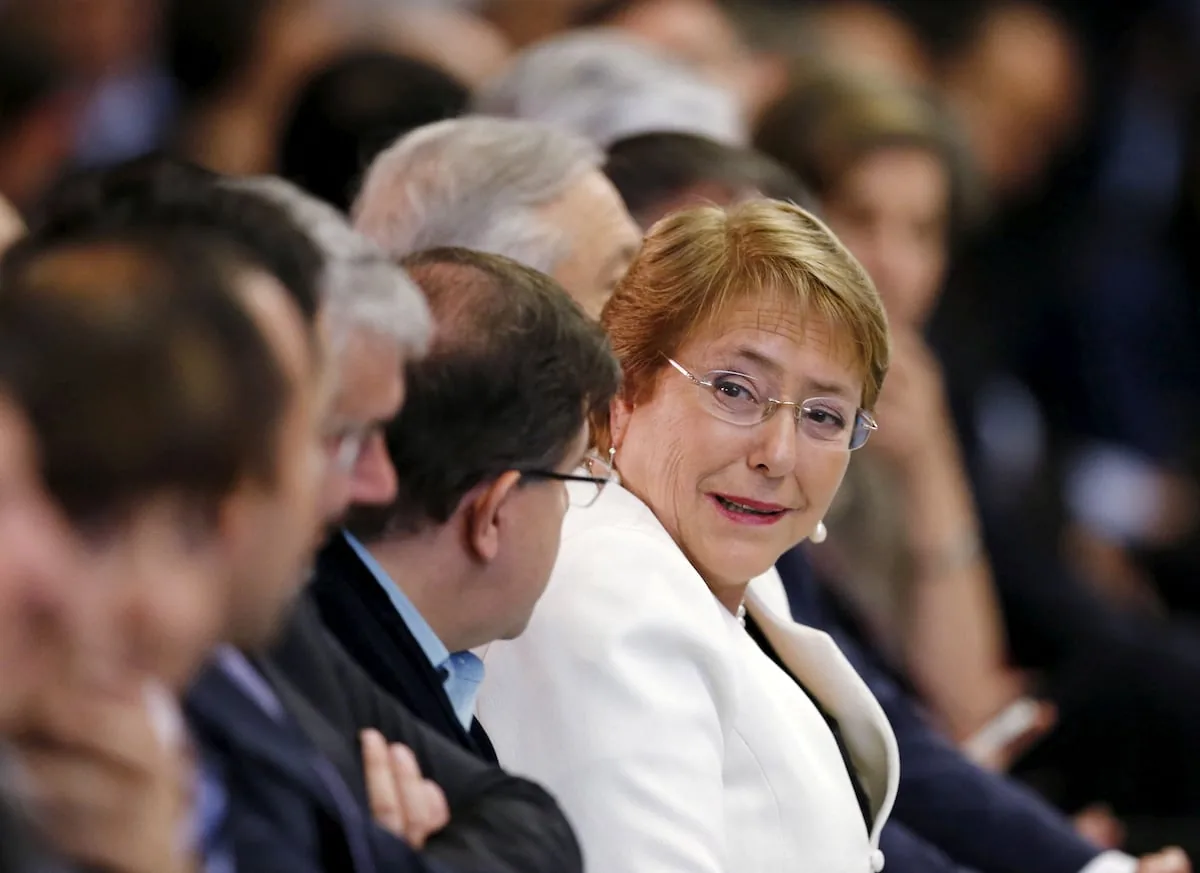
The race for the United Nations Secretary-General enters a decisive phase this Tuesday. The two-time president of Chile, the socialist Michelle Bachelet, is the first of the four aspirants to lead the UN to appear before the ambassadors of the 193 member countries in the General Assembly and then submit, for three hours, to their questions about her positions on contingent issues. She arrives with the backing of Mexico and Brazil, after the new government of the ultraconservative José Antonio Kast withdrew Chile’s support for her candidacy a month ago, which had been provided during the administration of Gabriel Boric (2022-2026). The 74-year-old doctor has prepared “intensely” for what is known in the diplomatic world as the “social debut” of her candidacy, her advisory committee reports. In addition to about fifty minutes on possible topics they may consult her on – security, reforms to the organization, human rights, among others – Bachelet also participated in a rehearsal (a simulation exercise) at New York University of what Tuesday’s session will be like.
In recent weeks, Bachelet was in Chile preparing her role in this Tuesday’s “interactive dialogue” at the UN, which consists of 10 minutes of appearance followed by three hours of questions. She met with ambassadors from the European Union in Chile and also with Russia’s, Vladimir Belinsky. In parallel, a committee led by Bachelet’s former foreign minister, Heraldo Muñoz, in which six other former foreign ministers from center-left governments and four undersecretaries participate, has developed the campaign strategy. The help of the Mexican and Brazilian delegations at the UN, with whom part of the advisory committee has two weekly meetings, has been “invaluable,” her team reports. The former president, who arrived in New York on April 16, is even staying at the Brazilian ambassador’s residence in the US.
Over the weekend, the campaign deployment moved to Barcelona, where the IV Summit in Defense of Democracy, organized by progressive leaders, and the Global Progressive Mobilisation (GPM) were held. Both the former president of Chile, Gabriel Boric, and the Spanish president, Pedro Sánchez, warned about the weakening of multilateralism and advocated for the UN to be led by a woman for the first time. Members of Bachelet’s campaign advisory committee met with authorities and former authorities from several countries, including Portugal and Sweden, “who can influence the decisions of their respective governments,” they report. In turn, they asked the Mexican and Brazilian delegations to do the same in the Catalan capital with other countries.
One of the preparations for this Tuesday consisted of a simulation of the three-hour interrogation the candidate will have to undergo. The exercise was carried out at New York University, where members of the educational center played the role of ambassadors from UN countries. As Bachelet was director of UN Women and High Commissioner for Human Rights, there are several issues she masters, her entourage points out, but the focus has been on updating them according to current events.
After Bachelet’s “interactive dialogue,” it will be the turn of the UN’s nuclear chief, candidate Rafael Mariano Grossi, from Argentina. On Wednesday, the UN’s trade chief, Rebeca Grynspan, will present, and finally, the former president of Senegal, Macky Sall. The four presentations were defined in alphabetical order. In 2016, when the Portuguese António Guterres was elected secretary-general, there were 13 candidates, and diplomatic circles say that his good performance in the “interactive dialogues” was key to his victory. This time, the elections come with only four aspirants, in a context where wars are underway in Ukraine, Gaza, and Iran, and with the organization’s representativeness questioned by the United States under Donald Trump’s mandate, and its ally Israel. They are also held with significant international pressure for a woman to occupy the position for the first time in 80 years, which, according to the informal criterion of rotation of contenders, should be from Latin America.
Bachelet proposes on her website to “promote continuous reform that strengthens coherence, accountability, and results-based management, making the most of existing resources.” In addition, she aims to reinforce the UN’s legitimacy “by demonstrating concrete impacts” on people’s lives, reaffirming the principles of impartiality, respect for international law, the sovereign equality of States, and human dignity, and promoting more inclusive multilateral governance, strengthening regional cooperation and using innovation and technology — including artificial intelligence — in the service of sustainable development and human rights.
Kast Government’s Snub
When the Kast government withdrew its support for Bachelet’s candidacy, citing infeasibility, it also reported that Chile would not support any candidacy. “The dispersion of candidacies from Latin American countries and the differences with some of the relevant actors that define this process make this candidacy and the eventual success of this application unviable,” they argued then – there are only three Latin American candidacies. President Kast assured that with her international influence, Bachelet could collaborate “in establishing the Chile brand in the world, but not through the UN.” In the event that the former president wins, Foreign Minister Francisco Pérez Mackenna defended that the Administration would work with her “as we would with any secretary-general.”
The Executive’s decision has been branded as “petty” by the left. Bachelet even decided to reveal after the fact that the center-right former president, Sebastián Piñera – who died in 2024 in an accident – had encouraged her to run for the position, assuring her of his support. “We will move forward, because whatever the outcome, it is worth fighting for the first woman secretary-general,” she responded when the new Administration withdrew its support.
One of the doubts raised by the opposition to Bachelet’s candidacy is a possible US veto. In a letter dated March 25 to Secretary of State Marco Rubio, 28 Republican legislators from the Senate and House of Representatives — out of 271 existing — requested that the United States veto Bachelet, whom they criticized for her pro-abortion stances, and whose record, the letter states, “does not align with the qualifications that President Trump’s Administration has established for the next UN Secretary-General.” Last week, during a Senate Foreign Relations Committee hearing, Republican Senator Pete Ricketts, one of the signatories, asked Mike Waltz, US Ambassador to the UN, about Bachelet’s suitability for the position. Waltz replied that he was not in a position to say whether the United States would support or oppose her, but noted: “I share your concerns.” Bachelet’s entourage downplays Waltz’s comments, considering him to be lacking in judgment.
Chilean opposition parliamentarians have also referred to the possible veto. “Our aspiration is that this debate takes place with a broad perspective,” said the general secretary of the Communist Party, Bárbara Figueroa, “and hopefully the disposition of the parties and those who speak out nationally today will not be subject to submission to the United States,” she added. The general secretary of the Socialist Party, Arturo Barrios, for his part, stated: “We understand that we are in a competition, in a situation where a decision must be made.” Liberal Party Senator Vlado Mirosevic suggested that he does not believe Trump will have other considerations in mind beyond “the balance with other powers, and also seeing who the other candidates are, whether they have viability or not.”
Read more More than 3,000 victims in eight years of investigation: “We can’t keep up with the cases in Spain”