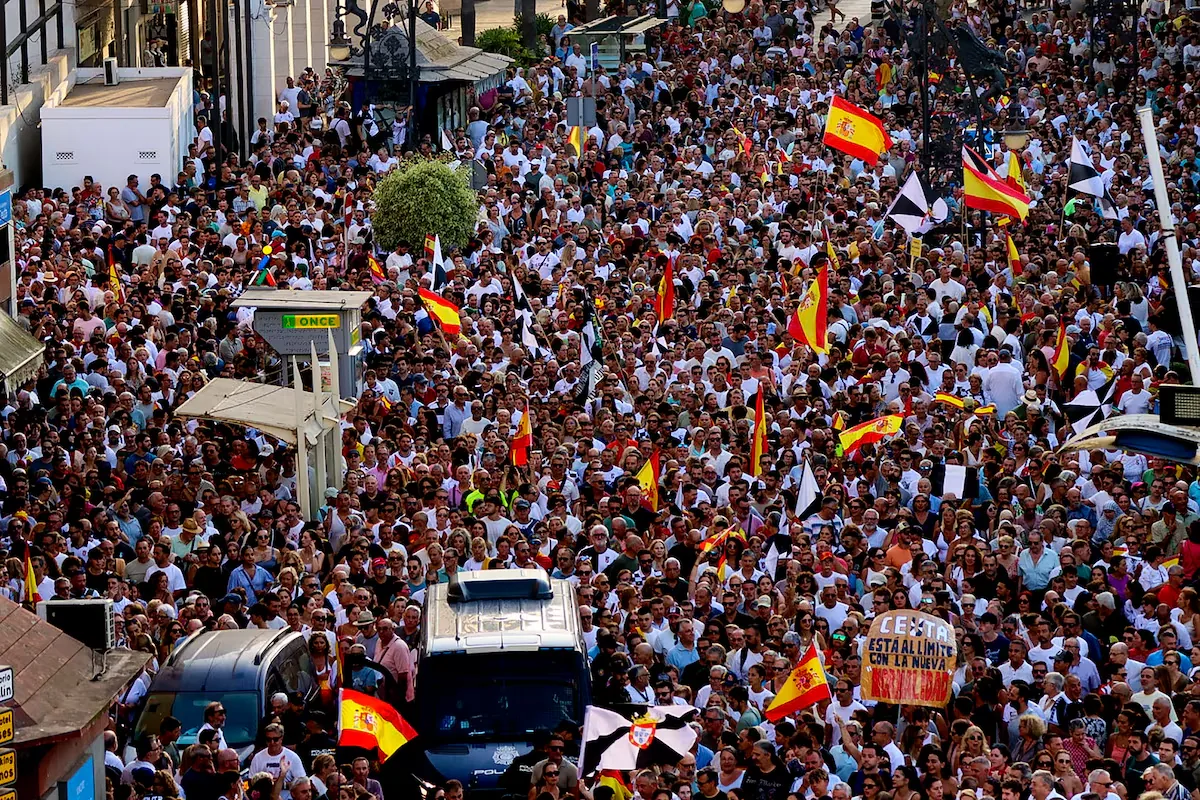
“Ceuta is not for sale. Ceuta is Spain.” The shout echoes in the Plaza de la Constitución, packed with Spanish and Ceutan flags and thousands of demonstrators. Ten days of tension following the massive entry from Morocco of more than 70,000 people into the city culminate this Sunday in this Ceutan corner, where the accumulated unrest is already heard loudly in one of the most massive demonstrations the inhabitants remember. The horns blare nonstop and the “I am Spanish” is repeated over and over among the crowd, louder each time. The manifesto read has demanded “responses” from the authorities for the crisis, “solidarity” from the entire Spanish society, and “calm and unity” from the Ceutans themselves.
The event had barely begun when from the platform they asked for a minute of silence for those who lost their lives trying to reach Ceuta. The request provokes rejection among part of the audience. “Well, we’re off to a good start,” a man is heard saying. The murmur grows until the demonstrators themselves end up preventing the silence. Then the Ceuta anthem sounds. This time, the entire square sings in unison. More than 10,000 people attended the call, according to the organizers; just over 5,000 according to the National Police estimate.
The rhythm of the gathering is then marked by two slogans. “President, you are not alone,” they shout in support of Juan Jesús Vivas. Just seconds later, the tone changes: “Sánchez, resignation!” From the platform, the president of the Hindu community, Ramesh Chandiramani, tries to ease the tension and refocus the message that has brought together the four Ceutan religious communities — Christian, Muslim, Jewish, and Hindu. One of the most notable absences was the Government delegate in Ceuta, Miguel Ángel Pérez Triano, who did not attend the demonstration and was shouted at demanding his “resignation.”
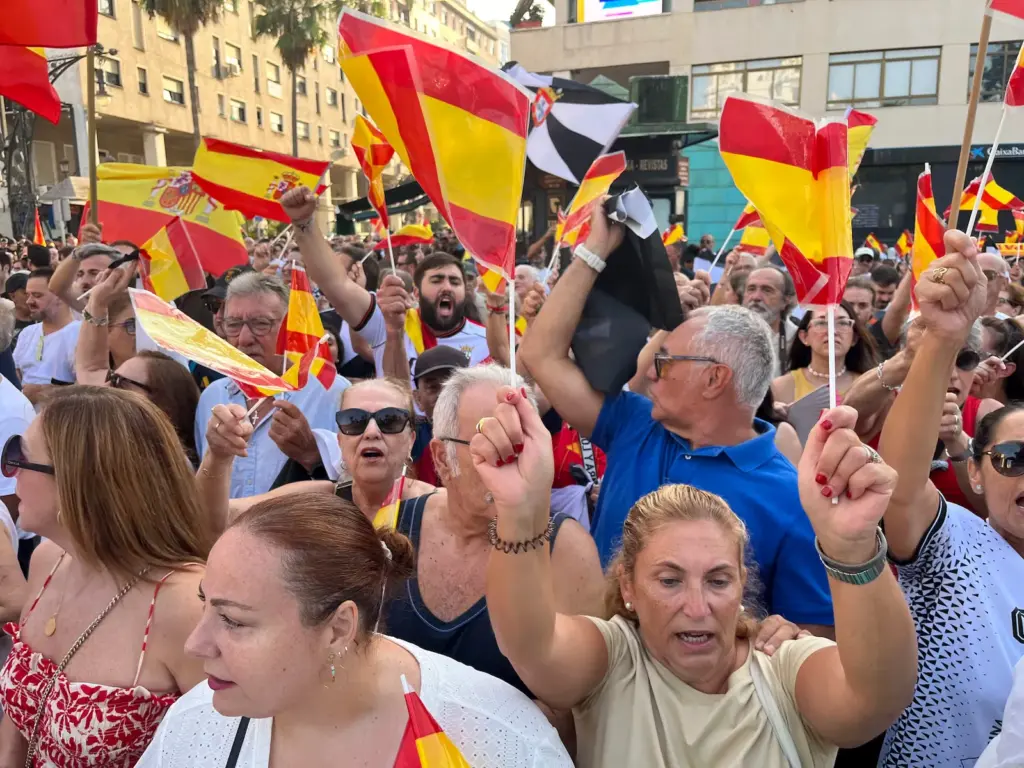
Among those listening to the manifesto is Lorena Serrano, 43 years old. It is the first protest she has attended since the massive entry into Ceuta on July 30 and 31. Since then, she says she feels “abandoned.” “We have a great sadness. We only ask for help,” she says, looking towards the Peninsula. For her, what happened that day was an “invasion.”
A few meters away, on a bench along the promenade bordering the square, Hamza watches the scene silently. He is 20 years old and arrived in Ceuta from Morocco precisely that day. He does not understand the shouts or slogans because he does not speak Spanish, but he does know he does not share what those demonstrating are saying. He remains seated while voices demand “responses” just meters from him.
His gaze, however, tells another story. Since then he has been sleeping on the street and still remembers the harshness of the swim. “I looked death in the face,” he says with his eyes downcast. Now he only thinks about leaving Ceuta and reaching one of the capitals of the Peninsula, where he hopes to find the better life he came looking for.
Read more Jon Rahm, a three-time LIV champion wrapped in doubts
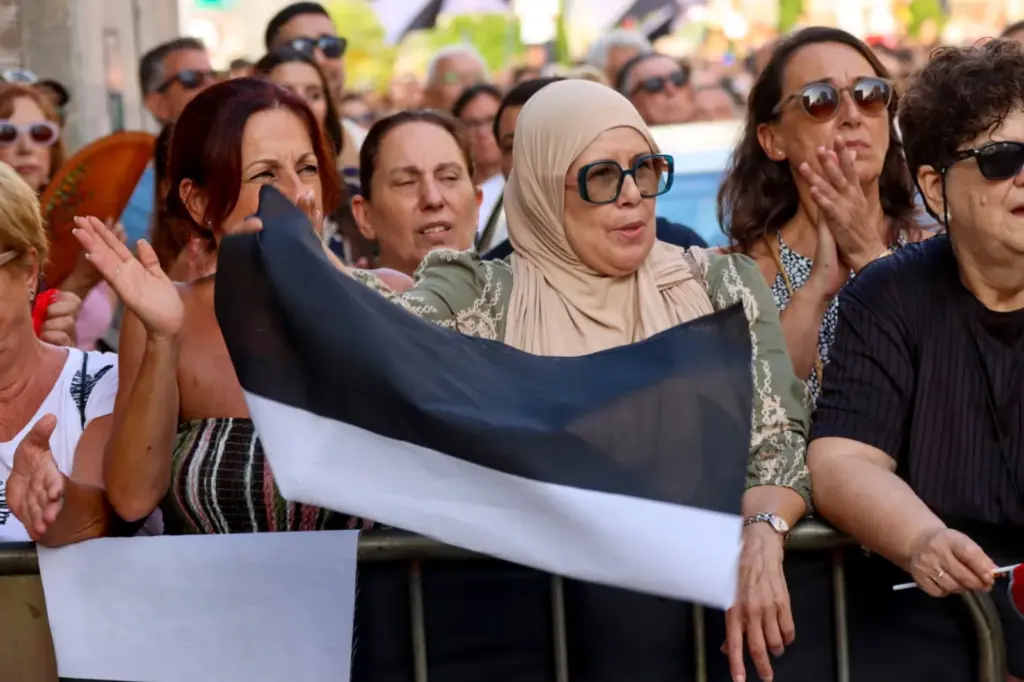
It is the contrast that crosses the square. While Chandiramani insists from the platform that “this call is not born from rejection of anyone,” other voices are heard among the crowd: “Invaders!” The message from the religious communities seeks to mark a boundary between the claim and rejection, but the slogans from some demonstrators show that this line is not so easy to maintain.
There was not a single improvised word from the organizers. Every phrase of the manifesto had been previously agreed upon to gather the largest possible number of demonstrators and reinforce an idea that the autonomous city has been repeating for days: the situation is “extraordinarily critical” and Ceuta “cannot face alone a situation that far exceeds its capacities and affects the whole of Spain and Europe.” The request, therefore, is concrete: “an immediate response” from the Government and European institutions, with “sufficient means, human and material resources” and “priority attention to its borders” to face migratory pressure.
“We cannot help them all,” a woman tells her companion among the crowd. Near them, another demonstrator raises a sign with a photo of the King: “Felipe VI, come to Ceuta. Don’t be a coward.” The tension is palpable among a crowd that seems to have waited ten days to release its anger. When a Televisión Española journalist tries to make a live connection, demonstrators stationed by the barriers begin to heckle her: “Manipulators! Get out of here!” Voices clash and the atmosphere heats up.
In the middle of the protest, a Muslim man, with the Spanish flag draped over his shoulders, ends up verbally confronting other demonstrators. He reproaches them for their lack of tolerance. For a moment, the scene sums up the contradiction crossing the square: a protest called in the name of unity and coexistence, but also marked by a tension that sometimes overflows.
And that tension then moves to the vicinity of the Government Delegation. There the shouts and slogans that have marked the day continue, while demonstrators demand the resignation of the Government delegate. But, little by little, the noise begins to die down. More than an hour after the start of the gathering, the square begins to empty. The flags gradually disappear among the last groups.
Read more Italy calls it «unacceptable» that Spain establishes controls, as the Italian Government did before