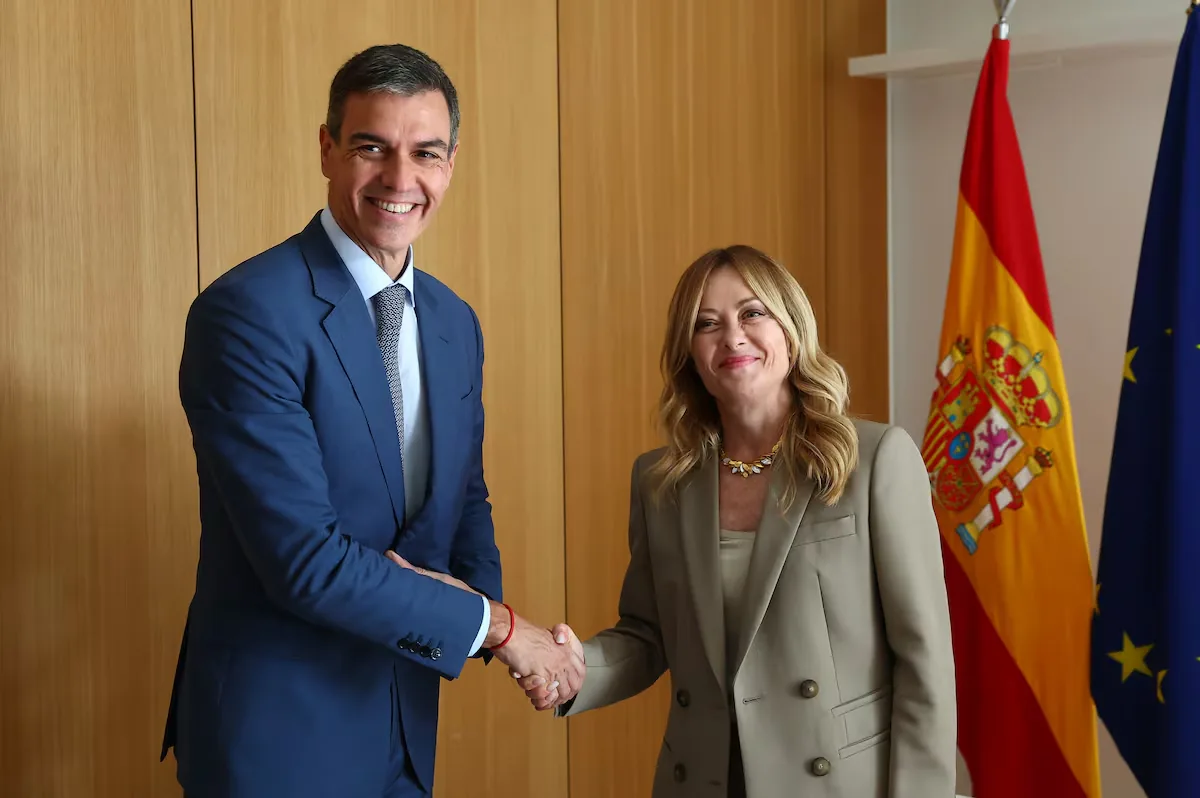
Italy remains firm in its decision to maintain border controls for travelers coming from Spain. Giorgia Meloni’s government has not wavered in its determination to suspend the free movement of people under the Schengen treaty, and it has been of no use that Spain has done the same with passengers arriving from Italy since midnight last Saturday. Quite the opposite: Deputy Prime Minister Matteo Salvini blamed the Spanish government this Sunday for “bordering on the ridiculous” and stated: “We defend European borders, Spain has not.”
Read more Why do they laugh at Christopher Nolan’s ‘The Odyssey’?
“If you regularize 500,000 undocumented immigrants all at once, you can’t be surprised that thousands seek to share the same fate,” asserts the Lega secretary in an interview with the newspaper Corriere della Sera. “And what if among those 50,000 [his figure for people arriving in Ceuta] jihadists or terrorists willing to attack had infiltrated?” he asked.
Another member of Meloni’s Cabinet, the Italian Foreign Minister Antonio Tajani, assured that controls will continue and harshly criticized the decision of Pedro Sánchez’s government, calling it a “reprisal” and a “disproportionate” reaction by the Spanish Prime Minister to Italy’s suspension of Schengen. “What is incomprehensible and totally unacceptable,” he added, “is Spain’s reaction,” which “has not been as vigilant as it should have been” on border issues.
“It is necessary to put things in order: we are not against Spain, but we have the duty to protect our borders,” Tajani said in an interview with the newspaper La Stampa, in which he downplayed the fact that migrants who entered by the tens of thousands in Ceuta on July 30 and 31 cannot access the Peninsula (and therefore the rest of the Schengen area) because they must pass a police check. The Italian Foreign Minister pointed to an additional reason for suspending free movement, in line with Salvini, a security risk: “There is no doubt that the arrival of people from sub-Saharan Africa poses a jihadist threat,” he said. Tajani also referred to future waves of people toward the Spanish North African enclave. “There is a risk of a new wave in mid-August: not lifting our measure is a precaution, but we hope to do so soon, as soon as the risk has disappeared.”
On the Spanish side, the political discourse has maintained a different tone. Third Vice President Sara Aagesen expressed hope that Italy “reacts and understands that the Schengen area has not been violated at any time and is guaranteed” and responded to the arguments put forward by Italy about the possible threat of a large number of irregular migrants arriving on continental European soil. “Not a single person has crossed and reached the peninsula at this time. The Schengen area is being respected and guaranteed,” the vice president emphasized.
Read more Alone and harassed: the drama of the girls who swam to Ceuta
Aagesen also responded to letters sent by the President of the Senate, Pedro Rollán, to the Ministers of Interior, Defense, and Foreign Affairs warning them of legal consequences for not appearing in the Chamber without justification. The vice president recalled that four members of the government have requested, on their own initiative, to appear before Congress.
The Spanish decision was published this Sunday in the BOE. Random checks are established for 30 days, from August 8 to September 7, on air and sea connections coming from Italy. This Saturday, the first day of the controls’ implementation, the police carried out 199 document checks on travelers from 12 flights arriving from Italy at the six busiest airports until nine in the evening.
Italy implemented controls after the massive entry into Ceuta on July 30 and 31. Spain demanded their removal and initially set a deadline until this Sunday, but Rome rejected Madrid’s ultimatum. The government set midnight Saturday for the reestablishment of controls equivalent to those of Italy on travelers coming from the transalpine country.
Read more Lessons from the crisis in Ceuta