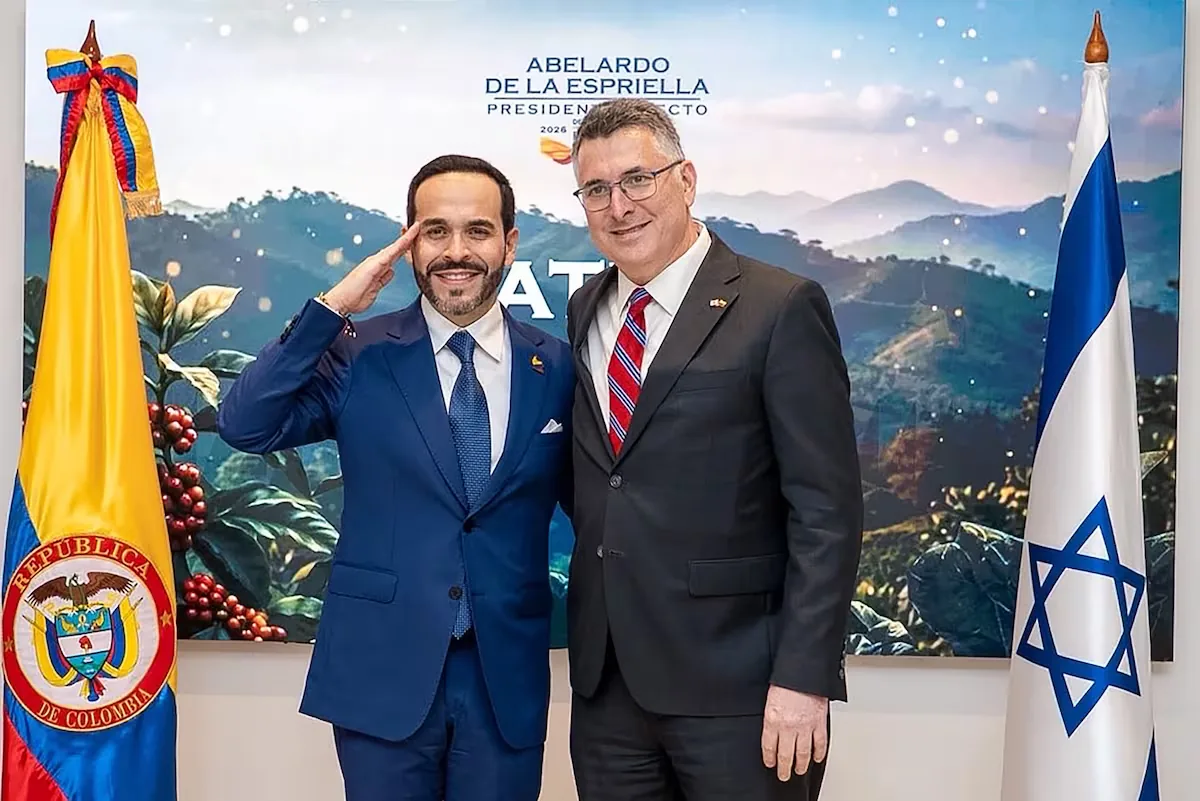
The crisis caused by the magnitude 7.4 earthquake that shook Colombia this Monday is not the only one facing President Abelardo de la Espriella, who has been in office for just four days. His decision to recognize Israel’s sovereignty over the Syrian Golan Heights, breaking an international consensus from which only the United States had previously deviated, has sparked a diplomatic crisis with Arab countries, which categorically reject the new Colombian government’s change of stance. The only one to welcome this decision has been Israeli Prime Minister Benjamin Netanyahu, whose closeness to De la Espriella is becoming increasingly evident.
Read more eToro buys TradeZero for 231 million to expand its business to the United States
Netanyahu expressed his gratitude in a video shared on X. “Today the [Israeli] people stand with Colombia, as the president, our friend, has recognized Israel’s sovereignty over the Golan Heights. I thank you.” It is a Syrian territory, occupied by Israel since the Six-Day War of 1967 as a defense mechanism, but annexed since the 1980s. Only the United States — by Donald Trump’s decision — had recognized this unilateral takeover.
With a map in his office, Netanyahu explained that this area is “vital” for Israel’s security. “The Israeli flag flies here and will continue to do so because this is our land,” he added. This is the same argument used by Colombian diplomacy, which announced its change of stance on Monday, considering that the “maintenance of Israeli control and sovereignty” constitutes “an essential component of its national defense and its ability to protect and safeguard its citizens.”
The decision took the foreign ministries of Arab countries and the Colombian citizens themselves by surprise, who had just suffered the largest earthquake in nearly 50 years a few hours earlier. The Arab League, which groups 22 states from the Middle East and the Maghreb, has strongly rejected the diplomatic shift.
“This declaration lacks legal effect and has no value in determining the status of the Golan or sovereignty over it,” said the organization’s Secretary-General, Nabil Fahmy, who also urged the Colombian government to “retract this declaration and rectify its position.”
Egypt and Saudi Arabia, members of the League, have also joined the rejection on their own. The Egyptian Ministry of Foreign Affairs issued a statement “condemning” Colombia’s new stance “considering it contrary to international law norms and resolutions of international legitimacy.” Similarly, the Saudi Foreign Ministry emphasized that the recognition “constitutes a flagrant violation” of UN resolutions and that these positions “do not contribute to achieving peace.”
Read more Burnham intervenes to prevent the early release of two convicts for the death of a police officer
Meanwhile, the Syrian government rejected the decision in an extensive statement, asserting that the Golan is “an inseparable part of its territory.” The government of Ahmed Al Shara, in charge of the transition in Syria, stated it will use “all legitimate diplomatic and legal means to defend its sovereignty” and regain control of the territories occupied by Israel.
An allied country for De la Espriella
De la Espriella never hid his affinity with Netanyahu and his territorial claims during the campaign. On the contrary, he praised the ultranationalist prime minister. The now Colombian president then maintained that supporting Israel meant “taking the right side of history” and praised the “fight against terrorism,” referring to the massacre in Gaza where, according to independent NGOs and UN experts, international law has been violated and war crimes committed.
The Colombian government goes further: it wants to promote cooperation in security and intelligence with Israel, despite violations against Palestinians, and wants to move the embassy from Tel Aviv to Jerusalem, which would imply implicit recognition of Israel’s position that it is its “eternal and indivisible” capital.
The day before his inauguration, De la Espriella and his team held a meeting with Gideon Saar, Israel’s Foreign Minister, with whom they resumed “historical ties of friendship.” Vice President José Manuel Restrepo then announced that a government delegation will travel to Israel to “consolidate this strategic alliance.” At the same time, he launched an “economic commission” to strengthen economic and social relations.
Among the Colombian government’s commitments are also the withdrawal of Colombia’s genocide complaint in Gaza before the Hague Tribunal and the resumption of coal exports, suspended by the leftist government of Gustavo Petro, who became one of the most visible faces of the pro-Palestinian movement. The claims he promoted during his term will be completely reversed by his successor, who has placed Israel at the center of his diplomatic priorities.
Read more Guide to Watching the Perseids: How, Where, and When to View the ‘Tears of Saint Lawrence’