





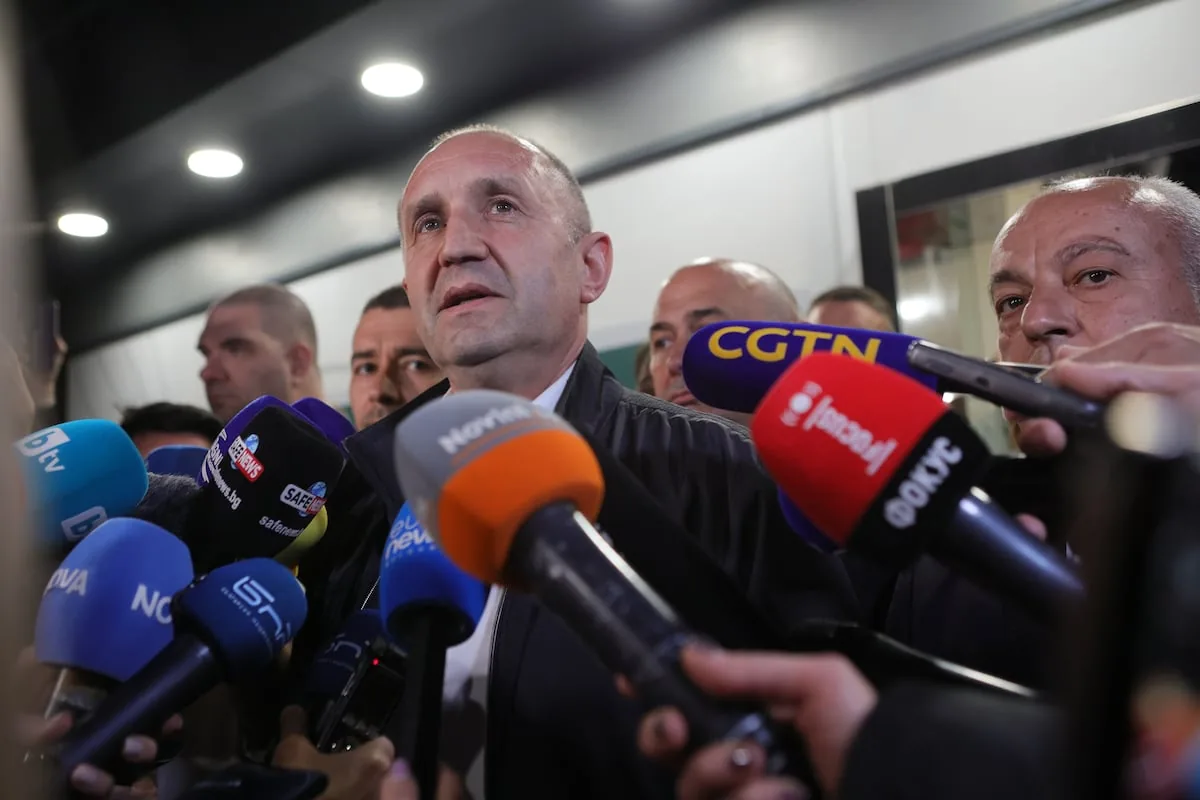
Pro-Russian and Eurosceptic Rumen Radev has won the legislative elections in Bulgaria with 44.5% of the votes, an absolute majority that will allow him to govern alone, according to the count of 91% of the votes, reported the Central Electoral Commission of the Balkan country.
If this result is confirmed, Progressive Bulgaria, Radev’s party, will have 131 of the 240 seats in Parliament, which could lead to a stable government that pulls the country out of the political stagnation of the last five years, during which there were eight parliamentary elections.
In second place, with 13.5% (41 seats), was the pro-European and reformist party We Continue the Change-Democratic Bulgaria (PP-DB), followed by the conservative Citizens for European Development (GERB), of former Prime Minister Boyko Borisov, with 13.3% (39 deputies).
Also entering Parliament are DPS-New Beginning, led by a businessman sanctioned by the US and the UK for corruption, with 6% of the votes (16 deputies); and the ultranationalist and pro-Russian Revival (4.3%, 13 deputies).
Former Communists, out of Parliament
For the first time since the end of communism in Bulgaria almost four decades ago, the Socialist Party (BSP), heir to the communist party that governed the country in the past regime, will not be represented in parliament, as it failed to exceed the required 4% threshold.
“Progressive Bulgaria has won decisively. It is a victory of hope over distrust, of freedom over fear,” Radev declared on Sunday night after the exit poll projections were released, which already pointed to his clear victory, though not yet with an absolute majority.
The fact that Progressive Bulgaria can govern alone should facilitate institutional stability that Bulgaria, the poorest country in the European Union (EU), has not experienced since 2021, when massive citizen protests against corruption led to the fall of Boyko Borisov’s last government.
Sunday’s elections are the eighth in five years, a period in which the country has had seven different prime ministers.
Radev, who resigned from the presidency last January to run in these elections, has capitalized on citizen discontent in a country of 6.5 million inhabitants with a campaign focused on the fight against corruption, poverty, and the oligarchy of politicians and businessmen who, in his opinion, dominate the country.
Furthermore, he has advocated a “pragmatic and mutually respectful” foreign policy with Moscow, arguing for improving relations with Russia, ending international sanctions against the Kremlin, and reopening the flow of Russian oil and gas to Europe.
He has also criticized some European Union policies, such as the Green Deal, and has shown his admiration for the ultranationalist Hungarian leader Viktor Orbán (defeated in the Hungarian elections just a week ago), with whom he shares a deeply conservative vision.
Nevertheless, Radev has assured that Bulgaria will maintain its European course and its NATO membership.