









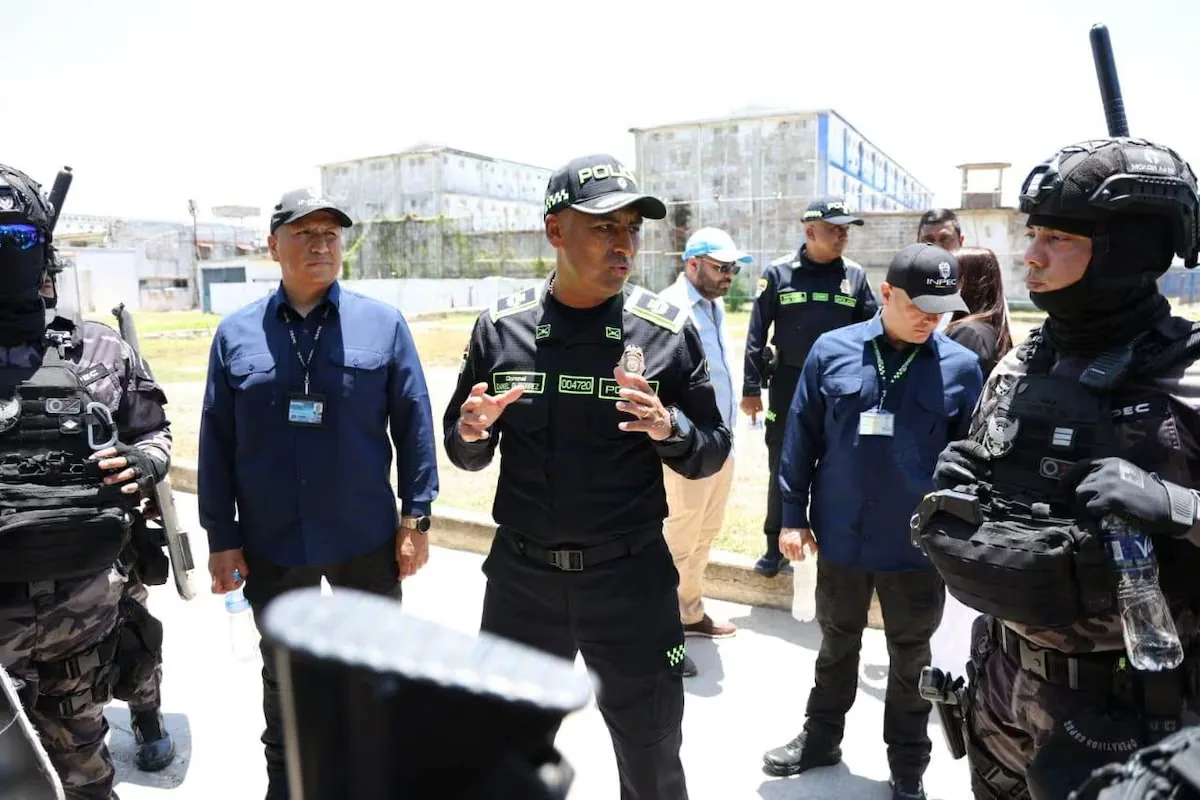
When Abelardo de la Espriella arrived at the Casa de Nariño, it was known that the new leader would promote a shake-up in the most influential public positions within the Government. However, there is a notable exception to this rule. Colonel Diego Fernando Gutiérrez Rojas, director of the National Penitentiary and Prison Institute (INPEC), is, so far, the only official in a key position for his policies who was confirmed. This permanence was made official last Thursday, August 20, when he took the oath of office before the Minister of Justice, Iván Cancino. During the campaign, De la Espriella questioned the functioning of INPEC and even proposed eliminating it as part of one of his major campaign promises: the creation of mega-prisons, in the style of Nayib Bukele, which if realized will be managed by Gutiérrez.
Read more The ideal folding ironing board for small apartments now costs 33% less
Amid this restructuring, the Government announced this Tuesday a drastic and immediate measure, such as isolating some inmates in a kind of “prison ship” offshore. According to the newspaper El Tiempo, the Ministries of Defense and Justice, together with INPEC, are already coordinating efforts to execute this strategy, dubbed the High Security Maritime Special Detention Strategy.
Thus, Gutiérrez went from being one of the few long-standing officials in Gustavo Petro’s government to becoming, almost quietly, a figure of this strategy. While much of the cabinet and the executive’s senior management has been replaced by people close to De la Espriella or his political allies, the colonel managed to adapt to the new Administration.
In fact, De la Espriella’s first presidential decision after his inauguration on August 7 was the relocation of 117 inmates that INPEC transferred from the Itagüí prison to maximum security facilities in Bogotá, Medellín, Girón, Valledupar, La Dorada, Palmira, Ibagué, and El Barne. Among them were leaders of criminal organizations who had participated in the urban peace tables of Medellín and Buenaventura, promoted by Gustavo Petro’s Government, such as those known by the aliases Carlos Pesebre and Douglas. The order, conceived in a new cabinet meeting, was executed precisely under Gutiérrez’s direction, a colonel of the National Police.
Originally from Boyacá, he was promoted from lieutenant colonel to colonel on July 2. He has over 20 years of experience in the institution and took over as director of INPEC on September 13, 2022, when Petro was just over a month into his presidency. His tenure, unusually long in a position prone to crises due to prison problems, has not been free of controversies. These include scandals due to clandestine parties in the maximum security prison of Itagüí, as well as a trail of murders and threats against his officials, including the homicide of the director of one of the country’s most famous prisons, the Modelo Prison of Bogotá.
The colonel’s permanence in the new Government has been well received in some progressive sectors. Petro’s last Minister of Justice, academic Jorge Iván Cuervo, applauded the determination and highlighted the senior officer’s professional career, in a continuity that contrasts with other internal movements in INPEC.
This Tuesday it became known that Colonel Rolando Antonio Ramírez, director of Custody and Surveillance and considered close to Gutiérrez, left the institution. It is the first high-level change since the start of the new Government. Ramírez had been accused of signing, in June 2025, a resolution ordering the transfer of nine prisoners from the Itagüí prison to the La Alpujarra plaza in downtown Medellín to participate in the so-called “tarimazo,” a controversial act by the Petro Administration to defend its peace negotiations. The presence on the platform of inmates belonging to criminal structures but legally shielded due to being in a peace negotiation process with the State was strongly questioned by the opposition.
The movements requested by De la Espriella in the prison system have continued. This Tuesday, Director Gutiérrez authorized the transfer of 20 inmates from the El Bosque district prison in Barranquilla to other penitentiary centers in the country. Additionally, he has carried out massive operations. In less than three weeks of Government, 400 prisoners have been transferred from various penitentiary centers. This is not unusual: the Petro Government tried to tackle crime behind bars through Operation Domino, when it transferred 28 leaders. Gutiérrez embodies, for now, the rarity of serving as continuity in an Administration that has made questioning its predecessor a cornerstone of its discourse and decisions.