




Temples are sacred places, but sometimes there is no choice but to take the saints elsewhere. That unusual move is what the Madrid Café Central had to inevitably face this Thursday, surely the most renowned jazz club in the capital and one of the essentials on the European circuit, forced to change location due to the impossibility of renewing its lease after 43 and a half years of history at its Plaza del Ángel venue. Those nearly 16,000 nights of live music, from August 12, 1982, until this very Wednesday, with only interruptions during the worst weeks of the pandemic, are now part of the annals. Also left for the city’s collective memory is the unexpected sight of the crowd that attended the symbolic relocation ceremony this Thursday: between 1,500 and 2,000 people, according to the municipal police, who internally had not anticipated more than 300 attendees.
Read more Trump announces a 10-day ceasefire between Israel and Lebanon starting tonight
The death and resurrection of the Central was a small melodrama in two acts, because it was not a matter of equating a change of venue with a Greek tragedy. At 11:52 p.m. on the 15th, the six musicians of Racalmuto, the swing band led by saxophonist Miguel Malla, closed the curtain on the usual Café Central with a concert full of laughter, some tears, many sighs, numerous cheers from the audience (a full house; that is, 75 attendees), and a final shower of carnations that the waiters distributed among the customers, symbolizing this small urban-jazz revolution.
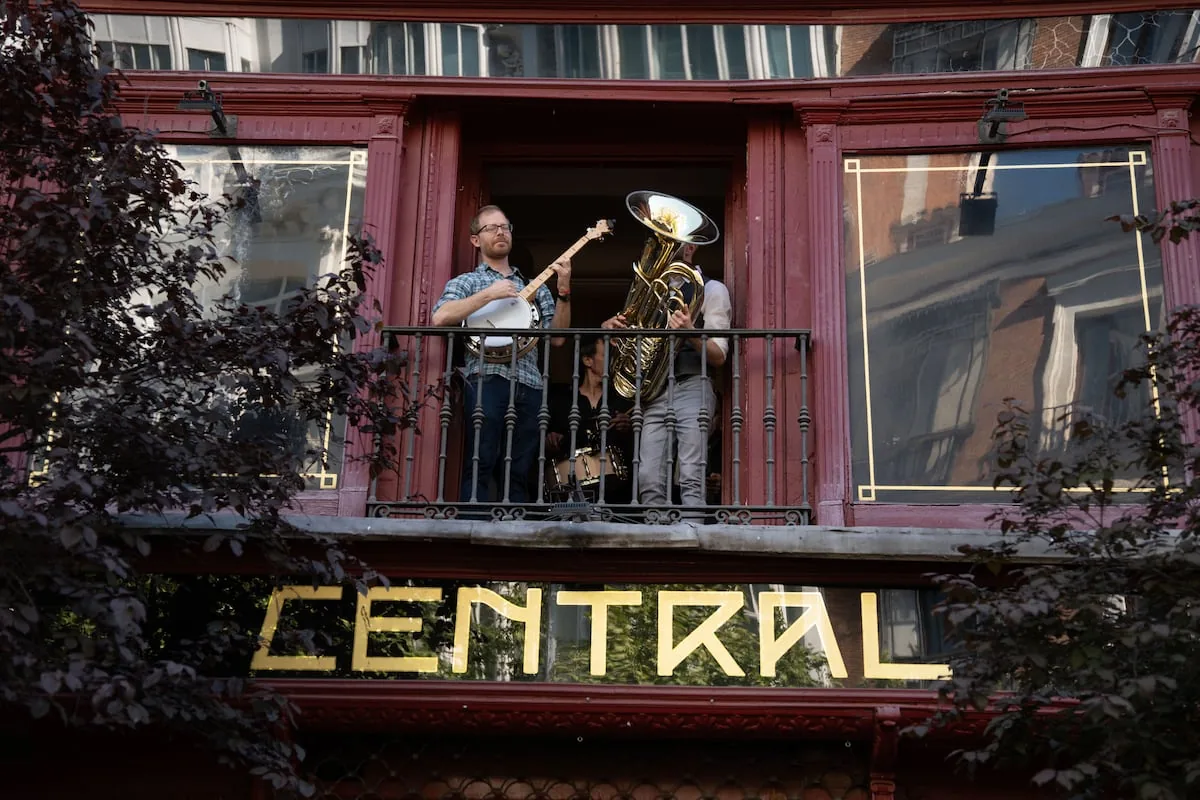
And at five in the afternoon the next day, the same Madrid sextet staged the packing up and move to the new location, in the restaurant adjacent to the Ateneo de Madrid, leading a parade between the venue we have always known and the one that now aspires to join the town’s collective imagination. It was less than 400 meters of a procession aiming to emulate the New Orleans carnival, “because this cannot look like a funeral, but a celebration,” summarized the venue’s programmer, Javier González, who had spent the last month encouraging musicians, customers, and fans of all kinds to join a decidedly non-mournful procession.
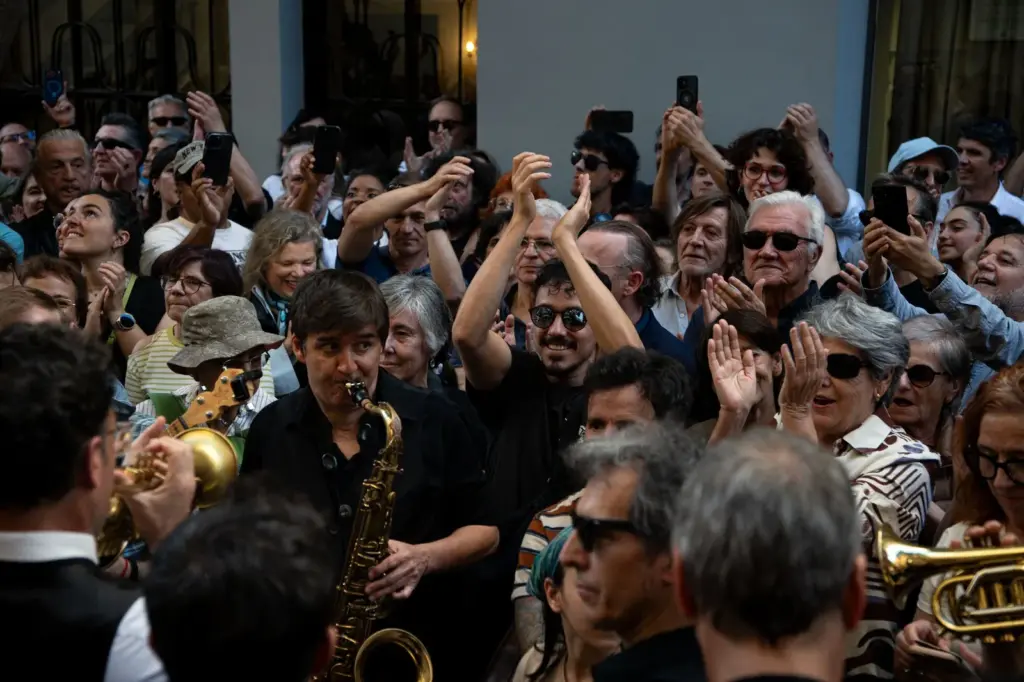
The most optimistic forecasts were blown away. The walk between the original location and the new one, which normally takes less than 10 minutes, lasted more than an hour in a vibrant, springlike, and optimistic atmosphere. “We are excited, proud, happy, and surprised, honestly,” confessed Javier Olmedo, manager of the Madrid en Vivo association, who had feared a definitive closure of the Central when it became known last July that the lease would not be renewed under any circumstances. In his view, “the people of Madrid have managed to preserve an essential part of their culture.” And judging by the profile of the attendees, the affection for the venue goes far beyond old jazz clichés: there were certainly some gray-haired walkers (or those with little hair left to comb), but also plenty of new blood and many moms and dads carrying future generations of music lovers on their shoulders.
“We want there to be no more closures like those of Café Gijón or the Tipos Infames bookstore. This time they couldn’t beat us!” shouted Juantxu Bohigues, always expansive, head waiter as well as novelist, editor, and occasional actor, from the balcony of the genuine Central, megaphone in hand. He was cheered by hundreds of anonymous citizens like David, a swing dancer who had come “to applaud and take a look around”; Jaime, a tourist from Alicante who stumbled upon the crowd and asked what was happening (“the musicians, who are responsible for carrying the spirit of one Central to the other,” a passerby summarized for him); or Elena, Rosario, and Bienve, three lifelong friends, good enthusiasts, and occasional customers who had marked April 16 in their calendars as soon as they learned of the move and promised to visit the new facilities next to the Ateneo. “We will attend concerts with more friends for support. Now we have to keep the flame alive,” they warned.
Read more Aliança is left without its candidate for the Barcelona mayoralty and is looking for options
Also present, though with a much more discreet profile than usual in their professions, were the Madrid Community’s Culture Minister, Mariano de Paco, and the Minister for Digital Transformation and Secretary General of the Madrid Socialists, Óscar López. Many big names from the city’s jazz and music scene were there too, from singer Jeff Espinoza to Cecilia and Richard Krull, pianist Mariano Díaz, and accordionist Daniel García, a 56-year-old Madrid-born Conquense who first stepped on the Central stage at age 15. “I feel very sad about never returning to those stairs, the stage, or the backstage,” he admitted, “but the people who made that possible will know how to repeat it at the Ateneo.”
Javier González, the programmer, has lived the back-and-forth with the heirs who own the building from the front lines; they have yet to announce who the new buyer or tenant will be and what the building, dating back to the late 19th century and which housed the famous glass and mirror shop of Don José Prat during the first half of the 20th century, will be used for. “These days, half a lifetime is coming to mind,” admitted the Central’s spokesperson with his very Asturian modesty, “because within these walls we have grown and forged friendships… including that of the customer who is now my wife.”
“The City Council did not protect it”
These were assessments and memories no one could avoid; not even actor Alberto San Juan, a regular at the Café, who on Wednesday attended the second and last showing of the last concert from the very front row, just a foot from the piano over which Javier López’s hands glided. “I wanted to say goodbye to this Central, especially with Racalmuto, who are great friends. It would have been very natural for the City Council to protect and support this venue, but… it wasn’t so,” he noted. Miguel Malla himself admitted that being among the last musicians to step on that legendary and cramped mirrored stage was “an honor.” And he summed up: “I have seen some of my greatest idols here: Lee Konitz, Randy Weston, Perico Sambeat, Jorge Pardo… I have been performing here for 23 years. We are not exactly happy, but we are very moved.”
The tiny 9.99 square meters of stage (measuring 4.20 meters wide by 2.38 deep) will be reproduced with millimetric precision in the new Café Central Ateneo. There will also be mirrors, of course: “They are essential to see yourself and touch up from the stage, much more important than the piano!” Miguel Malla laughed. But the main asset of Café Central does not appear in any photograph or architectural plan. “It is that aura, half mystical and half religious, its dimension as living history,” summarized Pedro Ojesto, a historic master of jazz-flamenco, from the street level. And his wife, pianist Marisa Moro, added: “Central succeeded because it has something epidermal. It leaves a mark on your skin and tightens your heart.”
Read more Fernández Díaz’s defense attacks the phone messages that implicate him in Kitchen