






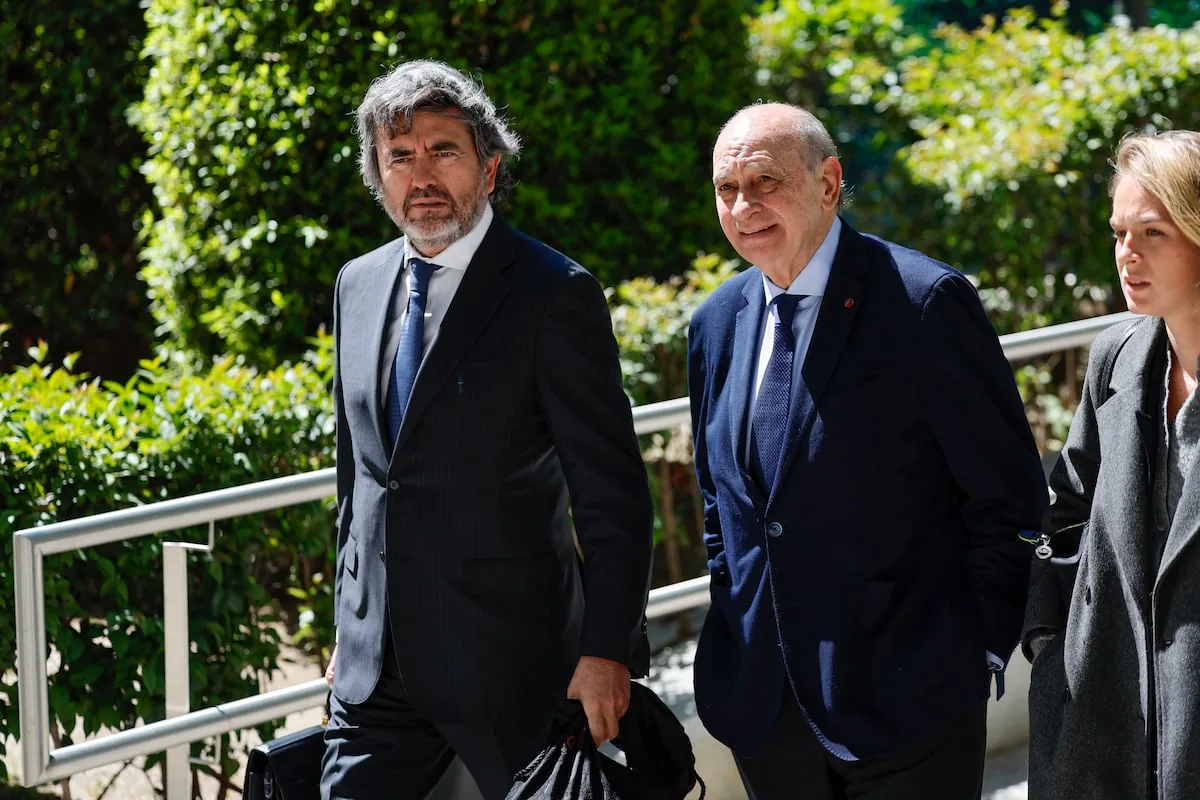
The defense of Jorge Fernández Díaz, Minister of the Interior under Mariano Rajoy from 2011 to 2016, took a step forward this Thursday to try to discredit one of the main pieces of evidence that puts him on trial for the Kitchen case. The lawyer of the former PP politician, Jesús Mandri, has tried to cast doubt on the veracity of a phone message that Francisco Martínez, former Secretary of State for Security and former number two of the minister, took to a notary to prove that his boss was aware of the surveillance operation on the former PP treasurer Luis Bárcenas activated in 2013.
Read more The International Energy Agency warns Europe that it has «six weeks» of jet fuel
Although it has not been much publicized until now, Fernández Díaz and his former collaborator, who was a person of his utmost trust, maintain opposing positions in the Kitchen oral hearing, which already caused a harsh clash during the investigation phase. The former minister repeats that he never knew anything about that police deployment on Bárcenas, nor about recruiting his driver as an informant. However, Martínez not only claims that he always believed that operation was legal, but also that his boss knew about it. In fact, to try to prove it, he took two messages to two notaries that, according to him, were sent by his superior during the surveillance operations. These SMS refer to the driver and the removal of electronic devices from Bárcenas.
Enrique Franch, who testified this Thursday, is one of those notaries. According to the notary’s explanation to the court, Martínez provided him in October 2019 — when the Kitchen investigation was escalating towards the Interior Ministry’s top ranks — a message that reads: “The operation was successful. Everything has been dumped (2 iPhones and 1 iPad).” The witness explained that he cannot confirm 100% that Fernández Díaz sent that message. But, he added, the former Secretary of State “told” him that he received that SMS from the former minister’s number; that he himself verified that Martínez had that phone saved under his superior’s name; and that if he had seen it corresponded to another phone, he would have noted it in the record.
“What Francisco Martínez told me was that there had been an operation, that something had gone wrong, and that they were trying to hold him responsible,” Enrique Franch contextualized in response to questions from the Anti-Corruption Prosecutor’s Office, which considers that SMS a key piece of evidence of the minister’s involvement. However, Fernández Díaz’s lawyer pressed the notary to make clear that he cannot certify that the message, whose authorship his client denies, is from the former government member.
—Can you attest to the origin of the message? —the lawyer asked during the interrogation.
—No —the notary answered.
The prosecution tries to fit the pieces of the puzzle. And the date of that SMS, allegedly sent by Fernández Díaz, takes on key relevance. The message provided by Martínez to the notary is dated October 18, 2013. Commissioner Enrique García Castaño, alias El Gordo or Big, told the investigating judge Manuel García-Castellón that Bárcenas’s driver handed him some electronic devices stolen from Bárcenas that month, which the network cloned to take control of their content. In fact, Commissioner José Manuel Villarejo, also implicated in the espionage, noted the phrase “Cook relationship—copying phones [sic]” in his agendas on October 17 of that year, alongside the nickname “Big.”
Precisely, two agents who were under El Gordo’s command at that time — in the Central Operational Support Unit (UCAO) — told the court this Thursday that they participated in dumping at least two electronic devices (an iPhone and an iPad tablet) in October 2013. According to their details, García Castaño summoned them to a Vips chain restaurant, where he arrived accompanied by an informant, whose identity he did not reveal, who handed over the devices. They copied their content onto a computer and took it away. The two agents added that, although they did not know at the time that it was Bárcenas’s driver (Sergio Ríos), later information fits that the anonymous person was him.
One of these officers emphasized that the copied material was compiled into an extensive PDF document, whose structure is “compatible” with the PDF provided by García Castaño to the National Court as supposed evidence that information was stolen from Luis Bárcenas contained in those electronic devices. That material includes phone messages (SMS and WhatsApps), emails, and the contact list. “I remember there were two Apple devices (a phone and a tablet) and vaguely remember a third, a phone, but it was not Apple,” the officer said.
“It was in October 2013. I think it was around the middle of the month. Around the 12th-15th. It was in the morning. A working day,” the other agent specified, emphasizing that the dumped content was saved on a pendrive, which finally remained in El Gordo’s possession.
The surveillances
On the other hand, the case file already provided plenty of evidence (reports and photographs) that high-ranking police officers launched surveillance on Luis Bárcenas’s environment in the summer of 2013; but the parade of agents before the court has reinforced that idea. Four agents from two different units already confirmed on Tuesday and Wednesday that they coordinated or participated in the surveillance deployed for months on the former treasurer’s wife, Rosalía Iglesias. This Thursday, five more officers from the Central Operational Support Unit (UCAO), dependent on the General Information Commissariat, joined them. “We made reports every day,” one officer said.
The police reiterated that, to justify their involvement, they were told they were supporting another investigative unit — the Gürtel case was handled by the UDEF — to locate the “money” that the former PP accountant supposedly hid; but they immediately added that they never knew if the information gathered reached their colleagues. They provided it to their bosses. In this regard, another officer said on Wednesday that Commissioner Enrique García Castaño, head of the UCAO, “monopolized” all that data, who supposedly had to be in charge of transferring it. The Anti-Corruption Prosecutor’s Office charged García Castaño for Kitchen, but he is not on trial due to his poor health (he suffered a stroke).
Read more A person dies after being hit by a train near Palencia station
![The Kitchen court plays Villarejo's audios: "We have to rack our brains to find that 'pendrive' [of Bárcenas]"](https://worldpressa.com/wp-content/uploads/2026/05/7896f76fc797329a4b21a7f809fe1424.webp "The Kitchen court plays Villarejo's audios: \"We have to rack our brains to find that 'pendrive' [of Bárcenas]\"")