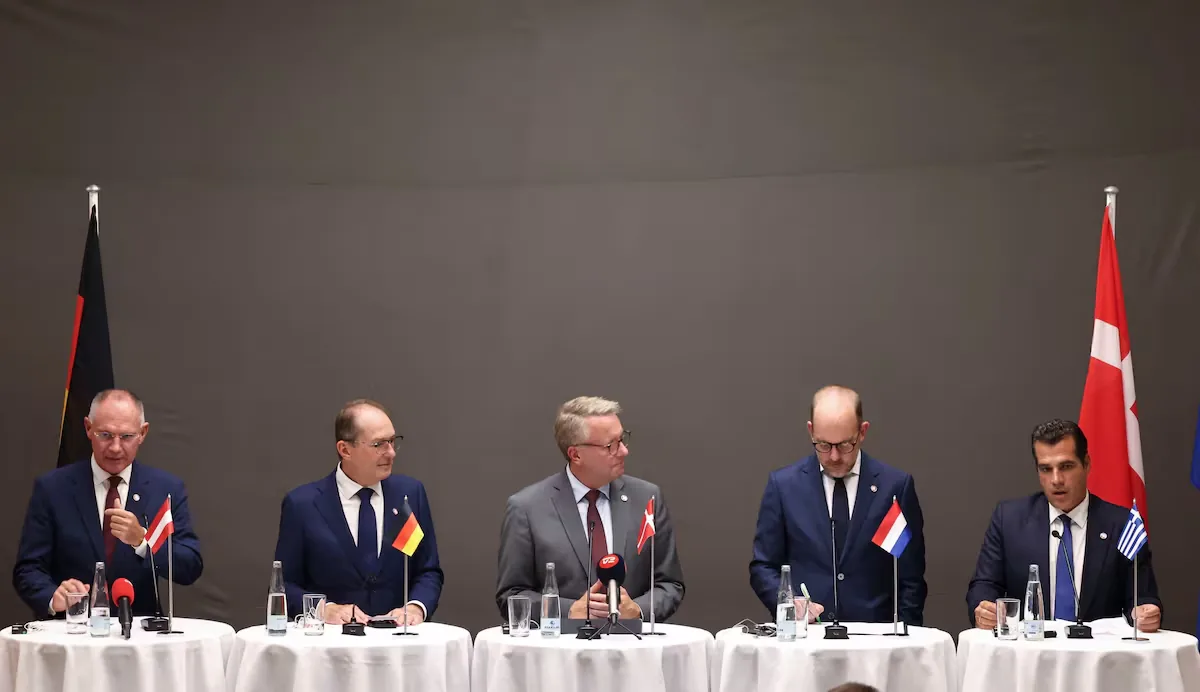
The tightening of European migration policy is taking shape. Germany, Austria, Denmark, Greece, and the Netherlands agreed this Wednesday in Copenhagen on the “model” and the “roadmap” with which they hope to soon close agreements with third countries to build the controversial deportation centers outside the EU to which irregular migrants, including families with minors, will be sent. After a summer in which the Ceuta crisis has given momentum to the hardest line, there is urgency: according to the Danish government, they want to close the first agreement with one of the candidate countries at the beginning of 2027 to start sending the expelled before the end of next year.
Read more The labor market gives Trump a breather with the creation of 162,000 jobs in August
“Around New Year’s we expect to close an agreement with a country outside the EU (…) Our goal is to be ready to send people who do not have the right to be here by the end of 2027,” said the Danish Minister for Immigration and Integration, Morten Bodskov, after holding a meeting where a “concrete and clear roadmap” was also agreed upon, in the words of his Greek counterpart, Thanos Plevris, which will allow “deepening” the technical discussions with third countries that have already been underway for some time.
Despite repeated failures on previous occasions, such as Denmark’s attempts to close an agreement with Rwanda, or the center in Albania managed by Italy for two years with high costs and few results, the new talks are increasingly “fruitful,” Plevris congratulated. “We hope to be able to announce a country next time,” he added at a press conference with his European counterparts, without revealing the names of the candidate countries to take charge of the immigrants Europe does not want. Europeans who support the deportation centers — around twenty member states — mainly favor one country in Africa.
Amid shouts of send them back (send them back) from the most ultra factions, the European Parliament gave final approval in June to the returns regulation that includes the possibility of creating the euphemistically called return hubs or return centers in third countries. With support from conservative forces and the far-right in the hemicycle, the Eurochamber further toughened the original proposal to include among those deportable, for an unspecified time, families with minors. Shortly after, 19 member states, led by Denmark, Italy, the Netherlands, and Austria, requested by letter to the European Commission to financially support these controversial centers, which they call “innovative solutions.” The European Executive has been present “at a technical level” at the Copenhagen meeting.
The Ceuta crisis has further strengthened the position of the hardest countries now gathered in the Danish capital, who already held a videoconference discussion after the wave of irregular migrants that flooded the Spanish autonomous city at the end of July. “The events of recent days highlight the need and importance of this group,” said the Austrian Interior Minister, Gerhard Kartner, at the time. “Our common goal is to reduce illegal immigration to zero,” he has said now from the Danish capital.
With the returns regulation “we established the legal basis for new and innovative solutions,” said the Migration Commissioner, also Austrian Magnus Brunner, in a comment sent to journalists within the framework of the new Danish meeting, in which the European Executive has been present at a “technical level,” according to Brussels. “Repatriation only works if we act coherently. The fact that member states coordinate closely and open new paths together is an important signal,” Brunner added.
Danish Bodskov has rejected criticism from human rights organizations and international institutions such as the Council of Europe, whose Commissioner for Human Rights, Michael O’Flaherty, has warned that Europe risks with the deportation centers “creating a black hole of human rights.”
“The press talks about camps or prisons, that is not the case. It is an agreement with an associated country that gives a new opportunity in that country to those who do not have the right to stay in Europe,” he said, emphasizing that organizations such as UNHCR will be monitoring the centers “from day one.” “We need future solutions,” but “we want to do it in accordance with EU values,” insisted the Dutch Minister of Asylum and Migration, Bart van den Brink, according to whom the agreement now reached will allow “deepening” the technical discussions with the candidate countries and sending missions to ensure an adequate “legal framework.”