The leader of the opposition, Alberto Núñez Feijóo, has delved this weekend into the “public health crisis” in Ceuta due to the massive influx of migrants on July 30 and 31, during which thousands of people live on its streets, many in overcrowded conditions and without basic hygiene. The PP leader has asked Pedro Sánchez’s government to consider the “confinement” of those with infectious diseases, such as scabies or tuberculosis. The Minister of Health, Mónica García, called the measure “unjustified” and “excessive,” also reminding that public health responsibilities lie with the Ceuta government, led by the Popular Party’s Juan Jesús Vivas. García emphasized that the “fundamental” and “most urgent” thing is to shelter people and provide them with basic hygiene and sanitation. “If Mr. Feijóo wants to help, he should ask the Ceuta city government for the immediate transfer of all available spaces to be able to house these people healthily,” demanded the Health Minister in a thread on the social network X. The Spanish Society of Epidemiology last week asked not to blame immigrants for the spread of diseases.
Read more Israel tells Hamas it will intensify its bombings if kite launches from Gaza do not stop
Today Mr. Núñez Feijóo has asked that we confine the migrant population of Ceuta for public health reasons. I think it is worth responding by pointing out some important aspects from science:
— Mónica García (@Monica_Garcia_G) August 23, 2026
1. The public health responsibilities in Ceuta lie with the…
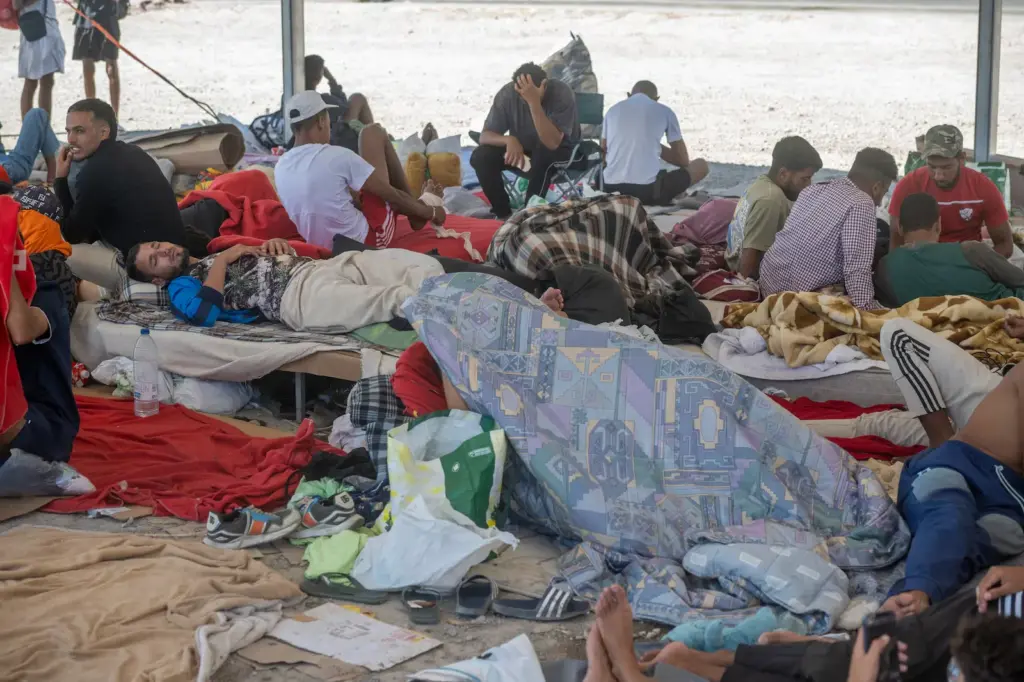
The available space in Ceuta, a city of 83,000 inhabitants and 20 square kilometers, is very limited. Both the central government and the autonomous city are balancing to find those much-desired temporary reception places, prepare them, and overcome the reluctance of the Ceutans, who are very worn out by the effects this migratory and humanitarian crisis has on their daily lives. In the last week, the government has promoted a large eviction of the main migrant settlement in the city, located at Playa del Trampolín, and 1,800 people have been housed in two enclosures, one in Loma Margarita, near the Temporary Stay Center for Migrants (CETI), and another in Loma Colmenar, next to the El Tarajal border. Additionally, three other spaces are being prepared: the equestrian facilities, the old football field of the Cavalry barracks, and the El Guano area. The autonomous city, responsible for the guardianship of migrant minors, is also preparing enclosures to accommodate them, as many teenagers and also small children have been living on the streets or taken in by neighborhood associations or social entities that have cared for them out of pure compassion for three weeks. The most moderate estimates put the number of migrants in the city at 5,000, and the Interior Ministry has identified 2,500 minors.
Feijóo already denounced on Wednesday, during his second visit to Ceuta, the existence of this “public health crisis” caused by cases of tuberculosis and scabies detected in the city, adding overwhelmed health services. This weekend, he took it a step further by demanding that the government “carefully” study the confinement of people. “With 400 or 500 cases of gastroenteritis, that can have a huge impact on the population, in addition to tuberculosis, in addition to scabies affecting military and state security forces,” he argued in an interview with Europa Press. “The way to protocolize this matter is the responsibility of the Spanish government,” sources from the party detailed, questioning from how many scabies cases action will be taken and criticizing the government for acting “normally” in the face of outbreaks affecting not only the civilian population but also military, police, or civil guards, reports Javier Casqueiro.
Given the health situation in Ceuta, the government should consider decreeing confinement of carriers of infectious diseases for public health reasons. pic.twitter.com/YaVYbAmxES
— Alberto Núñez Feijóo (@NunezFeijoo) August 23, 2026
The Minister of Health has explained that the migrants who arrived in the city during the massive influx do not live in the same spaces as the Ceutans. She emphasized that brief interactions that may occur on the street “are not likely to constitute a risk to public health.” “As for professionals who come into contact with patients with possible infectious diseases, there are protocols, which are neither new nor exclusive to this crisis,” she stated. García assured that the risk of transmission to the general population is low, citing a rapid assessment by the Coordination Center for Health Alerts and Emergencies, while for the migrant population it is moderate, due to living on the street, overcrowding, and limited access to hygienic and dietary measures.
Read more Missing Spanish businessman after falling from his boat between Italy and Greece
Regarding the diseases being mentioned, the Sumar minister pointed out that there are only three confirmed cases of tuberculosis (two non-contagious and one under treatment). She specified that scabies or gastroenteritis are “diseases present in our environment and whose surveillance systems are always active, especially in a situation like this.” Many of the diseases emerging are related to unsanitary conditions. Scabies is a skin infestation caused by a microscopic mite. It spreads through close contact with an infected person or by sleeping on a mattress that has these mites. Gastroenteritis (García mentioned 450 cases) could be related to the consumption of untreated water.
Of the three suspected chickenpox cases, the minister said one has been ruled out and the other two hospitalized, pending confirmation, “have nothing to do with the migrant population” Feijóo refers to, nor are they related to each other. “Chickenpox is not eradicated in our country and cases occur from time to time,” she added. “Stop stirring up fears and measures that you would not bring to light if the population were not migrants from Africa,” García demanded of the Popular Party leader.
The minister also detailed the work being done in Ceuta ―within her competencies― to detect tuberculosis cases, such as systematic detection studies in centers where the population is monitored and referrals to the National Institute of Health Management (INGESA), dependent on the Ministry of Health, when a tuberculin test is positive, which does not constitute a diagnosis but leads to either ruling out or confirming diagnosis. “Of the suspicions, none have been confirmatory. Since the border closure [by Morocco] in 2020, we have had about 90 TB cases in Ceuta and about 20,000 in all of Spain,” she pointed out.
In response to EL PAÍS, the Ceuta government has not commented on Feijóo’s words. Nabila Benzina, the city’s Health Councilor, explained this week in an interview with this newspaper that they had increased their public health efforts, with health personnel from other areas. “By royal decree, we have to analyze the waters of bathing areas (…) and as of today, they are fine,” she said on Tuesday. Their technicians are examining other coastal areas not previously analyzed because they were not considered bathing areas, such as Playa del Trampolín, where one of the main irregular migrant settlements was dismantled, located on the outskirts, or Fuente Caballo. “We are looking at all the irrigation parts in the city where there could be contamination, any irrigation system they might drink from. We are analyzing everything,” she said.
Her public health staff works on the street, together with Médicos Mundi. “We have bought more vaccines, more tuberculins to administer to people. We are reinforcing everything within our capabilities,” she affirmed. Regarding infections, like García, she considered that as long as migrants are not located, it is very difficult to carry out health control. Regarding the detection and control of scabies cases and the study of outbreaks that do not require hospital admission, Benzina also highlighted that it was “common in overcrowding.” “It is not a deadly disease, but it is very annoying and very contagious. It spreads from one to another, but it is very treatable,” she reassured.
Read more David Soria holds Getafe and Enes Unal finishes off Racing