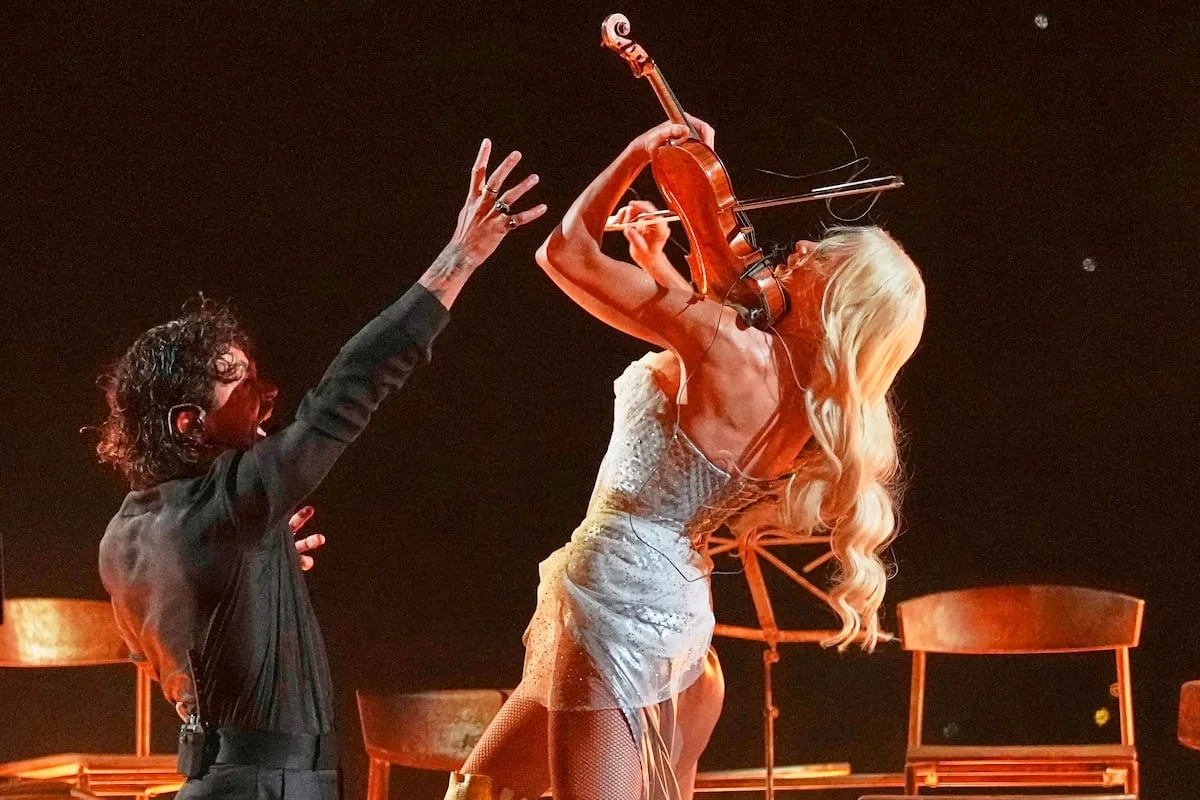

A powerful voice, that of Pete Parkkonen, and an equally intense violinist, Linda Lampenius, form the duo that has become the favorite in the bets to win Eurovision 2026. They represent Finland with the song Liekinheitin, which means “flamethrower” in English. If they achieve victory, they would not only once again prevent Israel from winning, which is feared by Eurovision fans. Their triumph would also open the door to a scenario so far completely unlikely: that Israel decides on its own not to participate in the next edition of the contest.
Ynet, the most widely read digital media in Israel, explains in a report about Eurovision that their country’s delegation is closely following the official bets, in which Finland is currently the clear favorite, while Noam Bettam remains in fifth position. This is precisely the scenario they fear, given “the tense situation” the country maintains with the Finns and the concern that Israel will have to go there next year. “If the Finnish candidate wins, it will be very difficult for us,” a source close to the Israeli delegation admitted to this publication. “It is true that we surpassed Malmö [the Swedish host of 2024], but the hatred towards us continues to grow, and we will have to address these issues very seriously if we reach that situation.” The Israeli delegation has not responded to this newspaper’s attempts to learn their official opinion.

“It is true that there was enormous tension in Malmö. It was also difficult for us,” Mikko Silvennoinen, the voice of Eurovision in Finland, who has been a commentator for both the festival and the local preselection for the country’s public broadcaster YLE for 10 years, tells this newspaper. “I understand their concern, but Finland is not Malmö,” the journalist defends.
The televote controversy
In recent years, the Eurovision festival has experienced a particular phenomenon around its televote. On one hand, there are accusations against Israel of manipulating the popular vote, with international advertising campaigns that violate the contest’s rules. This has been admitted by the European Broadcasting Union (EBU) itself, the organizer of the music contest, in several ways. Not only did it announce a few days ago that it had sent a “formal warning” to the Israeli delegation for requesting massive votes for their current candidate, Noam Bettan. It also published investigative reports in 2025 linking the Israeli government to the financing of these campaigns.
The New York Times expanded this investigation this week by providing concrete figures: up to 100,000 euros invested in promoting votes for Israel in the 2018 edition (which they won) or the fact that only 500 people would have been needed to achieve the 12 points in the televote that Spain gave Israel last year.
The other phenomenon, much more spontaneous and without suspicion of any governmental support, is that of those Eurovision fans who oppose Israel’s presence in the contest. As happened with countries like Austria and Estonia in 2025 and with Switzerland and Croatia in 2024, Finland and also Greece (second favorite in the polls) attract this year the sympathies of those who seek to counteract Israel’s interference in the televote.
Jordi Ramos, a Eurovision specialist who has been covering the contest for days for the RAC1 radio station from Vienna, the host city of this edition, assures that “Finland is the obvious choice for those who want to make their vote a political vote in favor of Palestine.” The journalist points out that the Finns themselves have begun to support this campaign and “have taken advantage of including in their strategy the idea of ‘vote for me so Israel doesn’t win’.”
People, if we all want the same thing, the return of 7 countries possible next year, we just voted for one country, VOTE For Finland!#Eurovision #Eurovision2026 #Finland https://t.co/WmfZ7pcBEv
— Zephxris 🐝| (@ThRou1787450) May 2, 2026
Pete Parkkone and Linda Lampenius have rightfully earned the status of favorites in 2026. At the end of February, they won the Uuden Musiikin Kilpailu 2026 — the equivalent in Finland to the Benidorm Fest, with which it shares the stage director, the Spaniard Sergio Jaén —. They received more than half of the votes from their country’s audience and were the highest rated by the professional jury.
“Finland has done very well in the festival since 2021 when it participated with the band Blind Channel. That success is largely based on this local preselection, which has become enormously popular. Great producers, artists, and songwriters want to participate in it,” Silvennoinen comments.
Upon arriving in Vienna, Finland’s representatives have won the favor of international experts. In the first semifinal last Tuesday, they qualified without problems. The music video of Liekinheitin is among the five most viewed among this year’s candidates on the official Eurovision YouTube channel, and the song ranks among the three most listened to on Spotify.
The keys to the favorite
Jordi Ramos points out that “this week in Vienna everyone is certain that Finland will be the winner,” in a year that is not especially competitive, with fewer contenders than in previous years. “After seeing them on stage, it is hard not to say they have everything to win. It has a catchy melody and the violin gives a lot of strength to the story. It is a proposal that clearly is made by and for this festival,” he argues. The absence in this edition of countries like Spain, one of the countries that brings the most fans to the stadiums where the contest is held, and the fact that Vienna is much larger than the past hosts, Basel and Malmö, has made the festival atmosphere more subdued this edition, the Catalan journalist opines.
The Eurovision organization usually prohibits the use of live instruments on stage, in order to guarantee technical efficiency during the quick act changes between candidates in the live broadcast. But, after a formal request from YLE (Finland’s public broadcaster), it has allowed the use of Linda Lampenius’s violin, which sounds live in much of their energetic performance. Without that voice, the duo would be reduced to a soloist. “Everything worked in their performance on Tuesday. I hope they don’t change anything for Saturday’s final,” evaluates the Finnish journalist who comments on the contest for YLE. “For Linda, the violin is her voice. Being able to play it live is an added value because it gives more edge to the performance. Any country that requested something similar based on an artistic foundation would have the EBU’s approval,” he defends.