









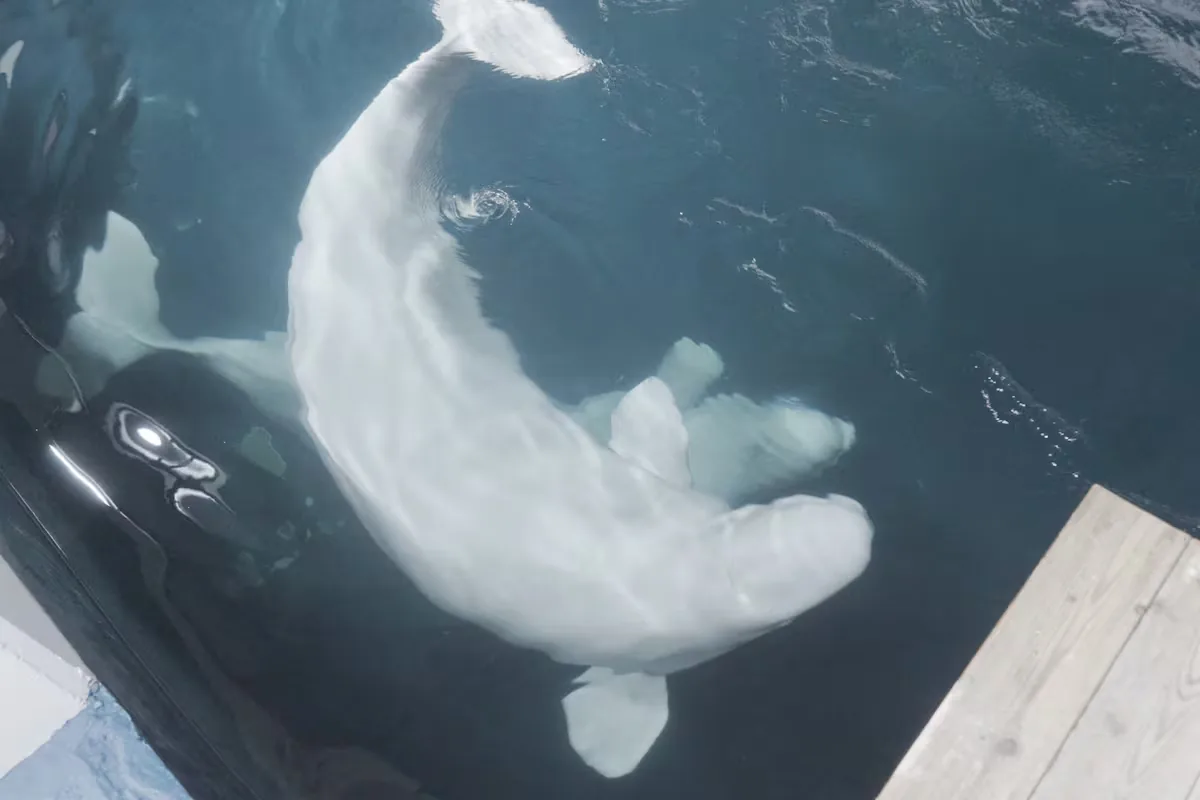
The Oceanogràfic of Valencia has two new belugas, Cleopatra and Jelly Bean, who have just arrived from Toronto (Canada), after a direct seven-hour flight on a plane specially chartered for their transfer. Both belong to the group of 30 specimens that remained in limbo in a Marineland aquatic park in Ontario (Canada) since it closed its doors in 2024. They faced the threat of being sacrificed, but the Canadian government rejected this possibility in January. The two whales traveled accompanied by four dolphins from the same facilities.
The operation began at the Marineland facilities, from where the six animals traveled by road to the Canadian airport. Throughout the journey, they were accompanied by veterinary teams and animal care specialists from the Oceanogràfic and other zoological institutions, according to a statement from the Valencia aquarium. Once at Valencia airport, the operation continued by road to the Oceanogràfic facilities.
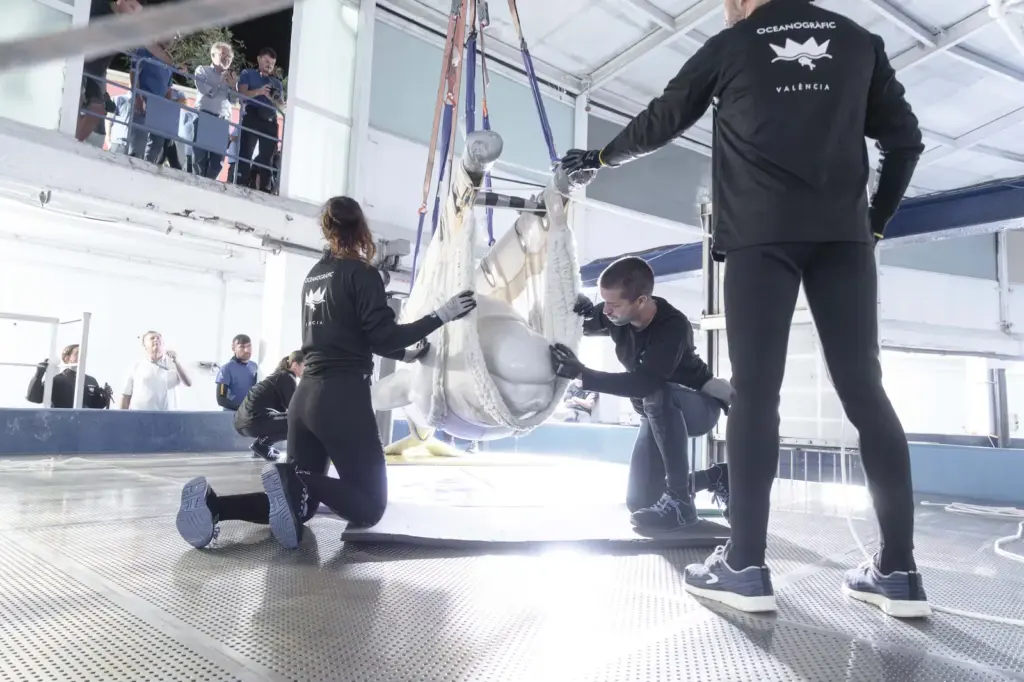
Now begins a complex adaptation process in the Valencia facilities ―the only ones in Europe with this species―. But they have companions. The center already houses four specimens: Yulka, who arrived in 2003 along with the male Kairo (deceased in 2022), and their son Kylu, born in 2016 at the Oceanogràfic; as well as Plombir and Miranda, rescued from a dolphinarium in Kharkiv (Ukraine) in 2024, a city subjected to bombings and located very close to the facilities where they lived.
The rest of the Marineland animals are being transferred to Shedd Aquarium, Georgia Aquarium, SeaWorld San Antonio, and SeaWorld San Diego. The Oceanogràfic is the only European aquarium involved in the rescue and the only zoological institution on the continent with this accreditation, the center notes.
Veterinary and technical teams from the Oceanogràfic traveled to Canada a few months ago to assess the health status of the animals, “whose delicate health situation requires continuous veterinary care.” Each specimen was evaluated to check if it could withstand the journey. Groups were formed taking into account existing social relationships. Both whales and dolphins are animals that live in groups and weave complex relationships among themselves.
For now, they will remain in areas not visible to the public to favor their acclimatization. Depending on their evolution, actions to be taken and integration with the rest will be progressively defined.
Captive breeding
The environmental association Animal Justice laments that all the whales from the Canadian aquatic park are being transferred to aquariums and that the option of sending them to a sanctuary is not considered. But, in this case, this “seems the best available option given the lack of long-term planning or investment by Marineland for the future of these animals, as well as the threat of sacrificing them all,” they indicate.
Read more The Treasure of Villena is stolen, one of the most important Bronze Age finds in Europe
They are especially concerned that these animals reproduce in captivity, because the Canadian government has not included restrictions in this regard in the export permits. Perhaps, “due to the urgency generated by Marineland’s threats.” And in Canada this practice is illegal, something that animal welfare law allows in Spain as long as it is done for “research and conservation purposes.” It is also allowed for them to participate in shows “under the supervision of their caretakers and related professionals.”
The association recalls that the whales and dolphins from Marineland Canada played a fundamental role in inspiring the 2019 Canadian law that banned captivity, breeding, and the use of these animals in shows. “They were supposed to be the last generation of belugas to suffer captivity, and we hope that the Oceanogràfic of Valencia sets an example by assuming this commitment, something that aquariums in the United States have not done to date,” they report.
The Oceanogràfic has a beluga breeding program, but in the case of the newcomers “there is no decision” about it, aquarium sources indicate. “Right now the priority is their adaptation and any future decision would be evaluated based on animal welfare criteria,” they add.
The controversy created with these belugas has brought to light the problem that exists with these cetaceans and others kept in captivity (many born in captivity) when aquatic parks cease to operate. This usually happens when the laws of countries prohibit exhibitions with them, which reduces their economic income.
In France there is a similar problem with the orcas Wikie and Keijo, whose fate has been discussed since Marineland Antibes (France) closed its doors a year and a half ago, after more than 50 years of existence. The closure occurred after the government banned exhibitions. The park management recalled that 90% of visitors came to the facility to attend orca and dolphin shows. The latest news points to their transfer to Loro Parque, in Tenerife, where four specimens already live and participate in public shows. In this center, calves have also been born from specimens in captivity.
Read more The health condition of King Harald of Norway worsens again: he is «very serious»