






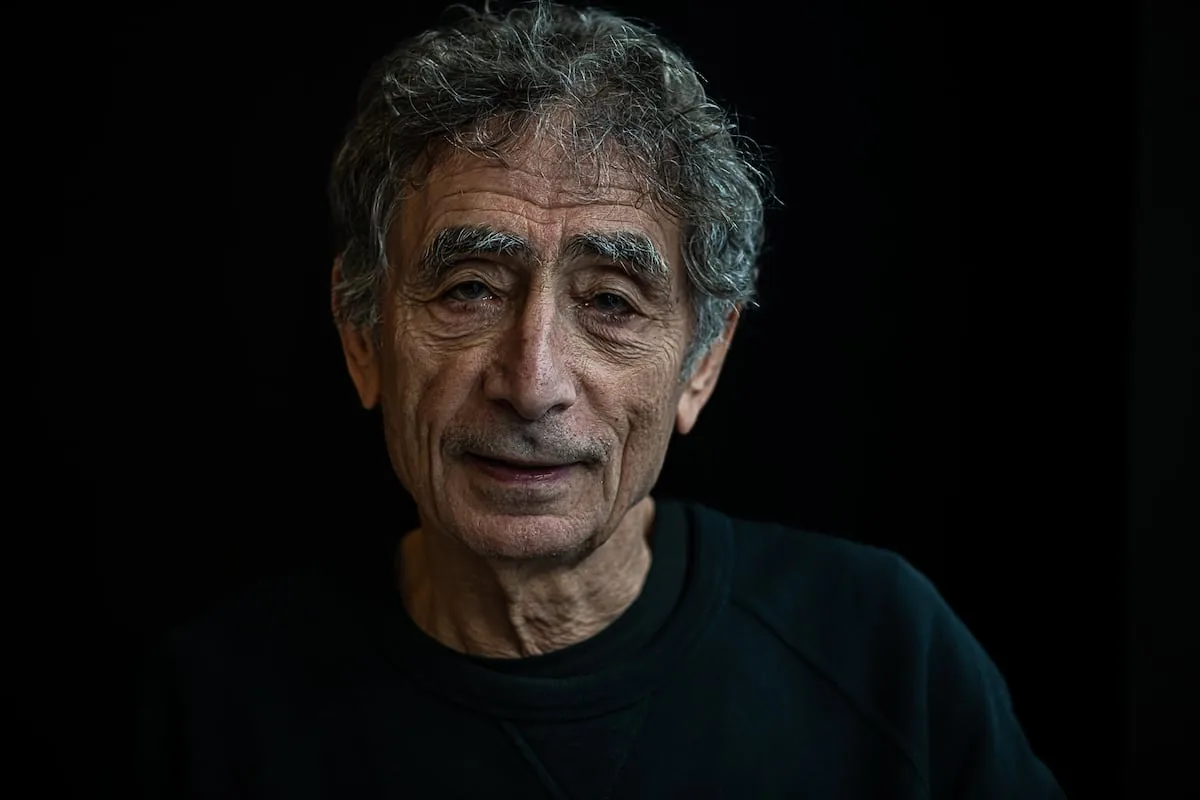
Gabor Maté argues that childhood traumas largely shape adult behaviors. Born in Budapest in 1944 into a Jewish family, his early years were turbulent. Emigrated to Canada during the Hungarian Revolution of 1956, he has developed a successful career as a doctor, lecturer, and writer specializing in addictions, but he has also suffered from them, perhaps influenced by those childhood traumas. In 2009 he published The Realm of Hungry Spirits: Close Encounters with Addiction, which Capitán Swing has just released in Spanish. Maté speaks to EL PAÍS via video call from Vancouver.
Read more Soraya Arnelas: “I gave my wig collection to some friends. I no longer play characters”
Question. Which of the stories you tell in the book impacted you the most?
Answer. The one about the pregnant woman in chapter six, whom I call Celia. She had already given a baby up for adoption. After the book was published, that baby, who by then was an adult, read that chapter and recognized herself. They made contact, but then the daughter died of an overdose. The second baby, who is now about 19 years old, also got in touch with her mother. And although she later lost him, Celia set aside part of her social assistance checks every month for his education. He has grown up very well. Celia no longer uses drugs and is somehow at peace.
Q. In the book you say your work is almost palliative medicine because most addicts you treat do not get cured.
A. That is true, but I also have several examples of people who have done very well, who no longer use drugs and who live very good lives.
Q. So there are exceptions.
A. There are exceptions, and there would be many more if we had a better system to support them.
Q. What should be improved?
A. The premise is that drug addicts are bad people who make bad decisions and therefore should be punished. We have to abandon that idea because they are not bad people. They are like the rest of us. They have just suffered more, have a greater need to escape pain, and use drugs. Most of us use something: alcohol, pornography, the internet, gambling, sex, food, or whatever. They use drugs, and we punish them. That has to end.
Secondly, because of the trauma they have suffered, they need much more support to rehabilitate. They need their trauma to be understood, heard, and healed. And that requires effort, time, and understanding. That is largely missing because most doctors are not trained in it. So we need to re-educate the medical profession to understand the science of how trauma shapes the brain and makes addictions more likely. All the money spent on putting people in jail should be spent on healing people.
Q. What is the main cause of addictions?
A. The main reason is suffering. All addictions are attempts to escape pain. And the more people suffer, the more likely they are to turn to addictions as an escape route. Now, not everyone who suffers turns to addictions, but everyone who turns to addictions has suffered. So addiction is not the only consequence of human suffering, but it is one of the main ones.
Q. Is there any way to address this problem from childhood?
A. Prevention must begin at the first prenatal visit because we already know that the human brain develops in interaction with the environment, from the womb. And the more stressed or suffering a pregnant woman is, the more negatively that will affect the child’s brain development and make it more likely that they will later have mental health problems and addictions. When doctors train in prenatal care, we are taught to assess physical health: blood pressure, sugar levels, weight gain… But no one asks us to talk to them about their mental health, even though all studies show that stress in pregnant women is already affecting the child’s brain in the womb. Prevention really has to start there. And then, in schools, there are more and more children with attention and behavioral problems. And most schools do not understand that those behaviors represent trauma. So they tend to punish those children instead of addressing the sources of their behaviors. Telling children that drugs are bad is not prevention because those who listen to adults are not at risk, and those who are at risk do not listen to adults.
Q. Is there a biological predisposition to addiction?
A. Everything is biological, but what creates biology is life. Human biology is not simply determined by genetics; it is created by the action of experiences on genes.
Q. Some of the criticism you have received is for focusing too much on the environment and too little on genes.
A. Science says that biology is affected by life experience. I am not saying it is biology versus psychology. I am saying it is biology affected by life. The brain is a social organ: it develops in interaction with the environment. You can have a biologically perfect tree seed. Think of an acorn: it can be biologically perfect, but if you put it on the table, nothing will grow from it. For that acorn to biologically develop into an oak tree, it needs the environment. The same goes for the human brain. It needs the right conditions, and if it does not receive them, it will not develop properly.
Q. How much real choice do addicted people have?
A. In the book, I talk about my own addictions. I was not addicted to drugs, so I did not go through a physical withdrawal syndrome [he defined himself as addicted to work and buying music records, on which he spent up to $8,000 in a week]. But people addicted to drugs find it very hard to make free decisions because the compulsion is very strong. And if they quit drugs, they go through a terrible withdrawal syndrome. It is not that they have no choice, but it is very difficult for them. And that is why the question is not only how much choice they have, but what we can do to support their choices.
Read more El Mar Menor 10 years after the green soup: the unique lagoon is increasingly «a tiny Mediterranean»
Q. How did your addictions help you understand your patients?
A. When I was with my patients, I saw in myself everything I saw in them, although not to the same degree. I was much luckier than they were. My addictions were respectable. But the effect on my family was very negative. The effect on me was very negative.
Q. How did you overcome your addictions?
A. At some point, I had to decide what I wanted: whether I wanted the addiction or I wanted my [romantic] relationship. And secondly, I finally learned that no matter how much you get from outside, whether money, records, music, fame, or anything else external: it never, never fills the inner void. That void is mine and I have to take care of it, instead of trying to fill it from outside. But it took a long time.
Q. Why has the war on drugs failed?
A. If the intention is to stop drug use or stop drug trafficking, we know it is a failure. It gets worse every year. But if the intention is to maintain the profits of drug cartels; if the intention is to increase the power of the state, militarize the police forces, exert more control over the population, keep intact the entire legal system in which judges and lawyers make a lot of money from the war on drugs, then it is a great success. So it depends. Now, why is it a failure regarding its declared intentions? Because it completely misinterprets the nature of addiction. It starts from the idea that addictions are bad decisions people make and things like that.
Q. Do you think drug legalization would be a necessary condition to treat addictions?
A. Decriminalization of personal use is necessary, as in Portugal. I am not referring to legalization. I do not think there should be stores selling heroin or cocaine. I do not think they should be allowed to be sold like cigarettes or alcohol. But decriminalizing drug use and offering treatment instead of punishment seems essential to me.
Q. Do you think we are now in a worse position in terms of addictions than when you published the book?
A. In recent years, more than twice as many Americans have died from overdoses each year than in Vietnam, Iraq, and Afghanistan combined. So yes, we are worse. Also, if you look at the conditions that precede addictions, such as mental health problems in childhood, attention problems, behavioral problems, self-harm, anxiety, depression, those figures are increasing worldwide. And that is not due to a genetic explosion because genes do not change in 10, 20, 30, 50, or even 100 years. It is because society is more stressed, more isolated, and many more children are suffering harm.
Q. So in a few years we will have more addicted people, not just to drugs?
A. Yes. And this [pointing to the phone] is a focus of addiction for many people.
Q. There is some controversy among your colleagues about talking about addiction when referring to the phone, social networks, or the smartphone.
A. I wish my colleagues knew the science. Let me define addiction for you: it manifests in any behavior in which a person finds temporary relief or pleasure and therefore craves it, but then suffers negative consequences and does not give it up. So, whether cocaine or gambling, people suffer. Whether compulsive buying or heroin use, people suffer. Whether pornography or sex addiction, people suffer. Whether bulimia or methamphetamine, people suffer. Whether self-harm or fentanyl, people suffer. I am not comparing all degrees of suffering, I am not saying they are all the same, but they all have the same characteristics: a behavior that gives you temporary pleasure or relief, then you suffer and do not give it up. The second point is that, if you look at the brain, the same circuits are involved. If you look at gambling addicts or pornography addicts, the same dopamine circuits are involved in those addictions as in any other addiction. So, even biologically, we are talking about the same brain systems.
Q. So all this also applies to social networks or smartphones.
A. Yes, it applies. In fact, these things are designed to raise dopamine levels, which is what cocaine does.