


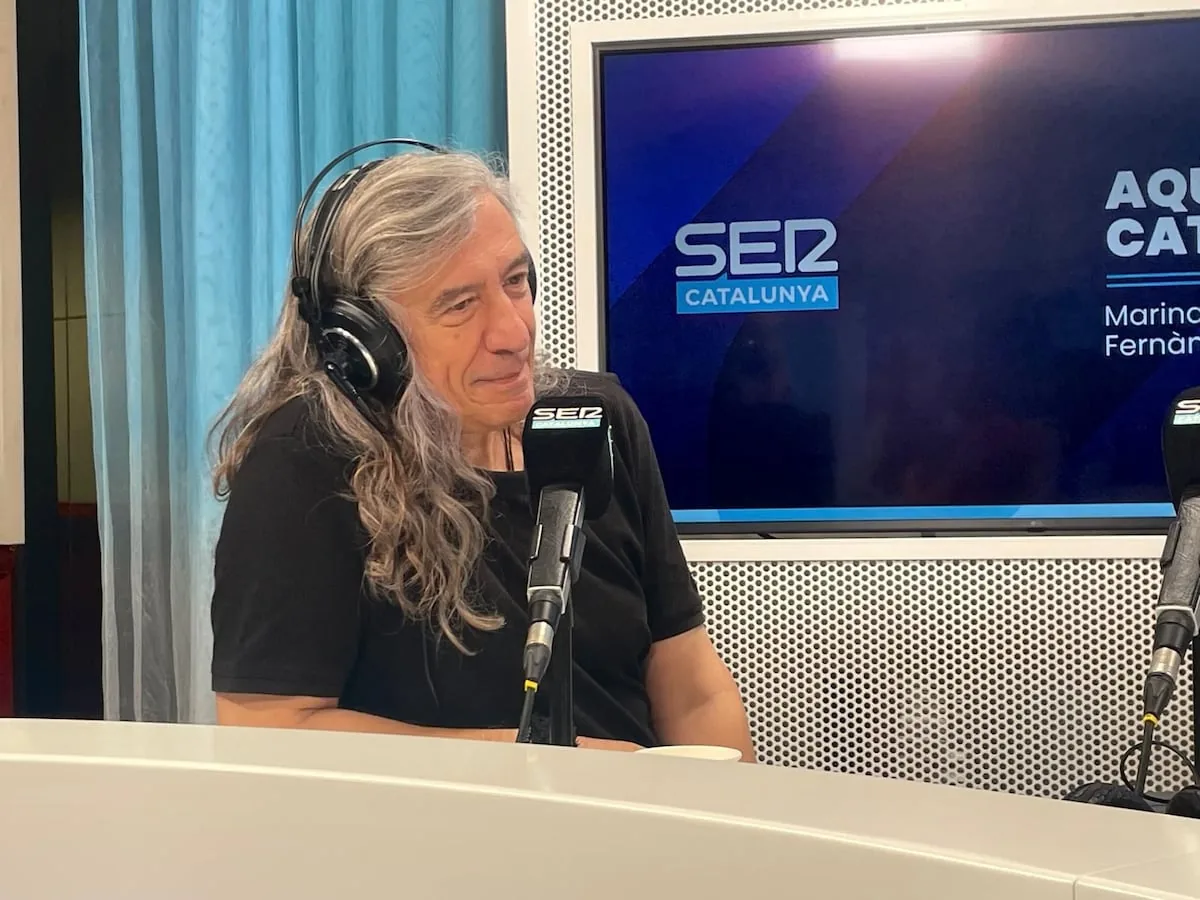
In an interview on the program Aquí Catalunya on SER Catalunya, Gerard Quintana reflects on some chapters of the 40-year history of the band Sopa de Cabra. One of the most delicate, the 1991 concert at Sant Jordi, alongside Sau, Els Pets, and Sangtraït. That was sold as the moment of the explosion of Catalan rock, but he disagrees. He recalls that his band had already made a name for itself and adds that they didn’t need that to succeed, that they would have filled Sant Jordi anyway. Quintana interprets it as an attempt at “instrumentalization of pujolism” and that they realized it when they were already involved in the event.
He had already talked about this in the 3Cat documentary about the band, “Sopa de Cabra, tornar enrere”. They felt used, the singer reflects. In fact, other journalists from Spain had even called them “the Generalitat’s bands.” “We were a tool for linguistic normalization,” he says he understood over the years, “but we didn’t want to be, and even less so of pujolism.” That caused a rift within the band; some of the bandmates had previously gone to disrupt Convergència rallies: “Suddenly we found ourselves embraced by that, I didn’t feel comfortable.”
The singer recalls that they came from years of leading the institutionalization of music from the regions, filling municipal football fields, but when they arrived in Barcelona their managers decided to ally with the Generalitat: “We found articles that talked about the concert as if it were a political event, not a music one,” he points out. That was what pushed the band to release Mundo infierno (1993), the Sopa de Cabra album entirely in Spanish. It wasn’t to enter a new space, he clarifies; they were already a band — born in 1986 — “we had five years of shocks, we were looking to approach places where we hadn’t been.” His dream, he admits, was already to play in South America, but that was the final push.
In hindsight, Quintana admits they would have done some things differently, “and surely we wouldn’t have reacted with that much visceral intensity. Maybe we wouldn’t have fallen so much into the game.” He recalls that the band’s first album, in 1989, was already a mix of languages: Catalan, Spanish, and English. The artist assures that “you learn from everything and that’s the fun, not letting yourself be defeated.”
He also reflects, from a more personal side, on his regrets and successes: “I regret thinking that my back is infinite and loading things on top of me, enduring things I shouldn’t have endured.” Even so, he assures he is proud to have gotten where he is because “I was convinced I wouldn’t make it past 30 years old”; they were a generation that spent all day on the street, in a social context where heroin “took many companions.”
Read more The Executive Council accelerates the approval of points of the budget agreement with ERC
Learning from the past
The band Sopa de Cabra now celebrates four decades of career. The singer recalls how the sector has evolved since the eighties: “The studio was like a sanctuary you entered every so often, the usual space was the stage or small venues.” This transformation has also multiplied the offer: “In 1986, in one year the same amount of music came out as today comes out in one day.” For that reason, the artist considers that the big current challenge is visibility: “The biggest effort is positioning what you do.” In fact, the singer assures that in many cases the promotional campaigns of some bands exceed the cost of recording.
Even so, the artist warns of the risks of adapting to new trends: “You run the risk of making a terrible fool of yourself.” Anyway, Quintana has explored many facets during his musical career and highlights the album De terrat en terrat with Albert Pla: “In the song ”El cel” a radio announcer appeared announcing my death, I had killed myself in the middle of the song.”
When he started his solo stage he was clear: “The last thing I wanted to do was something similar to Sopa de Cabra.” The artist confirms that each album was an opportunity and compares it to a train trip: “I won’t always get off at the same station.”
But after filling three Palau Sant Jordi and mobilizing 90,000 people, Quintana felt he had to return to the band. He recalls how it was born: “Josep was studying architecture and had left music, but he proposed doing a single concert for the 25th anniversary and everything broke loose. After 10 years inactive as a band you think people have forgotten, but that’s not the case. Both of them were very clear, this couldn’t stay like this.”
Read more The Valencian Jaime Siles, Queen Sofía Ibero-American Poetry Prize winner