





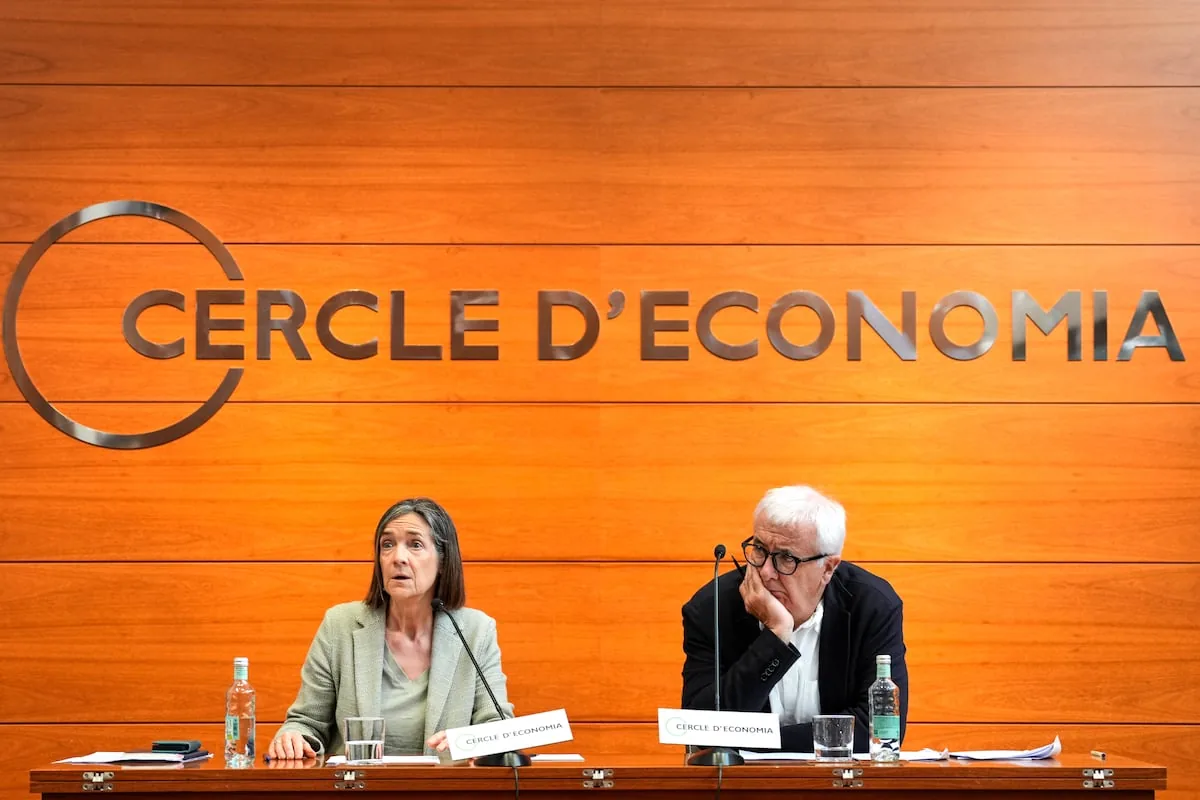
The verdict of the Cercle d’Economia is, to begin with, as clear as it is forceful: “Europe needs to change” because its strategic autonomy “is not a myth, but neither is it a reality.” With such a starting premise, the influential entity chaired by Teresa Garcia-Milà has organized the agenda and speakers for its annual meeting, scheduled for next week in Barcelona. “There are important geopolitical changes that significantly affect society, its economy, and its supplies,” analyzed the president of the Cercle this Tuesday, and warned of the convenience for Catalan and Spanish companies to know how to take economic advantage of the window of opportunity that opens with the new rules of the global game.
Read more Gerard Quintana: “That we were embraced by pujolismo pushed us to sing in Spanish”
The Cercle’s annual meeting, scheduled for June 1, 2, and 3, will convene King Felipe VI on Tuesday, in an event that will serve to recognize the career of Martin Wolf, associate editor of the Financial Times. “Geopolitical fragility is not a distant phenomenon: it directly affects Europe’s energy, trade routes, and security,” states the Cercle’s opinion note.
The entity’s conferences usually debate matters of political relevance and their impact on the economy. The bustling current context, with several open and latent armed conflicts and a world map fractured into blocs, brings about a kind of reindustrialization wave where the defense sector and dual technologies, equally valid for civil and military purposes, will have capital importance. Europe, a bloc encompassing 450 million consumers, must wake up to avoid being displaced and relegated to irrelevance. “Without a real single market, there will be no European champions, no technological sovereignty, nor the capacity to compete with the US and China on equal terms,” predicts El Cercle.
“We are in a situation where whoever can control technology will control geopolitics,” reasoned Teresa Garcia-Milà, accompanied by Miquel Nadal, general director of the Cercle. “The defense sector is an important sector that is in an emerging phase,” Nadal emphasized. Therefore, it is advocated that Spain and Catalonia play a relevant role in this challenge of strategic autonomy, as they have “real assets in energy, telecommunications, defense, technology, and the financial system.”
The Cercle d’Economia has designed its annual meeting with a program of strong political content. In a context of strong tension for the Government, the influential entity chaired by Teresa Garcia-Milà plans to grant an audience to the President of the Executive Pedro Sánchez on Wednesday, and to the leader of the opposition, Alberto Núñez Feijóo, on Tuesday. The current focus is on the impact that the indictment of former president José Luis Rodríguez Zapatero may have on the legislature. “We are aware that we are in a context of certain concern, due to the buzz there is,” Garcia-Milà acknowledged. Although the Cercle does not comment on whether Spain needs a political change or not, García-Milà was confident that a hypothetical change at the head of the Government would not alter some premises about the need for Spain to be part of a solid common project: “whatever the political situation, the majority of the Spanish population is very pro-European, and this will not change.”
The President of the Generalitat, Salvador Illa, will be in charge of inaugurating the event on Monday, along with the Mayor of Barcelona Jaume Collboni. The agenda also includes ministers Jordi Hereu, Industry and Tourism, and José Manuel Albares, Foreign Affairs, the Deputy Prime Minister of Poland Radostaw Sikorski, the former Indian ambassador to France and Bahrain, Mohan Kimar, or Jia Qingguo, a member of the highest political advisory body of the Communist Party of China.
Lehendakari Imanol Pradales and the President of the Xunta de Galicia Alfonso Rueda will discuss with Salvador Illa in the round table “Spain, territory and leadership: the vision of the regional presidents.” Unlike the bitter atmosphere surrounding the Spanish legislature, in Catalonia, Illa advances with favorable winds, driven by the recent approval of the budgets, after a pact with ERC and the Comuns.
Last year, the Cercle’s conferences were marked by the echo of BBVA’s offensive on Banco Sabadell and the statements by the Minister of Economy Carlos Cuerpo, where he announced a public consultation to evaluate the possible impacts of the hostile takeover bid.
Read more The Executive Council accelerates the approval of points of the budget agreement with ERC