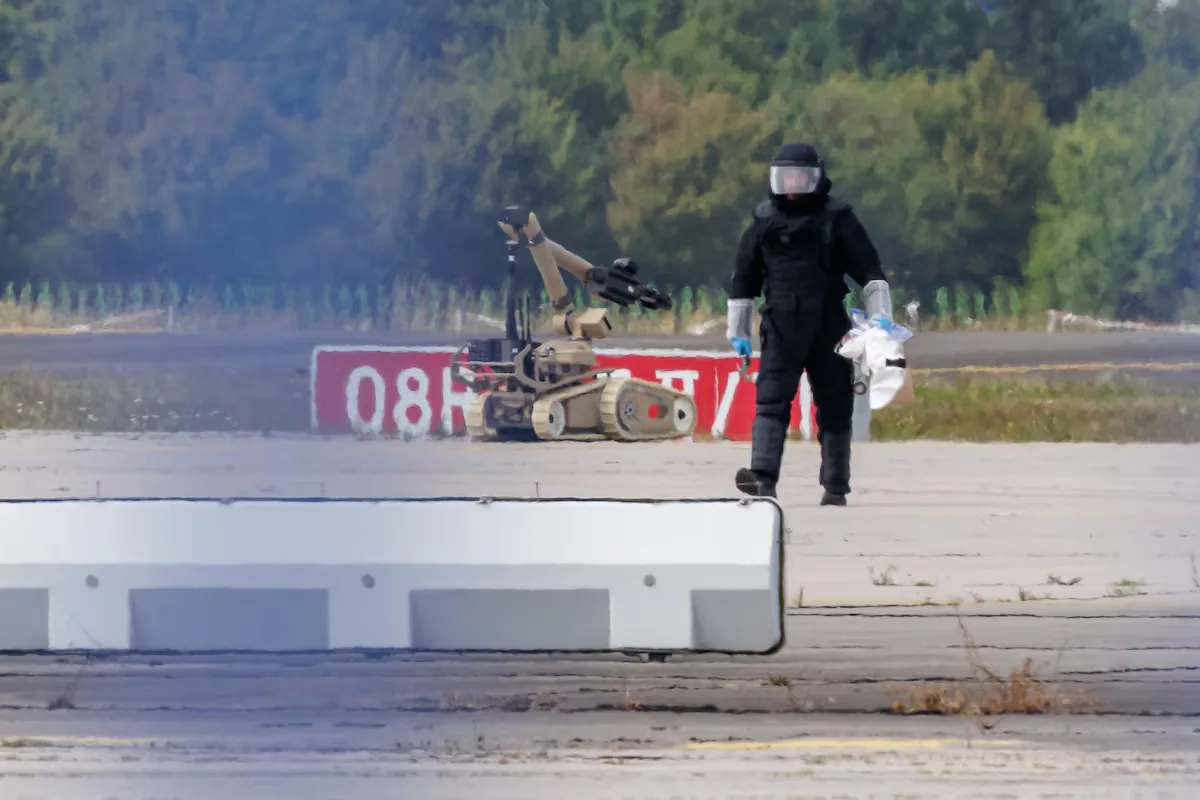
The German government considers that Tuesday saw the most serious drone threat in the country’s history. “A new level of danger,” as Interior Minister Alexander Dobrindt described it on Wednesday. It is the first time that an unmanned device loaded with explosives has infiltrated an airport, that of Leipzig. The hundred drone threats reported in recent years in Germany, especially since the start of the war in Ukraine and with the increase of Russian pressure in Europe, did not pose the same danger. An almost miraculous situation prevented the catastrophe.
Read more Errors persist on the plaque to the poet in Seville: “It should say Luis Cernuda and nothing else”
Politicians and experts question whether the German security forces are prepared to face this risk. The drone loaded with one kilogram of plastic explosive did not explode because the detonator cable was accidentally disconnected. Even more incredible, it was an airport bus driver who shot down the bomb drone. This person saw the device at ground level, in the area where four Ukrainian cargo planes were parked. The country invaded by Russia has its airspace closed and distributes its fleet of planes in airports across Europe. The driver, ignoring the risk, held the drone with his hands until the police arrived.
Several German media, including the newspaper Süddetsche Zeitung, reported this Thursday that at least one of the Ukrainian planes had a cargo of military ammunition. The plane would have arrived in Leipzig with this war material from France. This airport has a section for NATO operations. These international supplies for the Ukrainian army are later transported by land to their final destination.
“Russia has intensified its hybrid and cognitive war and Germany is at the center of these attacks. This is partly because Germany is a key logistical hub for NATO and for support to Ukraine,” wrote Roderich Kiesewetter, a reserve colonel and defense policy expert of the CDU, the leading party of the coalition government, in an analysis this Thursday: “Germany is particularly vulnerable because it is not prepared for the current threat situation nor for hybrid attack scenarios.”
Carlo Masala, professor at the Munich University of the Armed Forces and a prominent German defense expert, has been especially critical of what happened and warned on his social networks about the lack of preparation. “Do you also have to pay fees for drone detectors to work at airports? Do we need more brave Saxon bus drivers, or should we immediately buy more already manufactured drone defense systems instead of spending a lot of time developing our own?” he asked.
There is no precedent for a similar level of risk either in Germany or in other European Union countries that have detected drone threats to strategic infrastructure in the past year. One of the most serious cases occurred in December 2025 at Dublin airport when about five drones were detected following the plane carrying the President of Ukraine, Volodymyr Zelensky.
Second drone
The German police are now focusing on identifying the origin of the explosive and finding a second drone. On Tuesday night, at the same time the bomb device was being deactivated, a DHL cargo plane collided in Leipzig with another drone that had indeed been detected by radar. The aircraft had aborted its landing when it was only 400 meters high because the airport had been closed at that time for security reasons. The DHL plane was able to continue flying, with minor damage, to Hannover airport.
The police are searching the area to find the remains of this second device. So far they have not provided details about it but military experience indicates that this drone, if it was not loaded with explosives, was used to record or monitor the operation.
The Greens, an opposition party, have called for an urgent meeting of the National Security Council to analyze how the incident in Leipzig could have happened. This body was created in 2025 to strengthen coordination between the federal executive and the regions, precisely for scenarios like the one the Interior Minister confirmed in Leipzig: “a hybrid attack” by professionals, possibly with “a foreign power” behind it. Dobrindt has received numerous criticisms because in his Wednesday appearance he did not mention the possibility that Russia was behind the failed attack.
Read more Neither steel nor plastic: why copper is the best material for reusable water bottles
Martin Hagen, secretary general of the FDP, also an opposition party, has denounced that the Leipzig case “shows that Germany has huge security gaps that the government must solve.”
Also in 2025, Germany created the Joint Center for Defense against Hybrid Threats, including drone attacks. The priority of this institution, coordinating police and governments, is the detection of drones in flight. The other layers of defense, once the device is near its potential target, are electronic warfare equipment that interrupts the connection between the vehicle and the pilot, and cannons that fire interceptor nets. This is the last line of protection, when the risk is already very high.
Many experts say that the drone detection system in Germany is underdeveloped. This was the conclusion of a report presented in June by Deutsche Flugsicherung (DFS), the main consortium responsible for air traffic control at German airports. The DFS document focused on how to rapidly develop a system to identify unauthorized aerial devices using artificial intelligence and the mobile operators’ telecommunications network.
Mijailo Samus, director of the Ukrainian security analysis center New Geopolitics, believes Germany must get moving because the Russian threat will increase, especially if there is a strategic target like Ukrainian planes. Samus emphasizes that it is a priority to apply preventive measures, because once a small bomb drone like the one in Leipzig has taken off, little can be done. “German authorities must work more on monitoring the area, trying to identify possible enemy agents,” explains Samus. He himself has his own experience on this: “Not long ago I visited a missile factory in Germany and was surprised. They had no threat detection system on the perimeter of the facilities; it was a security plan from 20 years ago.”
Samus supports the German Interior and Defense ministries betting on net interceptors as the last line of defense, something less common in Ukraine: “Germany is a peaceful country and its forces operate in a civilian environment, they cannot prioritize the use of explosives, for example, at an airport with commercial aviation. In a war situation, like in Ukraine, more effective measures can be applied.”
Problem across NATO
John Helin, analyst at the Finnish defense study group Black Bird, emphasizes that the problem is not only Germany’s but all NATO countries’: “I don’t think European NATO is prepared for attacks like these. Some systems are being implemented, Germany bets on cannons that launch nets against drones, and even some airfields have trained birds of prey to hunt them, but overall I don’t think it is enough.”
Helin warns that it is almost impossible that in the face of a coordinated attack with drone swarms, as Russia and especially Ukraine are carrying out during the war, countries like Germany would know how to react. Regarding electronic systems that cut the drone’s signal, their effectiveness at airports is questioned, according to Helin, because the risk of interfering with airplane communications at the airport is high.
Read more Several candidates for the French presidency denounce Russian interference in the election campaign