








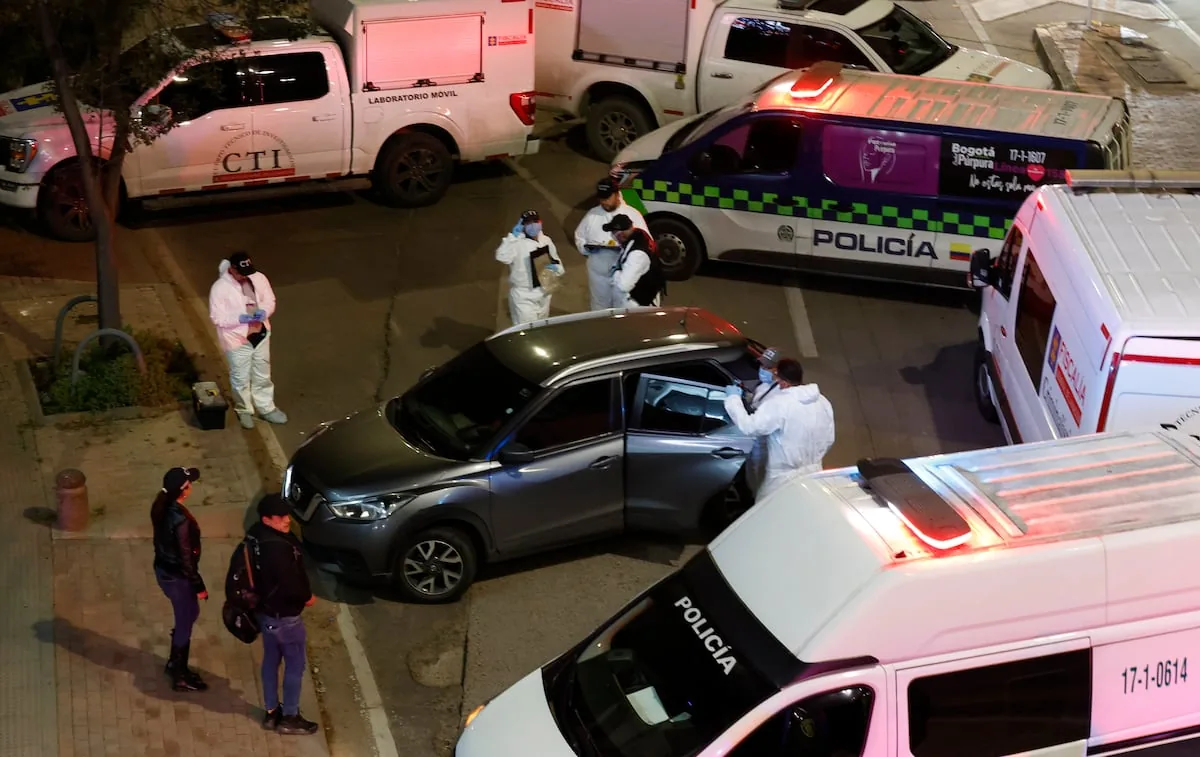
In Bogotá, killing has become a service. Five out of ten homicides that occur in the city are cases of contract killings. Between January and March of this year, 134 of the 265 homicides recorded in the Colombian capital (50.5%) correspond to contract murders, according to figures from the Metropolitan Police. It is a growing phenomenon: before the pandemic, this type of crime accounted for about 3 out of 10 cases, explains Andrés Nieto, director of the Security Observatory at Universidad Central. In 2018, for example, only 161 of the 1,064 homicides (15%) were cases of contract killings, .
Laura Suárez, director of the urban security area at the think tank ProBogotá, explains that the growth of the phenomenon is not entirely clear, as the National Police stopped systematically publishing this data. However, a June 2025 report by Green Party councilor Julián Espinosa, based on data obtained through a right of petition to the Directorate of Criminal Investigation (Dijin), shows the increase. In 2022 there were 431 cases of contract killings (42% of homicides); in 2023, 437 (40.3%); and in 2024 the figure rose to 606, almost half of the total 1,214 homicides (49.92%).
For Suárez, these figures reveal an instrumentalization of violence. “It responds to disputes between criminal gangs to control areas of the city that serve as drug corridors and for the control of illicit economies.” This precisely shows that there is no dominant structure, but multiple organizations competing with each other. “There are many gangs that, besides being very well financed, are fighting to control those territories.”
The dispute is not new; it has intensified at least over the last decade and in recent years has deepened, partly due to the strengthening of armed groups and their illicit economies throughout the country. The increase in cocaine production, which the debated United Nations estimates calculate to reach 3,000 tons annually, has increased the flow of money to urban criminal networks. “Gangs in Bogotá do not act in isolation: more money means more weapons, more ammunition, and more capacity to recruit people,” says Suárez. That dynamic, she insists, has allowed the sophistication of organized crime in the capital.
Nieto agrees and adds another element: the transformation of crime into a service system. “A criminal portfolio is being generated,” he explains. It is no longer the same gang that robs, kills, or traffics, but they are articulated in a network where some provide services to others. In that scheme, contract killing is a form of “criminal outsourcing.” Killing has rates, conditions, and levels of specialization. “That makes investigation difficult because there is no clear line: it is a network where someone pays for a service,” he says.
Added to that transformation is express access to weapons. “In sectors like San Bernardo (in the city center), weapons are rented from 15,000 pesos for half an hour, and the price rises if it is a ‘clean’ weapon,” Nieto assures. That ease is linked to the growth of illegal arms sales as a market for rural armed groups. “They are intermediaries of smuggling that enters through the borders of Venezuela and Ecuador and end up supplying urban gangs,” he explains. The result is an increase in the availability of weapons, ammunition, and explosives. Suárez agrees: “The financing of transnational crime is immense. Today criminals who were minor offenders, financed by common theft, are paid, and now they have resources from drug trafficking. That gives them better weapons, recruits more people, and allows them to act in a more organized and sophisticated way.”
For both experts, the problem is not only criminal but also institutional. Suárez warns that the national government has “left cities alone” and weakened their response capacity. Bogotá, a city of 8 million inhabitants and 470 square kilometers of urban area, currently has the lowest police force rate in a decade and the lowest of all Colombian capitals: 206 police officers per 100,000 inhabitants. In addition, she points out that intelligence capacity has been reduced. “It is impossible for Bogotá to really know how crime works, which does not start in the city but in Cauca. If the police do not understand how it gets from there to Suba or Ciudad Bolívar, it is very difficult to tackle.” She also insists on the need to “recover the data,” because, she says, security policy is being made “practically blindly.”
Read more The National Electoral Council: opportunities for improvement amid criticism
Nieto, for his part, criticizes that Bogotá’s criminal gangs are not a priority in the national security strategy. “The country still has a view from the 80s and 90s, where resource allocation depends on the risk due to the presence of armed groups.” Since they do not exercise territorial control in the city, their criminal structures are not a priority at the national level.
That is particularly problematic given the economic magnitude of urban crime. Nieto recalls the case of alias Camilo, leader of the Los Camilos gang, dismantled in 2021, who moved more than 2.6 billion pesos a month (about 70 million dollars at the time) in microtrafficking. “He did not plant bombs or attack police stations, but he had more criminal income than many fronts of armed groups,” he states.
Added to that is the loss of key tools for investigation, such as the Unified Criminal Inventory of the District Secretariat of Security, which the administration of Mayor Carlos Fernando Galán stopped updating. This combined the capacities of Gaula, SIJIN, SIPOL, and CTI and allowed mapping gangs, territorial disputes, and criminal patterns, something key when homicide and contract killings are concentrated in localities such as Santa Fe, Los Mártires, Usme, and Ciudad Bolívar. Factors such as urban deterioration, lower quality of services, and low institutional presence create conditions that facilitate crime operation.
But the violence does not stay in those areas. “The contract killing service allows crime to expand,” explains Nieto. “If someone pays to kill a person, they will kill them wherever they are.” That means that even homicides originating from territorial disputes can occur anywhere in the city.
Faced with this scenario, the response from the Mayor’s Office generates different readings. Suárez acknowledges progress, especially in dismantling gangs and monitoring illicit economies. She highlights that Bogotá achieved, between 2024 and 2025, a 3.4% reduction in homicides, being the only capital city to do so. Nieto, on the other hand, is more critical. In his view, the city has not had a clear strategy and has lost part of the “containment” of crimes it had achieved in past administrations. However, they agree that contract killing is a central piece to understand how and why people are being killed today in Bogotá.
Read more Organize the garden in one day with the best-selling storage shed on Amazon