



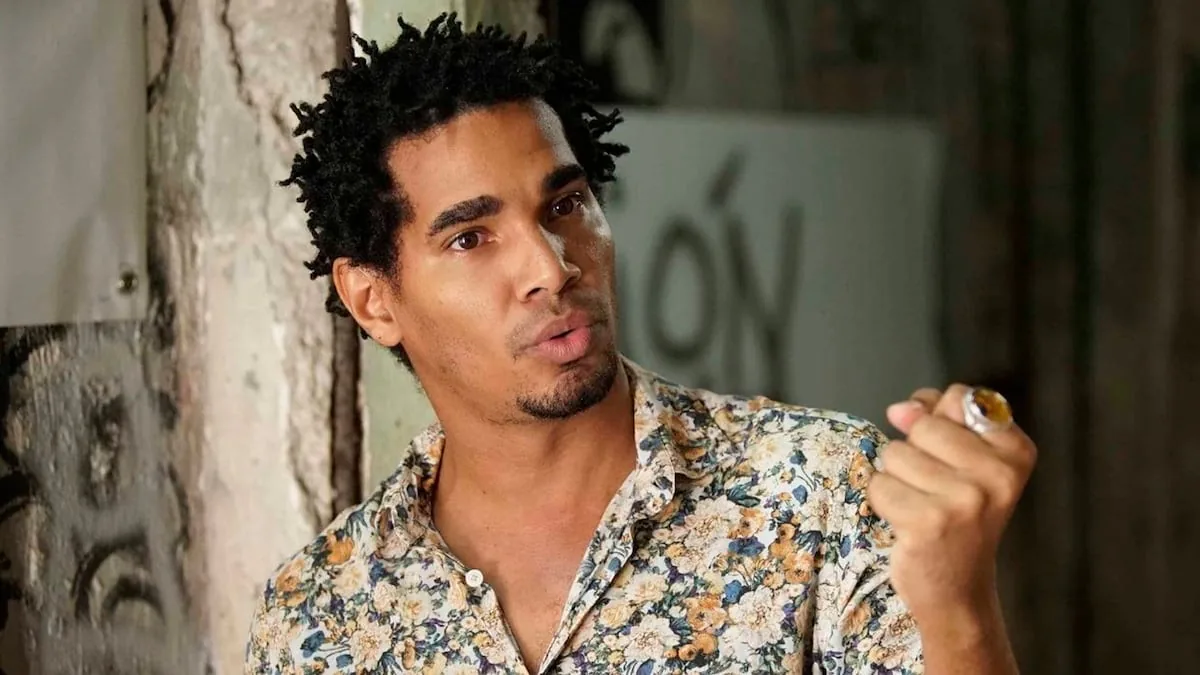
At the end of March, agents of the Cuban political police went to the maximum security prison of Guanajay, west of Havana, and during a cell inspection threatened the artist Luis Manuel Otero with death, who responded with an eight-day hunger strike. Accompanied by Javier Reboso, head of prisons in the Artemisa province, the State Security officers also confiscated agendas with phone numbers of two political prisoners there, Jorge Ayala and Daniel Alfaro, and even took the toilet cups from the cells, but in Otero’s case, leader of the San Isidro Movement and arbitrarily sentenced to five years of imprisonment, the argument with the guards escalated when the artist asked if they planned to fight the Americans with four AKMs (the Soviet assault rifle) and they replied no, but that one alone was enough to kill him.
Read more Half of the homicides in Bogotá are contract killings
With not many more resources to turn to, for the umpteenth time in the last six years Otero stopped eating, as a way to focus on the threat and protect himself from execution or some other reprisal, at least as far as that is possible. There is something mechanical in this procedure, from which its cruelty emanates. The strikes can be counted, also their duration, the abuses, the years in prison, perhaps even the magnitude of the resistance, but what cannot be measured is the suffering or mortification of the flesh. If, as Sarduy says, every repetition is a prayer, the recurrence of strikes is a prayer that implores us to look and get involved in a resource that, despite having acquired the appearance of a technical response, still holds more than one effectiveness, or at least the few that a subject has in such a situation.
Of course, turning the victim’s body into a stronghold that begins to behave like a machine is the way totalitarianism finds to deactivate it. Since time works in favor of the prison system, which does not wear out, an important part of the political prisoner’s protection lies in the collective consciousness, the attention of others, not accepting the dehumanization that comes with habit. It is difficult, especially in a country that produces more prisoners than food, where one inmate’s file is quickly replaced by another, and where the idea of individual hunger does not seem so distant from collective shortage. After an initial moment of attention, a considerable number of these prisoners remain only under the protection of their relatives, a few friends, and often not even their names become known, despite the efforts of human rights organizations and non-governmental media.
This is not the case of Luis Manuel Otero, who must be the most well-known Cuban political prisoner inside and outside the island. Even so, maintaining his presence among the free, where he belongs, requires incessant work. Activists and curators like Yanelys Núñez, from Madrid, or Claudia Genlui, from Miami, keep circulating the strictly conceptual works that Otero has proposed from prison over these years, and another colleague, curator and academic Anamely Ramos, made with him a surprising installation for its pious character. On February 19, dozens of statuettes of different saints from the Cuban syncretic pantheon appeared on a random street in the Párraga neighborhood, on the southern outskirts of Havana. Among the deities were Saint Lazarus, the Virgin of Regla, Saint Barbara, and the Virgin of Charity of Cobre.
However, the most decisive dimension of the matter remains, the prisoner and the inner struggle, the prison as an inoculated virus or as a private reality, which is ultimately what it is about. Otero is three months away from his release. After having held him until today, the State Security has not been able to prevent the sentence from also being measured in more than 4,000 canvases drawn in five years. What reaches the outside are ideas that become works, gestures, interpretations, laborious formations of meaning, but inside the prisoner entrenches himself in an augmented materiality, in the proliferation of images and concrete series, without which, he has said, he will not leave there. Suddenly, the prisoner has generated in prison a document that he needs to take out. Prison gave him something, not everything has been sterile. That, if it can be said, is a battle won, since the prisoner has been able to conceive a language from which the same amount of freedom has been taken away, but which does not literally respond to what happens to him.
“My paintings,” Otero said in an interview, “have no direct or aggressive political connotation. They don’t say ‘Down with Fidel!’ or anything like that. There are about twenty series. They are like my experiences and the energies that have surrounded me here, carried onto cardboard.” Although people have not yet seen them, that is precisely the reason why it can be assumed that the paintings escape the dictates of the ideological machine, the reproduction of its phrasing. Painting as denunciation would generate a second confinement and, worse, two oppressions. Why would the artist say what his body is already expressing for him? What function does the body then serve, if it does not manage to come between the jailer and art, if it does not soften the impact of that overwhelming force on sensitivity?
When the imprisoned artist offers the body (the only thing he has at hand), he saves what he was locked up for, which is actually what the confinement longed to destroy through the imprisonment of the person. But the confinement not only does not destroy it, but the artist duplicates it, although that is something, naturally, that can only be achieved if the artist does not start painting “Down with Fidel!” nor yield to another form of tautology. The prisoner’s body functions as a hinge of his freedoms and closures, but by treating it as something indeterminate, and using it as what it is not, its deterioration accelerates amid the swings of violence and neurosis.
To express himself, the political prisoner has to double the penance, make those outside listen by provoking a punishment that further radicalizes the one inflicted on him. Unfortunately, suffering bodies speak through prayer. The political prisoner protects himself by harming himself and appears when he martyrizes himself. None of that is art by itself, but it is its shield. Of course, a death threat cannot be opposed by a stroke, a color, or a drawing. The hunger strike is what it is, not a political statement, nor a sign of the artist’s lack of imagination. What runs out, what is finite, are the resources to resist, not necessarily the one who resists. We are talking about a black self-taught artist in mourning with a system that, in Goethe’s words, “makes the poor become guilty.”
Read more The National Electoral Council: opportunities for improvement amid criticism