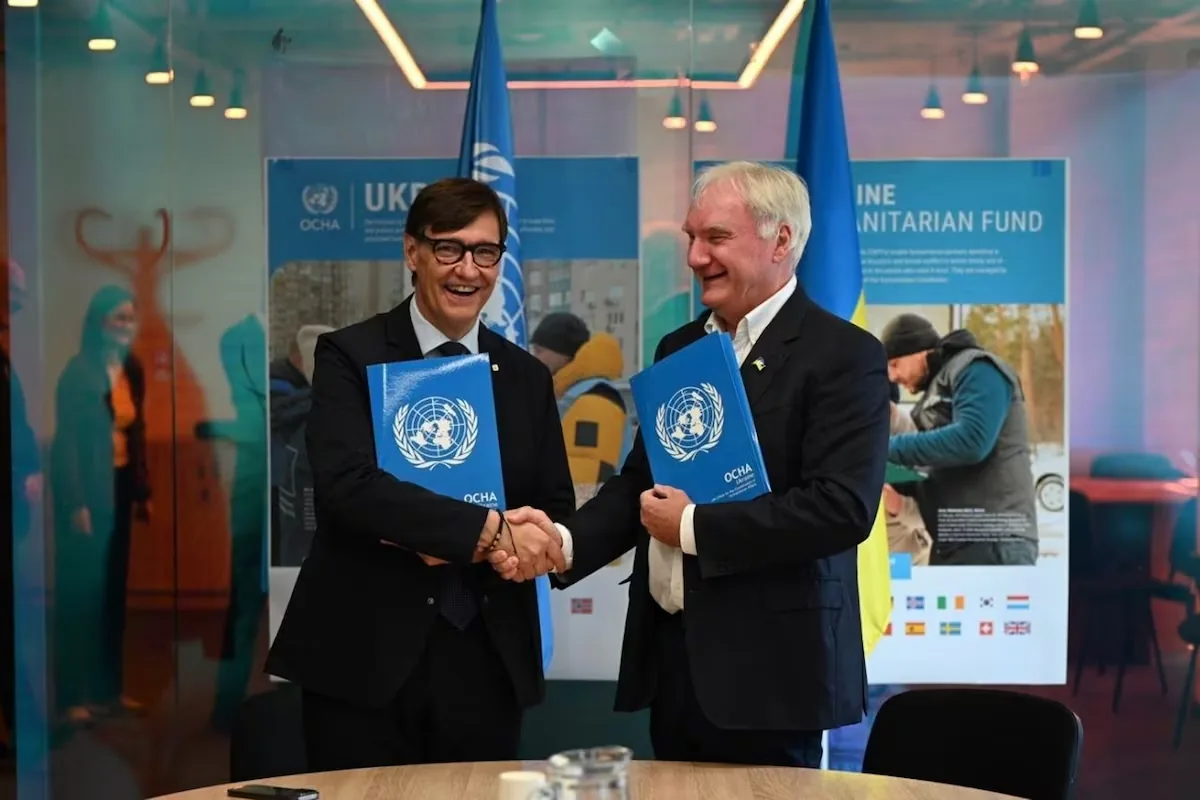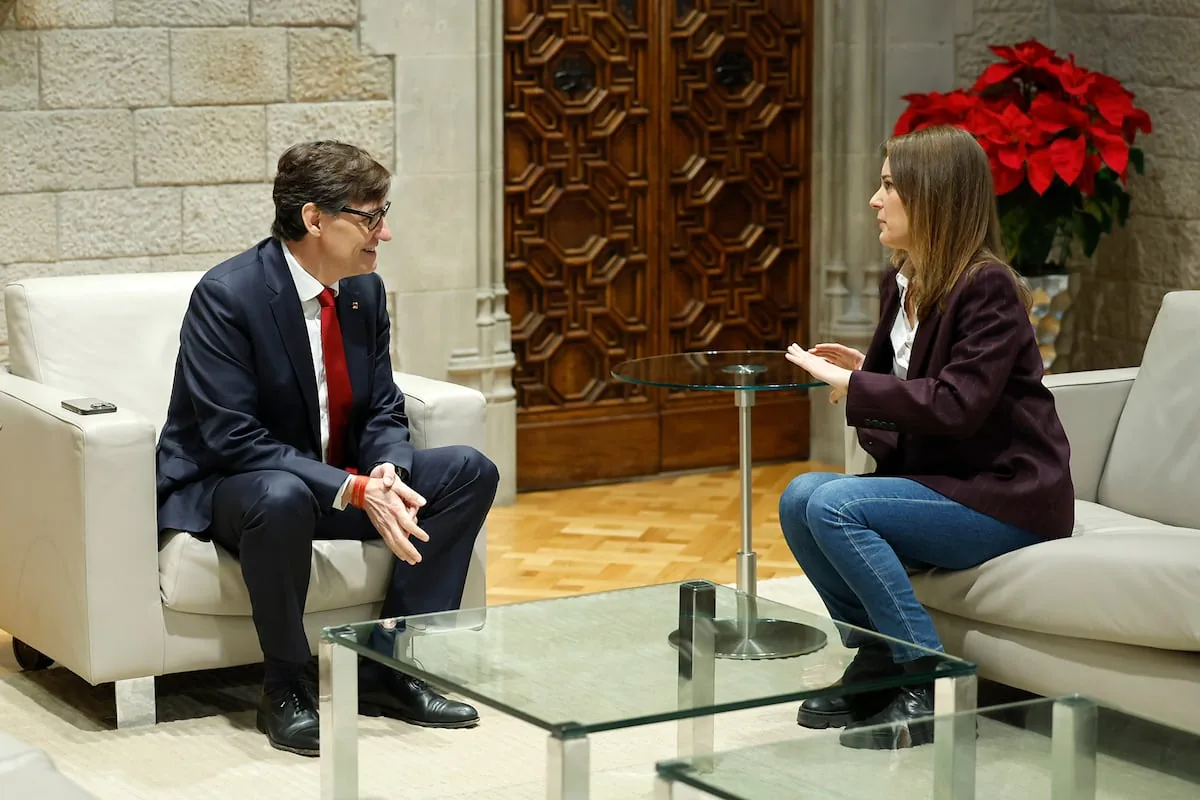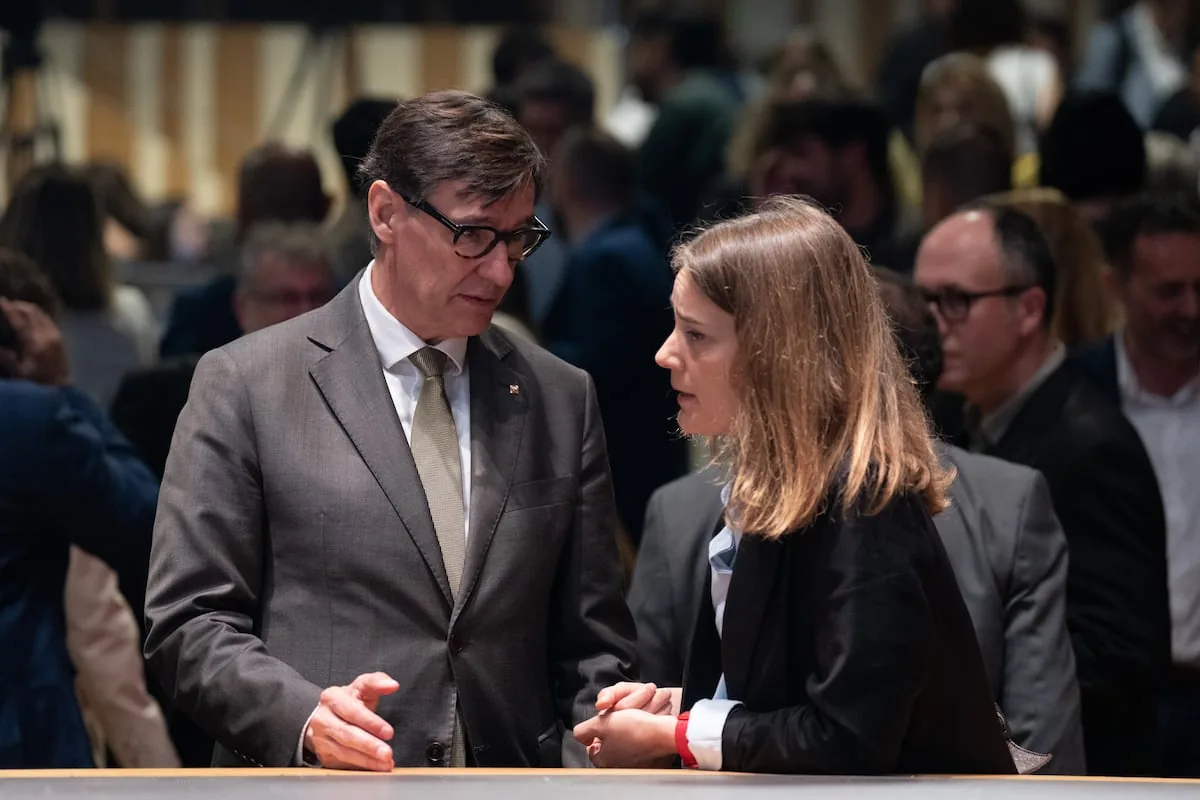





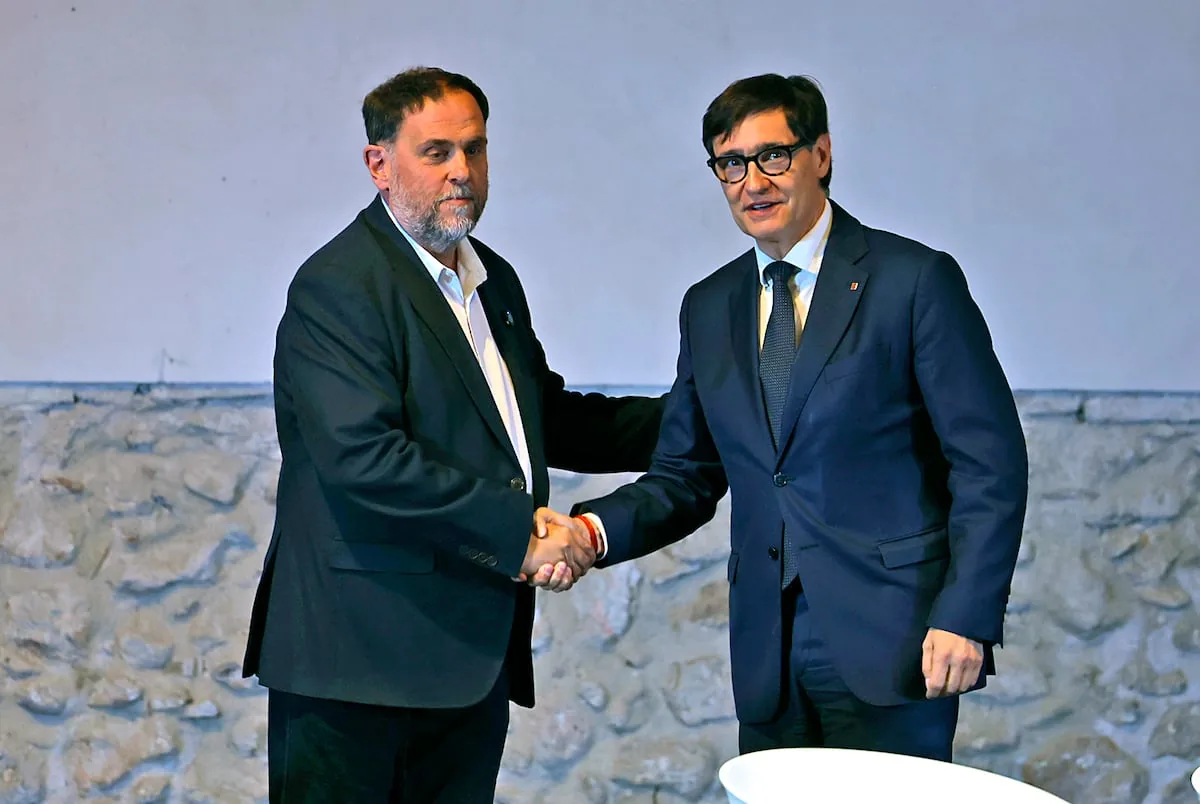
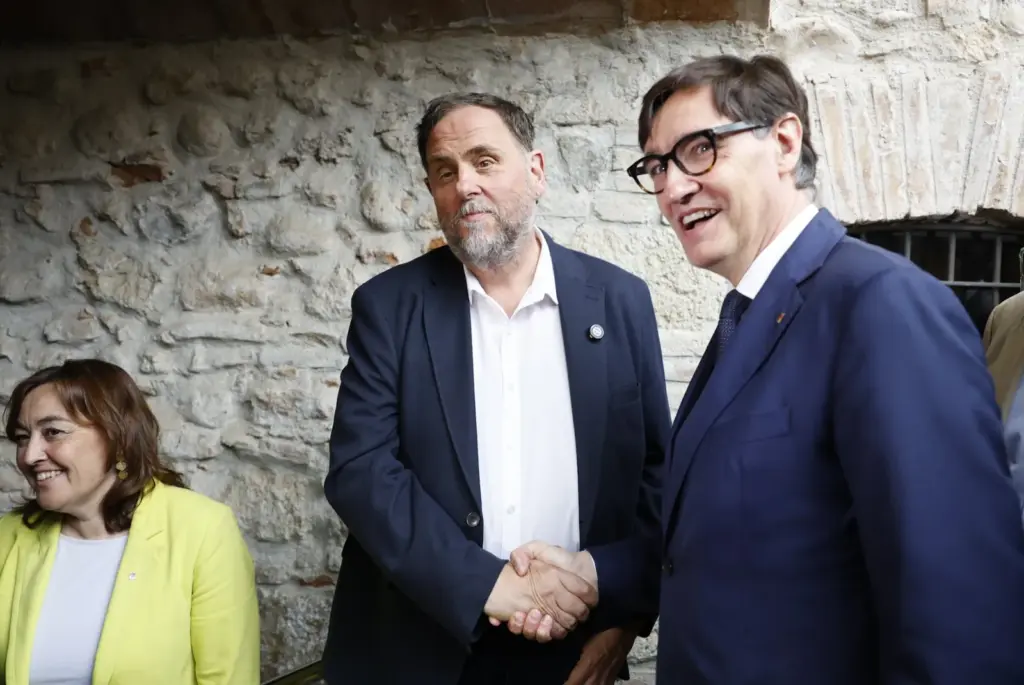
President Salvador Illa and the leader of Esquerra, Oriol Junqueras, staged their preliminary agreement to approve the budgets this Monday in Sant Sadurní d’Anoia (Barcelona), the first of the legislature that began in 2024. Awaiting validation by the ERC National Council this Monday, the two leaders showed their harmony in an event where they presented the “political boost,” according to the statement, of the Orbital Railway Line, the project on which the accounts will pivot instead of the IRPF revenue as ERC intended months ago. “It is a commitment to sustainable mobility,” Illa said, linking the project to housing policies. “I thank ERC for their sense of country,” the president emphasized this Monday, freshly arrived from California, in an eloquent message.
Both parties have been extremely cautious as the decision of the Republicans’ National Council is pending. Unless a major shift occurs, the republican body will approve the accounts, which will be the first of the socialist Government. Everything points to this being the case, or at least that is what ERC officials convey and the Catalan Executive trusts. Illa, in fact, also referred to the importance of the will to reach agreements. If nothing goes wrong, the final agreement will be presented this Tuesday and will involve the approval of the budgets after the failure of the project the Government promoted in February. Catalonia is now governed by the 2023 accounts.
During the event, held at the Cava Centre space, brochures with the railway project surrounding Barcelona were distributed, which will involve an estimated investment of 5.2 billion and will be completed in 2041. The distribution of these brochures shows that the agreement had already been made for some time. Socialist and republican leaders attended the project presentation, which marks a turning point in the legislature. The project will be ratified this Wednesday at the Bilateral Commission between the Government and the Generalitat held in Madrid.
Before an audience of about a hundred people, mostly PSC and ERC officials and mayors, Junqueras claimed the far-reaching project. “Planning is essential to guarantee the improvement of connectivity for an area of 3.5 million citizens,” Junqueras said, referring to that railway network. “More than a train line, it is the will to change the country model. We are committed to this with full conviction,” he assured.
With a calculated balance, four mayors from Barcelona’s second ring—two from ERC and two from PSC—praised the project because they believe it would benefit citizens’ quality of life. In the four-way dialogue, the republicans Aurora Carbonell (Sitges) and Isidre Pineda (Caldes de Montbui) and the socialists Francisco Romero (Vilafranca del Penedès) and Marta Farrés (Sabadell) participated. The Minister of Territory, Sílvia Paneque, emphasized that the orbital line does not detract from Rodalies investments, which suffered a colossal crisis earlier this year. “It is a qualitative leap,” Paneque insisted, pointing out that the axis “facilitates” internal connection and guarantees “shared prosperity” for Catalonia’s 8.5 million inhabitants.
The infrastructure, conceived more than two decades ago but never executed, has become one of the main files in the budget negotiation between socialists and republicans. Curiously, the project was not included in the investiture pact between PSC and ERC but was in the one signed by the commons, who have always claimed that Catalonia must be a country of trains.
The Orbital Railway Line proposes building a railway network of about 120 kilometers to connect Vilanova i la Geltrú and Mataró passing through Vilafranca del Penedès, Martorell, Terrassa, Sabadell, and Granollers without needing to enter Barcelona. The project foresees 68 kilometers of new construction and 40 stations—23 of them new. The line will be designed for maximum speeds of 120 kilometers per hour and an average speed of about 60 kilometers per hour, with a full journey of about two hours. Connection times between Terrassa and Mataró; and between Vilafranca and Sabadell, will be about 45 minutes. According to Government calculations, about 30 million annual passengers could benefit from the route, a figure similar to the current R1 and R2 Rodalies lines.
Read more The problem of truth in politics
Phase 0 (2027-2030. R8 reinforcement). The first phase focuses on operationally reinforcing the current R8 line between Granollers and Martorell, where the territory demands moving from one train per hour to two trains per hour. The project includes new interchanges to facilitate connections with FGC and other Rodalies lines. Adif has already completed the preliminary project, and the Government expects to have the construction project in about a year to start bidding for the works before the end of the decade.
Phase 1 (2028-2034. Granollers-Terrassa. 665 million investment). The second action proposes the first major structural leap of the orbital line directly connecting the two Vallès. The project includes a new 32-kilometer railway section between Santa Perpètua and Sabadell, five new stations, and new depots in Terrassa Oest. This phase is already included in the Rodalies Plan, and the Ministry has studies underway.
Phase 2 (Mataró-Granollers. 1,450M): The next major section would directly connect Maresme and Vallès through a new railway corridor of between 17 and 20 kilometers that will require significant tunnels and engineering works, which is why the Government considers it one of the most complex sections. The action includes 11 stations (6 newly created).
Phase 3 (Terrassa-Vilafranca. 1,150M). This phase would connect the orbital core with Baix Llobregat and Penedès through a corridor between Terrassa and Martorell that must be coordinated with the future Transversal Railway Axis. The project includes six new stations and would use part of the existing route to Vilafranca via the Mediterranean corridor.
Phase 4 (Vilafranca-Vilanova. 1,400M). The final phase would completely close the metropolitan railway ring with a new 29-kilometer section between Vilafranca and Vilanova i la Geltrú. The action includes six new stations
Read more Europol dismantles an online propaganda campaign by the Iranian Revolutionary Guard