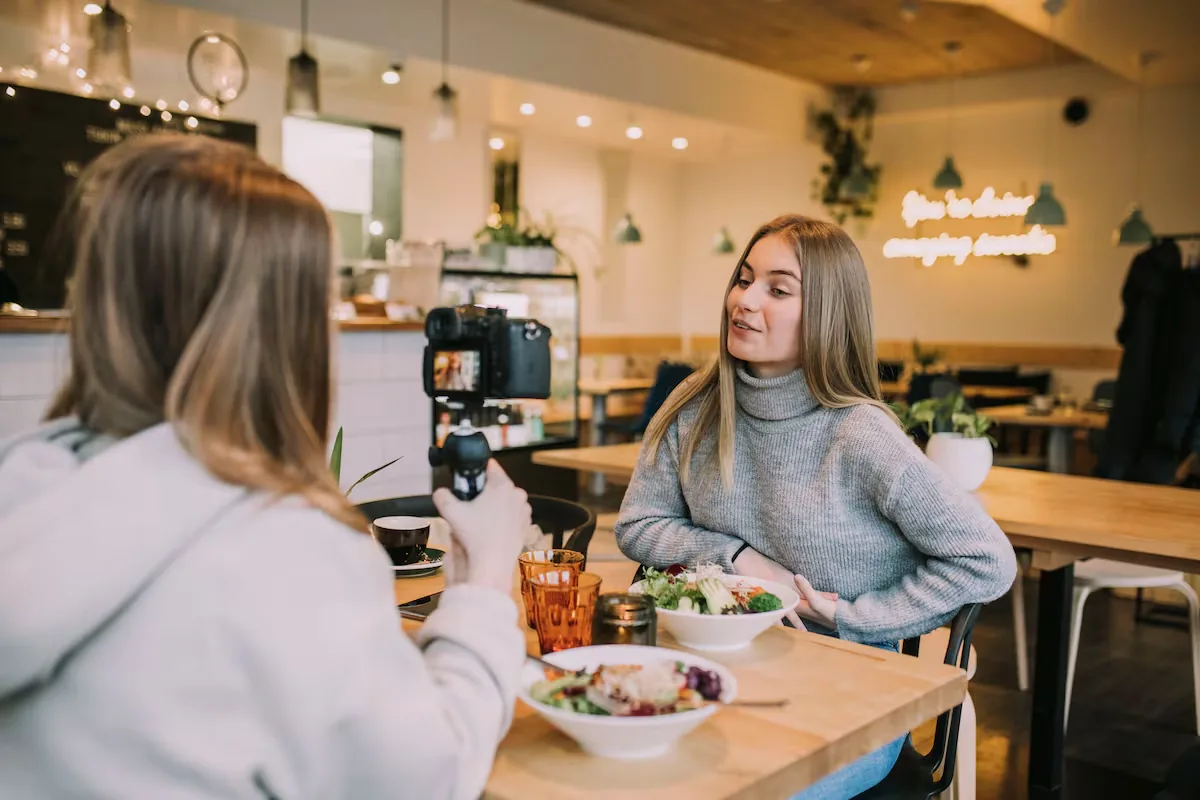
Gastronomic influencers are digital endorsers who often turn the culinary experience into a spectacle for social media. On the table, they set up spotlights, lights, and several phones mounted on stands; they narrate aloud, microphone in hand (the latest trend), each dish that arrives and chew in front of the camera while explaining sensations and flavors to their followers. What for some is an effective tool for promotion and advertising, for others represents a disruption of the atmosphere and a transformation of gastronomy into mere audiovisual content. They are figures who have gained great prominence in the last decade, due to the vast community of followers they have managed to create on networks like Instagram, TikTok, YouTube, or Facebook, capable of turning an unknown restaurant into a viral phenomenon overnight, without regard for its ephemeral nature.
And many are guilty, for this there is no legal penalty, of having fostered and fed some of the most surprising trends in the culinary scene: from shakes crowned with impossible mountains of whipped cream, cookies, and syrups to disproportionately sized hamburgers, overflowing with sauces and dressings; from dishes designed to be photographed before being tasted to the obsession, for example, with melted cheese cascading over any food. They have also contributed to imposing quantity over quality, elevating to the altars sheet-sized cachopos and other mammoth proposals where volume matters more than the product. Virality and spectacle over gastronomy.
See this post on InstagramA post shared by Guachinche Casa Aguere (@guachinchecasaaguere)
One of the recurring criticisms, and here, as almost always, the entire group ends up being lumped together, is the limited gastronomic training of many of these profiles. They may not distinguish a velouté from a béchamel, as their detractors claim, but no one can deny them an extraordinary ability to communicate. There are also doubts about their independence: invitations or financial compensation are part of the ecosystem, so it is not always entirely clear when one is facing a sincere opinion and when it is just a favor.
In recent days, several signs from establishments, some outside Spain, banning influencers have gone viral on social media. One of the most talked-about cases is that of the Tenerife-based Guachinche Casa Aguere. Another example is Pastifizzio, in Valladolid, a restaurant that will open on August 12 and which, even before opening, made its position clear on Instagram: “We have already received several proposals to come as guests in exchange for posting reels, stories, or reviews. We love that you want to come, get to know us, and share your experience. Really. But we believe a review has more value when it arises freely, without an invitation involved. That is why we do not exchange food for posts or opinions.”
The establishment’s managers add: “That does not mean we close the door to working with content creators. When we do, it will be within an agreed, transparent campaign clearly identified as advertising, not in exchange for a review. We prefer to earn every recommendation on the plate.”
The controversy has sparked debate: is it legal?
See this post on InstagramA post shared by Pastifizzio | Pasta Fresca en Valladolid (@pastifizzio)
“I was stunned when I saw all these photos. Signs like this are no longer isolated incidents but a trend that is starting to be seen in more restaurants inside and outside Spain. More and more restaurateurs are deciding to exercise their right of admission to limit or prohibit the entry of influencers,” wrote Mapi Hermida this week, the person behind the La Gastrónoma profile on social media. She argued that the main reason restaurants cite is the following: “Saturation of exchange proposals and the ‘everything free’ mentality, interruptions during service due to the use of spotlights or ring lights, and dishes cooling on the table while searching for the perfect shot, distorting the gastronomic experience. And let’s not fool ourselves, on many occasions we end up slowing down service, breaking the privacy of other customers, or disturbing neighboring tables just to get the best shots of the dishes.”
On the other hand, Hermida defended that part of the digital marketing sector considers content creators a key visibility tool for small venues that do not have budgets for traditional communication agencies. About customers, she added: “The most important ones increasingly get informed through these content creators, who seem like a reliable source to them.” And she ended with a lament: “As a journalist specialized in gastronomy, I see a very thin line here: what is considered an influencer?, how to ban them?, do we punish the innocent with the guilty?”
It is unknown if the innocent will pay for the guilty, but they are beginning to be unwelcome where until recently they were cheered and reserved the best table. Now they are greeted with a clear warning: here you come to eat, not to record content. “Personally, the word forbid seems very strong to me. Simply, each owner must know to whom they grant that influencer status. It is very relative who is said or considered as such,” Juanjo López Bedmar, creator of La Tasquita de Enfrente in Madrid, explains to EL PAÍS. He has on occasion expressed his opinion on this topic on social media and supports screening and analyzing who comes to his restaurant with those intentions. “You have to know if they are really a professional and if they will contribute something.” He also describes the widespread habit of hovering in the chair while tasting a dish as “an absolute vulgarity and lack of manners” and considers filming inside the dining room with a large deployment of equipment “horrible,” although he qualifies that “there are always situations and situations”: few diners, not peak service hours, or simply complying with one of the most basic rules of etiquette, asking for permission.
Read more Ayuso tries to erase the traces of the penthouse with a rushed sale and an unexpected construction
López Bedmar also believes there is saturation of this type of content creators: “For me, it’s crazy and I really don’t think it helps much. The message gets diluted and, above all, it becomes contradictory.” He is also clear about the lines he is not willing to cross: “To all who write to me asking for an invitation in exchange for a comment, I don’t reply.”
Conduct is regulated, not the person’s status
But can a restaurant really prohibit entry to a person who creates audiovisual content for social media? Lawyer Borja Adsuara, an expert in Digital Law, considers that it is not “legal to prohibit entry to influencers as a group, since there is no such card and, moreover, nowadays many users take photos or videos.” He explains that “it would be like prohibiting entry to journalists, for example, gastronomic ones.” He adds that such a measure “would go against Article 14 of the Constitution,” which enshrines the right to equality and non-discrimination. What an establishment can do, he clarifies, is “ask any diner who causes disturbances to others or disrupts the normal course of activity to leave,” for example, delaying service or hindering attention to other customers.
Adsuara emphasizes that public establishments, including those dedicated to catering, have the right of admission regulated by each autonomous community. For example, the Community of Madrid regulates it in art. 24.2 of the Law on Public Shows and Recreational Activities. The owners of the establishments, or their delegates, can exercise it, although it cannot be used to restrict access arbitrarily or discriminatorily, nor place the user in conditions of inferiority, defenselessness, or comparative grievance. This right aims to prevent access to people who behave violently, who may cause disturbances to the public, or who disrupt the normal course of activity. The conditions for its exercise must be displayed in a visible place at the entrance of the premises, establishment, or venue. The regulations also include prohibiting access to those wearing garments or symbols that incite violence, racism, or xenophobia.
See this post on InstagramA post shared by la_gastronoma (@la_gastronoma)
Entry can be prohibited to a person, but not simply for being an influencer, says Antonio Benítez Ostos, managing partner of Administrativando Abogados. “The owner of a public establishment carries out an activity protected by freedom of enterprise (Article 38 of the Constitution) and may reserve the right of admission; however, by opening their doors, they make an offer to the public, so refusal to a specific customer requires an objective and justified cause, not a whim,” he argues.
The expert adds that what can be regulated is conduct, not the person’s status. “Prohibiting filming, preventing the use of tripods, spotlights, or equipment that hinders service, requiring that other customers not be disturbed, or expelling those who break internal rules is perfectly lawful, provided those rules have been published beforehand.” However, he considers that “banning someone for being an influencer or as retaliation for a negative review is much more debatable.” He also recalls that Law 15/2022 on equal treatment includes conviction or opinion among the prohibited grounds for discrimination and closes the list with an open clause referring to any other personal or social condition or circumstance.
A different matter, he points out, is that the establishment decides to react to false or defamatory accusations. In that case, it is possible to defend its honor and professional reputation, a protection that the Constitutional Court also recognizes for legal entities. Benítez Ostos also clarifies that the person who materially exercises the right of admission cannot improvise their own criteria but must apply the conditions previously established and publicized by the owner. And he reminds that this right does not authorize the use of force. “If the customer refuses to leave the premises, the appropriate action is to seek assistance from the Security Forces and Corps. Acting by force can lead to liability for coercion or injury,” he maintains.
Regarding the possibility of filming in a restaurant and later sharing the images on social media, he explains that the restaurant is a private space for public use and its owner can prohibit or condition recordings as an internal rule, provided this has been duly communicated. “Filming is not a crime, but violating that rule may justify expulsion.” He also recalls that Organic Law 1/1982 considers the capture, reproduction, or publication of an identifiable person’s image without consent an unlawful intrusion. The exceptions provided by the regulations are limited and, in principle, do not cover the dissemination of images of anonymous customers during a meal.
In terms of data protection, he emphasizes that the image constitutes personal data and that the well-known domestic exception provided in the General Data Protection Regulation does not cover publication on social media when there is a professional or economic purpose. In those cases, the content creator acts as the data controller, with the obligations this entails before the Spanish Data Protection Agency. “In practice, the recommendation for the content creator is simple: ask permission from the establishment, frame shots avoiding third parties, blur faces when necessary, and if the content is advertising, identify it as commercial communication,” he summarizes. For its part, the restaurant should incorporate its recording policy into the admission conditions and communicate it at the time of booking.
Read more Abelardo de la Espriella swears in before the congressmen but gives his first speech to the military