








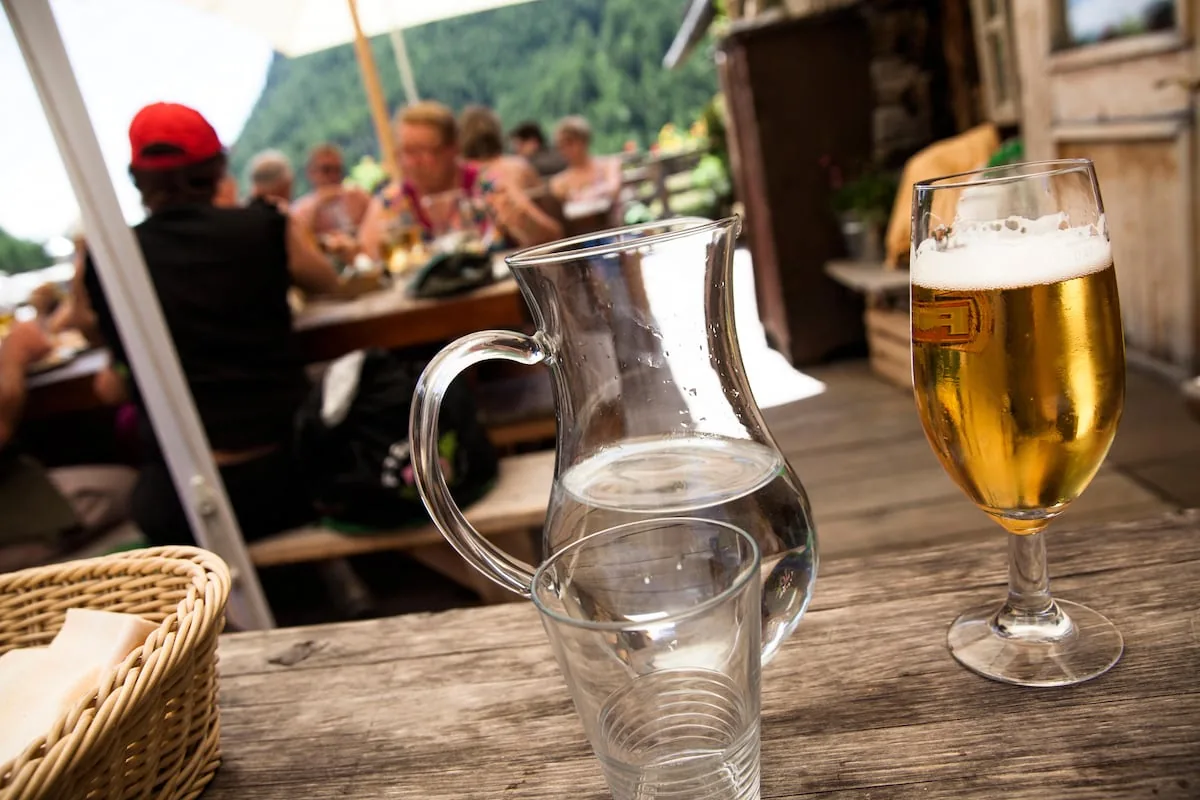
In Italy, the customer is not always right. Not even when their highest aspiration is to get a glass of tap water. According to the country’s Supreme Court, neither restaurants nor hotels are obliged to serve tap water to their customers. Not even when they are willing to pay for it. This is stated in a ruling that ends six years of legal battles in Italian courts by a tourist who, after staying at a five-star hotel in the Dolomites, was forced every day to consume bottles of mineral water costing seven euros each. Despite repeatedly requesting to be served tap water, the hotel refused.
Read more A new genetic clock opens the door to measuring biological aging and mortality
The tourist, whose identity is unknown, sued the Sassongher hotel in Corvara in 2019 and requested compensation of 2,763 euros for the expenses incurred and the damage suffered. The appeal filed before a court of first instance was based on the fact that water “is a natural good and a universal human right of every individual,” according to the newspaper Il Post.
The complainant argued that she had the right to “a minimum vital amount necessary” to meet her basic needs. In her appeal, she maintained that “anyone staying in a hotel establishment, regardless of their social class, legitimately expects to be able to drink tap water during meals, just as they take for granted finding a bed with sheets, a warm room, or soap.”
However, despite the European Union directive urging member countries to “promote” ―not to oblige― the use of tap water in restaurants, dining rooms, and catering services free of charge or at a moderate price, two Italian courts sided with the hotel. Ultimately, the Supreme Court confirmed this with a final ruling. The legal text states that, since there are no laws obliging restaurateurs to offer tap water, the decision to serve it lies with each establishment.
Two conflicting realities
Beyond the exorbitant price paid for the bottles ―which is not surprising, given that it is a luxury hotel in one of the most sought-after locations in the Alps― the visitor’s complaint highlights two conflicting realities: on one hand, the Italian society’s habit of consuming bottled water and, on the other, the scant efforts made by successive Italian governments to raise awareness among the population and restaurateurs about the benefits of consuming tap water in the context of the climate crisis.
In other European countries, such as Spain, the context is quite different. In 2022, a law was passed requiring restaurants and hotels to “always offer consumers (…) the possibility of consuming non-bottled water free of charge and as a complement.” In France, water is free and served obligatorily; you don’t even have to ask for it.
European directives require member states to achieve this result ―tap water served at no cost― but leave each capital the choice of how and by what means to achieve it. In Italy’s case, the third country in the world in bottled water consumption after Mexico and Thailand ―with 252 liters per person per year, according to the Mineral Waters Yearbook published by the transalpine portal Beverfood― replacing bottles with tap water can be a laborious task.
For decades, sitting at a table in an Italian restaurant has meant ordering “una e una” (a bottle of sparkling mineral water and one still). A widespread ritual among Italian consumers, which only very well-traveled consumers have begun to complain about. The habit of ordering sparkling water is very widespread: almost 20% of the population consumes it.
Filtered water
In Italy, very few restaurateurs are willing to offer tap water. In recent years, the possibility of obtaining filtered water has also spread. You also have to pay for it, but its price (between 1.5 and two euros) is usually lower than that of bottled mineral water.
The tourist who sued the hotel in question probably did not have financial problems, as she spent several days in an establishment where she paid 5,700 euros on a half-board basis. But she must have had an ecological awareness increasingly popular among consumers worldwide, who see no sense in consuming bottled water in countries where ―as in most of Europe― you can open the tap and drink.
The ruling has sparked a broad debate in the sector and has received some criticism, such as that of lawyer Paolo Martinello, professor of consumer protection at the IULM University of Milan. In an interview with the specialized media Il Fatto Alimentare, he asked: “Why, in a tourist-oriented country like Italy, do medieval levies like the cover charge in restaurants still survive? Hoteliers are willing to boast sustainable behaviors, offering ‘zero-kilometer’ dishes at high prices, but then refuse to serve tap water. A true paradox.”
With his words, Martinello refers to the custom of restaurants charging between two and four euros for the “coperto” (cover charge), which is actually like charging for placing the plate, spoon, knife, fork, and a glass on the table. Not even bread is included, and of course, neither is water.