







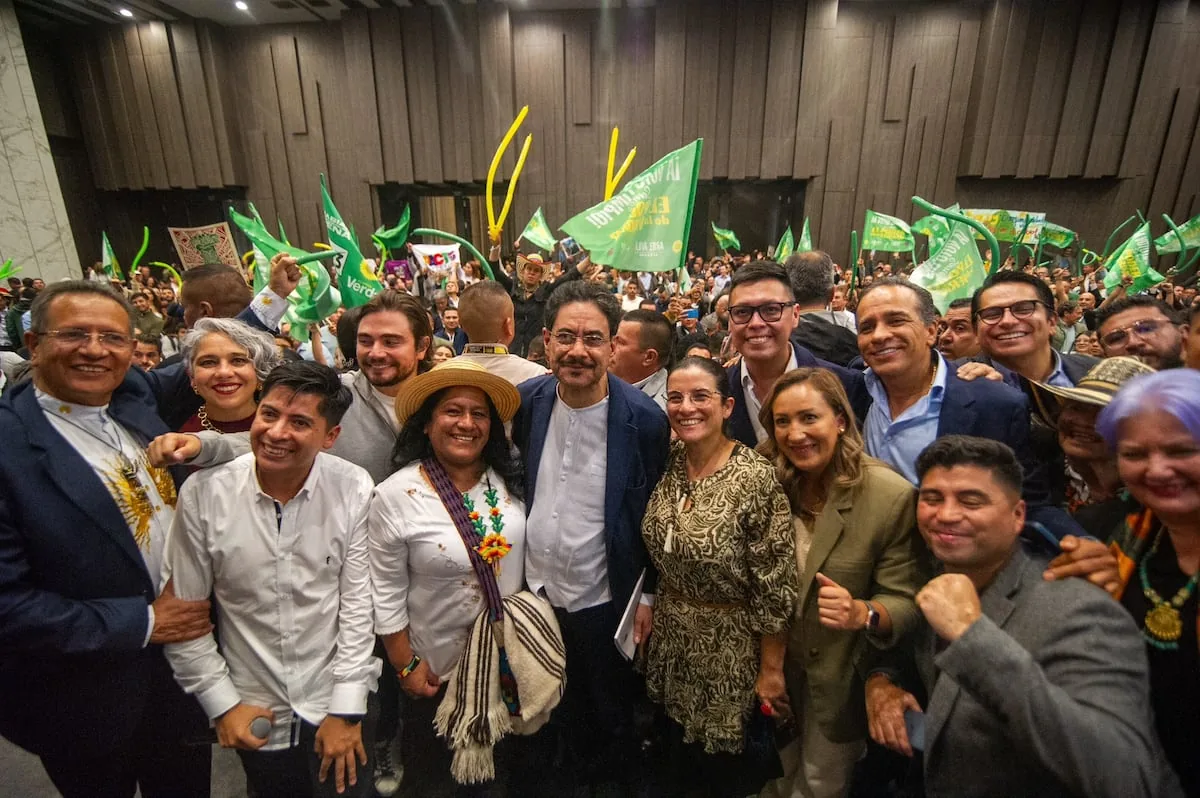
The Colombian left doubles down on its bet to seal alliances with like-minded sectors, but different from the official Historic Pact. The Green Alliance, the fragmented party that was once a reference for the political center, is preparing its arrival to the presidential campaign of Senator Iván Cepeda, the favorite in the polls to succeed Gustavo Petro. Awaiting to finalize a programmatic agreement, the national leadership of the group to which Antanas Mockus or Claudia López once belonged – who is still in the presidential race – has decided to prioritize alignment with the government’s social reforms, above the corruption scandals that are questioned from within its own ranks.
Read more Cheese, chocolate, or meat: the 5 best-rated fondues on Amazon to succeed at home
The decision by the national leadership to open that dialogue, heavily criticized by dissenters, does not imply immediate adherence, like the one already formalized a few days ago by Green Senator Ariel Ávila. There will be a commission responsible for building a programmatic agreement with Cepeda’s campaign, and that agreement implies recognizing the Greens’ proposals, Rodrigo Romero, one of the party’s three co-presidents, has assured. In that purpose, the initiative to convene a Constituent Assembly to change the 1991 political charter emerges as an obstacle, an idea Petro has insisted on but faces enormous resistance from different sides. “For the Green Party that is not viable, the Green does not support a Constituent Assembly,” Romero has warned.
“The only issue that generates distrust in large sectors of the Green Party is the Constituent Assembly. On everything else, there is total agreement,” confirms Senator Ávila in a phone conversation. “The left has already hit its ceiling, the only thing it can do is grow towards the center, center-left. It needs seven, eight, or even ten points. I believe the center does not want to return to the past with Uribism, and what it needs are certainties: economic, social, and political certainties. No fiscal adventures nor Constituent Assembly,” he elaborates in his diagnosis. Following Cepeda in the polls are two right-wing candidates: also Senator Paloma Valencia, from the Democratic Center, the party founded by former President Álvaro Uribe, and the ultra Abelardo de la Espriella, who exchange second place.
The Greens’ path is similar to the agreement Cepeda sealed last month with former liberal-origin minister Juan Fernando Cristo and his party En Marcha, the first gesture of openness with the purpose of convening a broader electoral coalition for the first round on May 31, which they have named the Alliance for Life. Then, despite his support, Cristo warned that it is necessary to correct the course of those policies that did not have the expected results. An example is the worn-out total peace, which proposed negotiating simultaneously with all armed groups. He also called the idea of convening a Constituent Assembly “inconvenient” and “untimely.”
“We do not blindly believe we are winners by locking ourselves in our political universe. We will seek the necessary alliances. We are building them,” Cepeda defended last month in an interview with EL PAÍS, one of the few he has granted in a campaign in which he has attended few debate spaces to prioritize speeches in public squares. His strategy involves allying with other political forces, including the Greens and some sectors of dissident liberalism. “I am not a staunch supporter of the Constituent Assembly. It is a possibility, but for me what is required is a dialogue that leads us to a national agreement that may include constitutional reforms on its path,” he conceded then.
Read more Why Literary Travels Are Thriving (and the Best Ones You Can Take This Year)
Amid irreconcilable differences, several trends survive within the Greens, including that of Carlos Amaya, the governor of Boyacá, who currently prevails as the majority – and is an ally of Petro, despite having leaned towards Rodolfo Hernández in the runoff four years ago. There is also a more progressive, center-left one, to which Senator Ávila belongs, and even some sectors close to the right, like that of Senator Jota Pe Hernández, who have already taken the first steps to seek a split. The party, despite its nuances, traditionally defended causes such as the environment, education, and peace. Also the fight against corruption, but that banner faded due to the scandal of the National Unit for Disaster Risk Management, which implicated several Green leaders, including Carlos Ramón González, a fugitive from Colombian justice, and led both Mockus and López to resign from the party.
The negotiation with the Greens corresponds to a new phase of Cepeda’s campaign, which comes after he designated Senator Aida Quilcué, also from the Historic Pact, as his running mate. Although that decision strengthened his party’s ties with the indigenous movement, it also missed the opportunity to court other sectors necessary to reach the majorities any candidate needs in a runoff – or to win in the first round, as the Pact proposes.
Senator María José Pizarro, his campaign chief, celebrated the Green Party’s majority decision. “We are building bridges, a series of endorsements have already arrived, accompanied by programmatic agreements, this implies that all the agreements we build for this second progressive government will also be agreements on the table, facing the people, because it is about also changing the political culture of our country,” she said this week in a debate on the program Hora 20, from Caracol Radio, in alliance with EL PAÍS. “We will start as soon as possible, including the construction of agreements with the Green Alliance party, so that they are agreements we can present on the table and guarantee what will be the second progressive government,” she reiterated.
Read more The LED light letters that are replacing garlands and balloons at parties