







The director of EL PAÍS, Jan Martínez Ahrens, gave a speech this Friday at the Festival of Ideas focused on freedom of the press in Latin America at a time when distrust in democracy and violence persist in the region. “Journalism can only live in democratic conditions, in societies that admit criticism and denunciation and that do not fear the disparity of opinions,” he said at the beginning of his intervention at the forum organized by PRISA Media, the publishing company of the newspaper.
Read more Crisis in Ceuta and current politics
Martínez Ahrens framed his words in the moment when the newspaper, which is celebrating its 50th anniversary, established itself as a defender of freedom of the press: “The night of February 23, 1981, when Spain suffered an attempted coup d’état and tanks were on the street, EL PAÍS decided to come out in defense of the Constitution. It was the only one to do so. That night, journalism, freedom of the press, and democracy joined hands.”
The safeguarding of freedom of the press is a challenge that remains very present in Latin America, Martínez Ahrens recalled. A clear example is Nicaragua, which under the dictatorship of Daniel Ortega, prevents free journalism and persecutes journalists, pushing many into exile. “Journalism is such when it tells the truth, not when it serves deception, disguises data, offers parallel realities to the liking of the politician or the prejudices of certain audiences. The journalist’s commitment is to the facts, even if they clash with their ideology,” he emphasized.
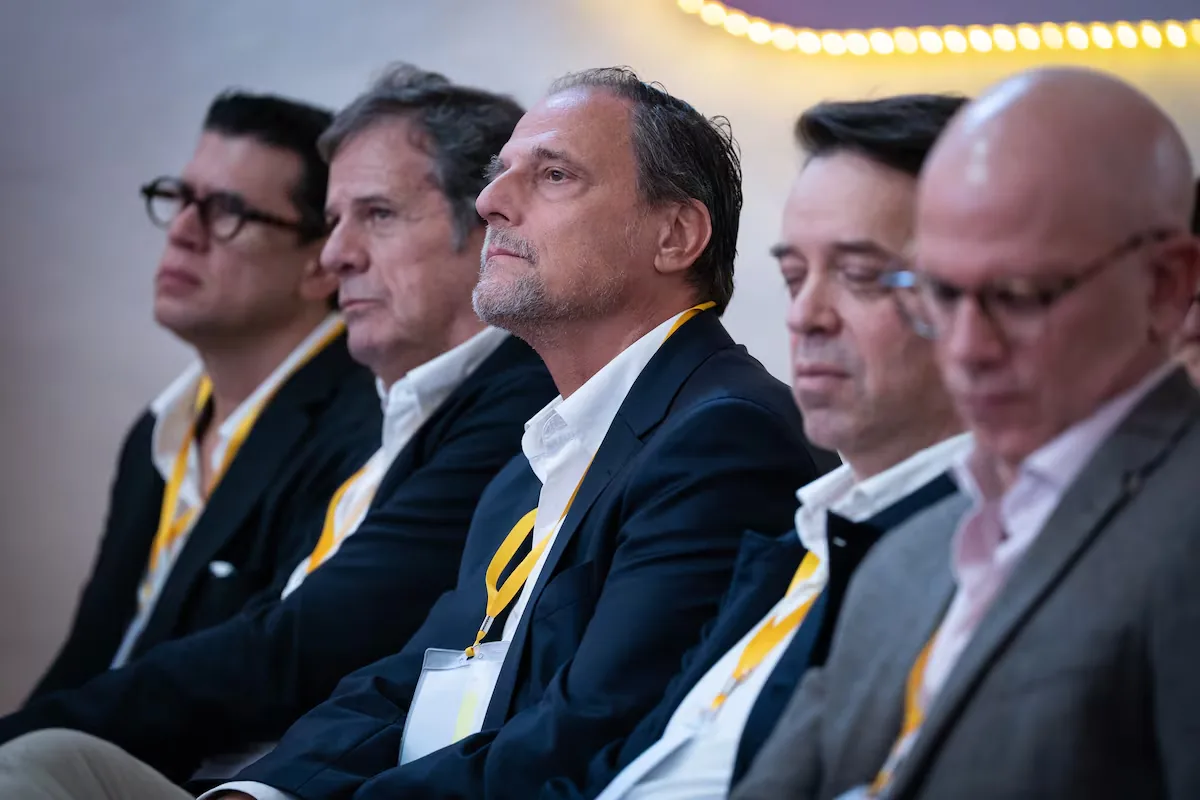
The newspaper director spoke before an audience of nearly 400 people, including politicians, academics, figures from the private sector, and civil society, who attended the sixth edition of the Festival of Ideas. His was one of the 13 moments on the agenda, among debates and conferences, revolving around the new stage the region is experiencing and, more specifically, Colombia, which renewed its government a month ago and faces major economic, political, and social challenges.
“Violence is a scourge that exposes the enormous vulnerability of our work. And also the deficiencies of a country. Where journalists are killed, the state falters and usually the judicial and police apparatus fails,” Martínez Ahrens stated.
Read more Salazar receives attacks from MAGA and criticism in Miami after his break with Trump
As an example, he cited figures of journalist murders: in Colombia there are 171, with an impunity rate close to 80%. In the case of Mexico, the figure rises to 174 since 2000, with 98% impunity. But the problem is not limited to homicides, Martínez Ahrens says. Violence “has many forms and is exercised not only against the journalist but often against the publishing company, with more sophisticated methods.”
The director of EL PAÍS points out that journalism is living a contradictory moment: while it enjoys a huge audience and global and diverse reach, it faces discredit like never before. “We live, ultimately, a revolution that left many media behind. Others believed they could save themselves with clickbait, became slaves to junk information and to an algorithm whose rules they did not even know well. And they confused the click with the reading.” That mistake, he added, has been decisive for the discredit of the media as a whole and even more so in the face of great disinformation.
The director concluded his speech referring to “the most challenging challenge and whose outcome we do not know”: Artificial Intelligence. On the one hand, he highlighted it as a “tool” to help journalists in reporting tasks, for example to contrast or analyze databases, but warned that, if misused, it can serve deception and confusion. “We are in another revolution and, from the previous one, we have learned a lesson: we cannot abandon our values and repeat the error of clickbait and junk information.”
“Journalists always live in the surf, but now we are going to face bigger waves. And it is the moment when we are more obliged than ever to do our work. On our side, we have our readers, the best of civil society, and our profession. In a world as turbulent as the current one, we cannot remain silent. Silence is defeat,” he concluded.
Read more National Drill of September 19: a key guide to prepare it at home