







The Chilean literary editor and journalist also publishes Huracán, a novel whose eponymous protagonist is a greyhound through whose eyes readers glimpse the world he had to live in
“He was brave and, at the same time, sensible; canine, yes, but at the same time extremely sensitive to human emotions.”
Thus, with some distance, Flush is described, the cocker spaniel dog who stars in the eponymous book by Virginia Woolf published in 1933. Since then and until today, perhaps more than ever before, animals have been the subject of literary and philosophical scrutiny: how to understand them, how to think about them, how not to believe ourselves superior or better than them.
One who knows about that scrutiny is editor and journalist Javier Rodríguez, who in 2024 published the short story volume Not Everything That Flies Is a Bird, where he invited readers to “lift their gaze from the ground – or from their own navel – and look around, not as a superior observer, but as part of the same living fabric made up of animals, plants, the wind.”
Now, through the Spanish label AdN, he presents his second novel, Huracán, which bears the name of a black greyhound with a white patch on its chest. An animal whose infamous owner profits from its speed on a racetrack in the town of Paine (near the Chilean capital) and who, going further than Flush, directly urges the reader to look at the world through his eyes, to feel it with his senses:
“I woke up dead thirsty and with someone sniffing my butt. I froze, thinking it could be one of the dogs from the night before. My throat dry, hard as a dusty carpet.”
Not the entire novel is narrated by the animal, who when writing does so with capitals if it concerns the essentials (Thirst, Water, Food). Not all, but a good part, more than enough to remind us through the mouth of a doctor that “we are all animals” and, in the voice of the mentioned Huracán, that there are humans less infamous than the owner he fled from, but who are “wolves in sheep’s clothing.” Another, a young man confronted with this “little greyhound of the little ones,” celebrates a supposed “new law” that will ban greyhound racing (the project exists, but Chilean deputies did not manage to vote on it in the parliamentary period that ended on March 11).
As an animal rights citizen with environmental concerns, Rodríguez rejects bullfighting, zoos, and certainly greyhound racing. But as a writer – and as the journalist who once traveled “unwillingly” on a bus with Pinochet supporters commemorating the dictator’s death – he could do no less than attend and get to know the world revolving around them and thus feed the fiction, for further depth in the lands of José Antonio Kast.
What is not fiction, or not entirely, is the image that appears when 30 of the 196 pages of the novel remain: a photo under which it reads, “Little greyhound wandering around the Aculeo area. Friendly. Urgently needs temporary or permanent home.”
Read more You don’t have to swallow toads and snakes
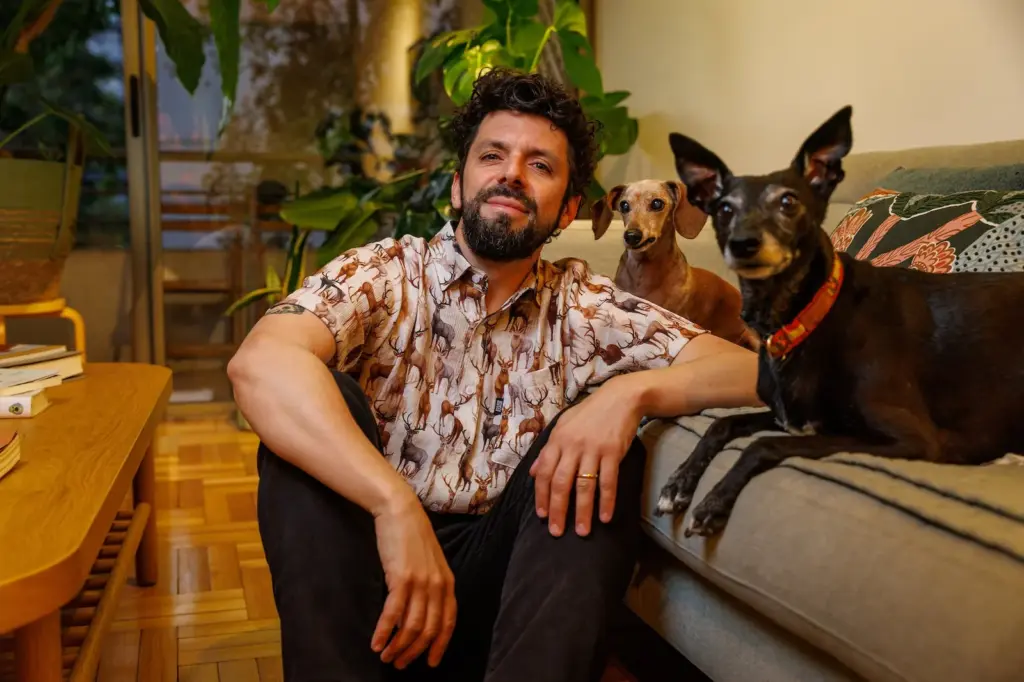
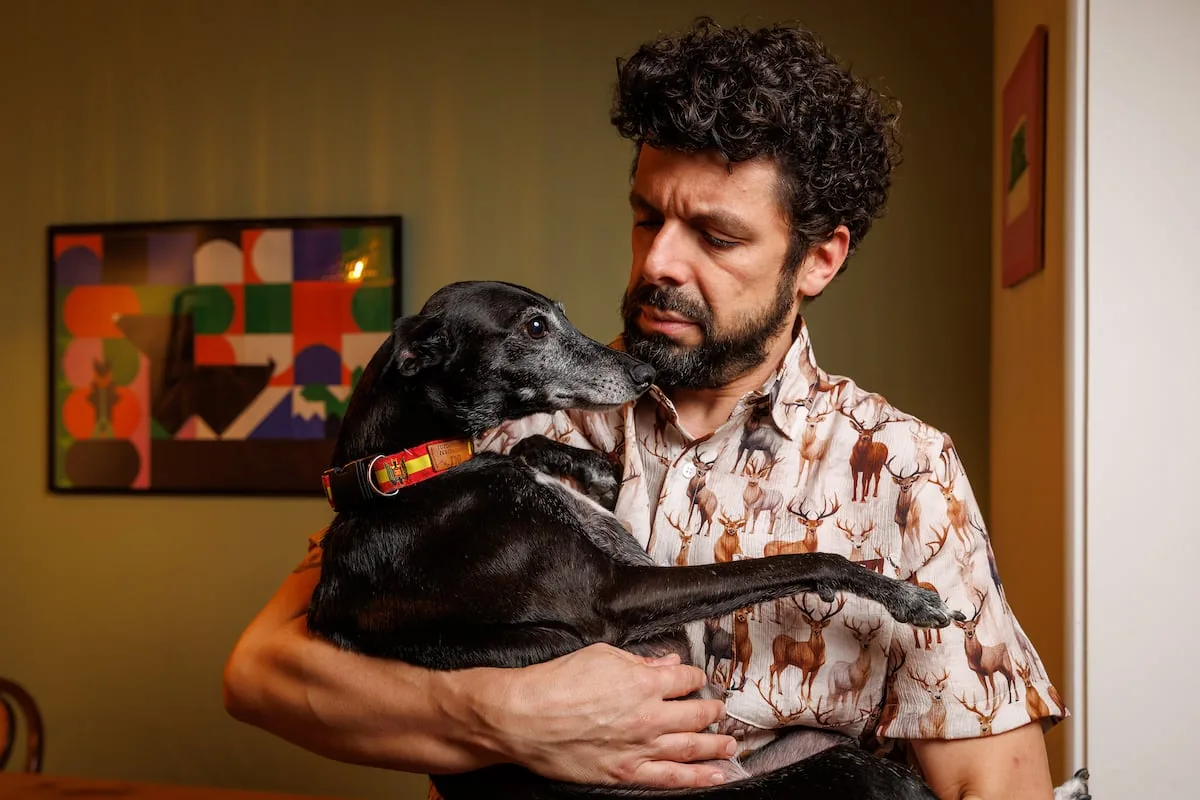
If you follow the fiction, the photographed dog is Huracán, the dog taken from his owner who is loose around there. But in reality, the photographed dog is named Olimpia, a greyhound mix who is six years old, was rescued from a breeder, and who a few days ago welcomed EL PAÍS into Rodríguez’s apartment, where Pina, a rather older dachshund, also lives.
On the third floor of Ricardo Lyon street, in the Providencia district of the capital, the author poses for the camera alongside Pina and Olimpia, and then stops to talk, among other things, about the paradoxes of a writing that wants to challenge anthropocentrism. About “the necessity and, at the same time, the impossibility of writing from the experience of an animal.”
Because entering that territory, the author thinks, “also implies touching something uncomfortable: the continuity between the violence exercised on animals and that exercised among humans themselves. Not as an easy equivalence, but as a contact zone that literature can explore without fully resolving.” And since science has not yet fully accounted for the animal mind, “art remains the most suitable space to imagine that alien experience, to try out forms of perception that are not ours.” All, with the understanding that “there is a political issue in putting a novel in the voice of a dog, precisely because I want to put the point of view there: I wanted to show what life is like for those dogs and believed that, stylistically, it could be an interesting challenge.” Assuming, of course, “the contradictions and finitude of my tools.”
Dressed in a short-sleeved shirt with reindeer motifs, surrounded by various indoor plants, Rodríguez dwells on “questioning anthropocentrism.” But not, it seems, to fall into antispeciesism or equalitarianism at all costs, but to see if it is possible to modify customs, especially some as rooted in Chile as rodeo: declared the national sport by Augusto Pinochet, it involves cruelty and suffering to the cattle that participate in it, according to sustained accusations by animal rights organizations, but is defended by the country’s new president, who at the end of March appeared at the Medialuna Monumental in the city of Rancagua on the occasion of the 77th National Rodeo Championship.
“I’m not saying that humans and non-humans are all equal, that we have the same rights, but I strongly believe in Peter Singer’s concept of equal consideration of interests,” he adds. “If an animal is sentient, it deserves the same consideration, and not for my benefit am I going to eat a cow, for example.”
Therefore, “when President Kast goes to the rodeo, he is validating an expression that may have roots, cultural weight, but there I don’t get lost and return to equal consideration: the animal suffers and so, for me, all this tradition, all this cultural matter, makes no sense when another being is suffering and the spectacle is precisely its suffering.”
Having said that, he confides that he has been a vegetarian for about four months and started doing so, not for a benefit to his body, but as “an ideological decision in the proper sense of the word.” However, he clarifies that militant veganism or vegetarianism does not suit him well: “It’s like a sign of the times, something that doesn’t allow you to converse.”
Finally, and to make a point, he quotes from memory something he heard former Environment Minister Marcelo Mena say: that Gabriel Boric’s government had “made a mistake in making environmentalism and animalism identity issues, when they should be issues for everyone.” We can question the categories, he says, “but we have to enter into a discussion. In the end, this cannot be a topic where you take sides as progressive or conservative.”