







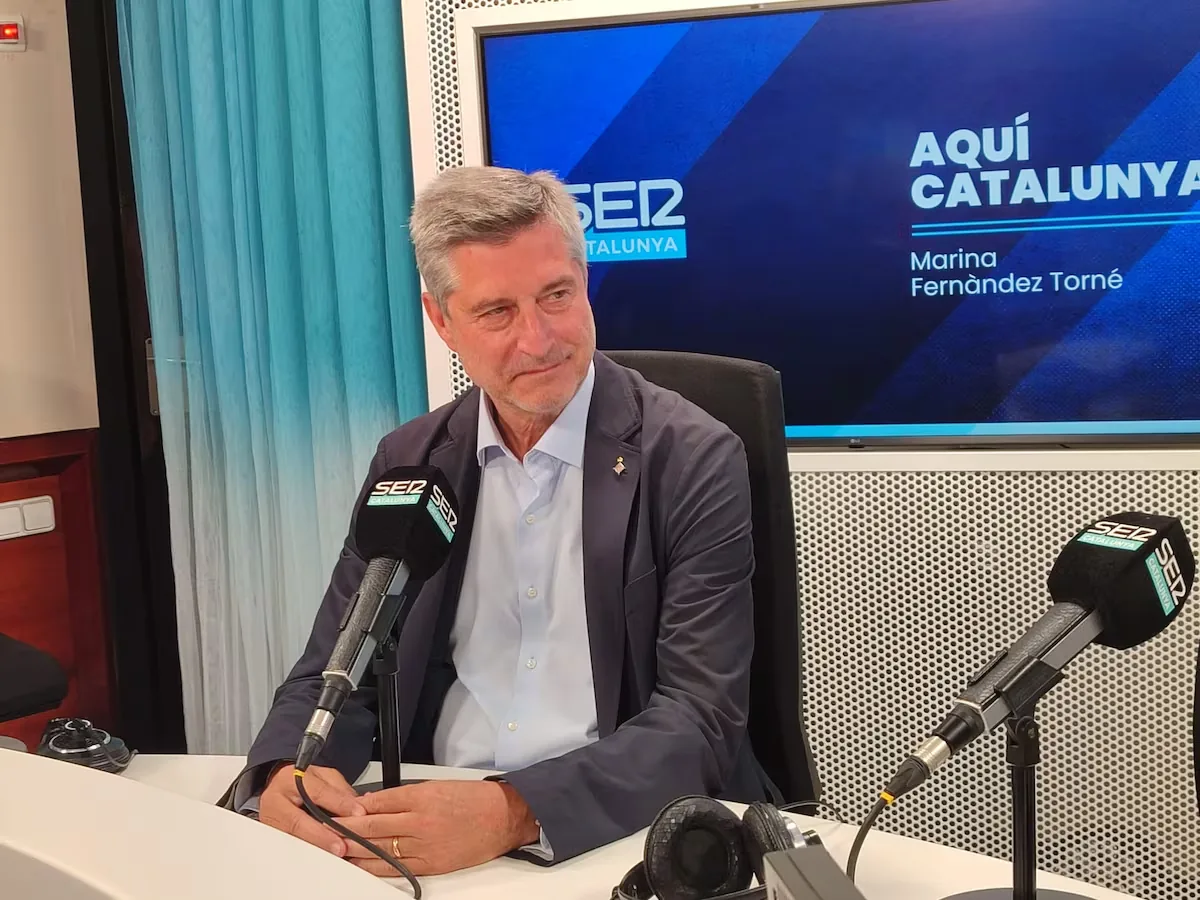
Junts per Barcelona begins this Monday the process for the party’s candidates for the mayoralty of Barcelona to submit their candidacy. In this context, the current leader in the City Council, Jordi Martí Galbis, defends in an interview on the program Aquí Catalunya the plurality of candidates and asks to focus the debate on the projects rather than the names. “I am delighted with the candidates we have and to celebrate this democratic process,” he points out, while admitting that until the last moment it will not be known if more interested parties may appear. Regarding the internal situation, he rejects the idea of a single officialist profile and emphasizes that they are all “well-known people, by the party and by a large part of the citizenry.” He adds: “We must transcend the labels. We will have time to explain our projects.”
Read more Dozens dead after an explosives depot explodes in Myanmar
Martí also claims the support of former mayor Xavier Trias, whom he defines as a key political asset: “I am very happy that he has given his support to the candidacy,” although he adds that “support has to be earned, nothing is given away.” Asked if his project will be a continuation of Trias, Martí responds that the goal is to “revalidate this victory” and recalls that he was part of that project at the time: “I have been an important part of Trias’s government and his 2023 electoral victory, therefore, I want to maintain and update all these assets.”
Regarding the current management of Mayor Jaume Collboni, he is critical of the socialists’ idea of “ordering” the city, seeing it as “deceptive.” He believes that making a real change “is impossible with these bases,” referring to the government depending on pacts with comunes and ERC. In his general diagnosis, he assures that Barcelona “has gotten worse” in issues such as housing or security. “Access to housing with very high prices… we are worse off than a few years ago,” he maintains. On security matters, he adds that “every day we see news about extremely serious incidents.”
The flag against insecurity
Regarding the rise of the far right and Aliança Catalana, Martí avoids speculating about pacts and meeting points, but responds firmly to the idea that they could appropriate the security discourse: “If anyone in recent years has taken up the serious and responsible flag against insecurity, it is Jordi Martí,” he states, referring to his party.
He also rules out entering into hypotheses of pacts: “Each thing in its time,” although he also maintains that in politics “almost everything can be discussed” and that pacts exist “so that both parties come out winning.” Martí assures that, for now, Aliança Catalana is an “unknown” in the Catalan capital and minimizes its political implantation. “We don’t have them in Barcelona. At this moment they are not in the City Council nor do I see them much, beyond four stalls they put on the street,” he states. The leader assures that he does not see them “working for Barcelona by making proposals like Junts.”
Regarding possible government agreements, even with the PSC, he assures that “it is something that has to be discussed” and he is not closed to anything. He does not cite any concrete example of a red line, only maintaining that from Junts’ ranks they will not accept “anti-democratic approaches,” because according to the candidate: “we are and will be the party of the ballot boxes.” Asked where independence stands in his city project, he places it as an irrenounceable horizon, although he admits that the municipal campaign will focus mainly on Barcelona’s everyday problems, such as housing or security.