








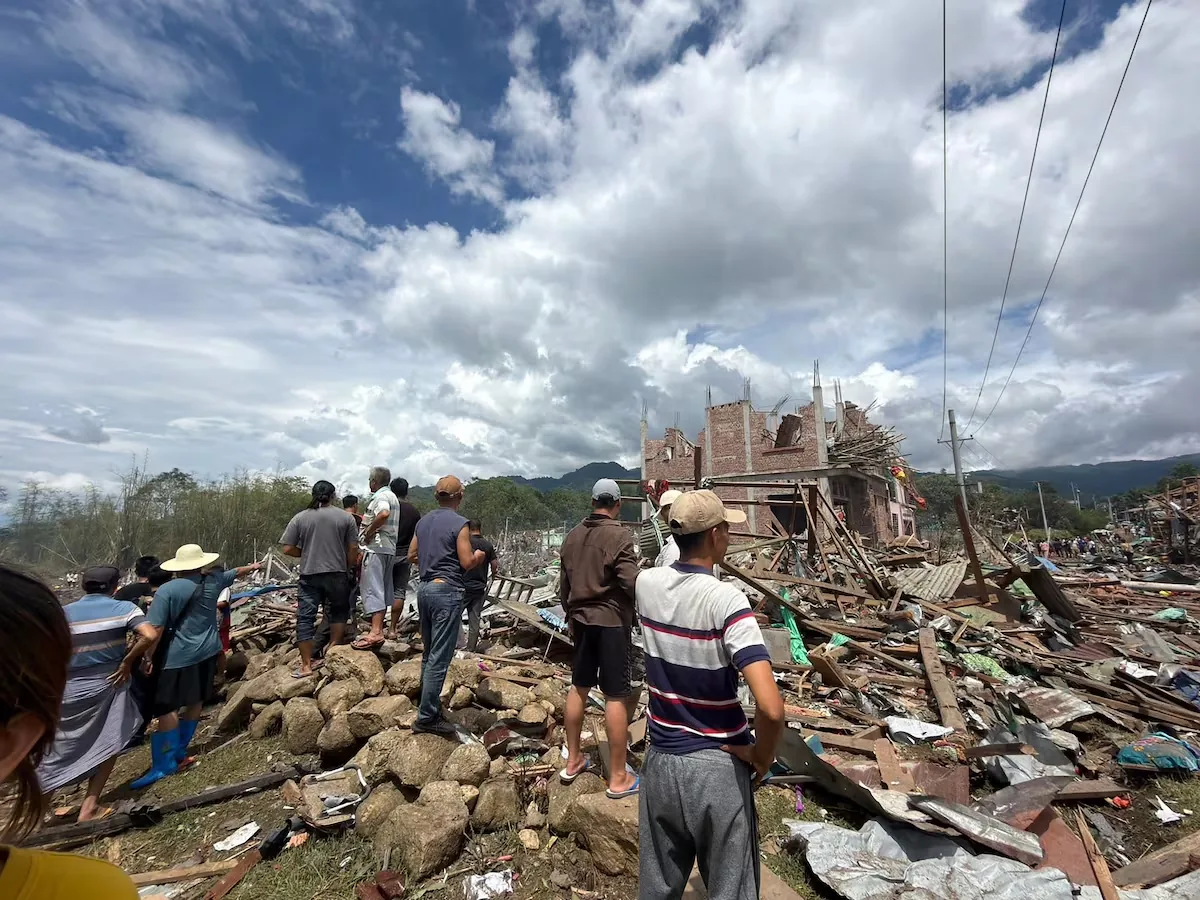
A powerful detonation in an explosives depot has left dozens dead and injured in the Burmese town of Kaung Tat, located in Shan State, in northeastern Myanmar (formerly Burma). Local media had reported on Monday morning that at least 55 people had died in the explosion, which occurred on Sunday, but the Ta’ang National Liberation Army (TNLA), the guerrilla group controlling the area, provided an initial official count in the afternoon placing the death toll at 39 and the number of injured at 75. Their data is based, according to spokesperson Lway Yay Oo, on a hospital tally.
The armed group, one of the most powerful in the country and currently maintaining a ceasefire with the Burmese army, had previously acknowledged storing explosives in Kaung Tat intended “for mining operations.” “We deeply regret this accident, which has resulted in the tragic loss of lives and immense devastation,” the TNLA said on Sunday. The organization has launched an investigation to determine how the explosion occurred and noted that more than 200 homes have been damaged.
The local agency Shwe Phee Myay, however, had previously reported, citing emergency personnel, that the death toll was 55: 25 women and 30 men. The hospital in the nearest city, Namhkam, has warned of a shortage of blood supplies to treat the injured.
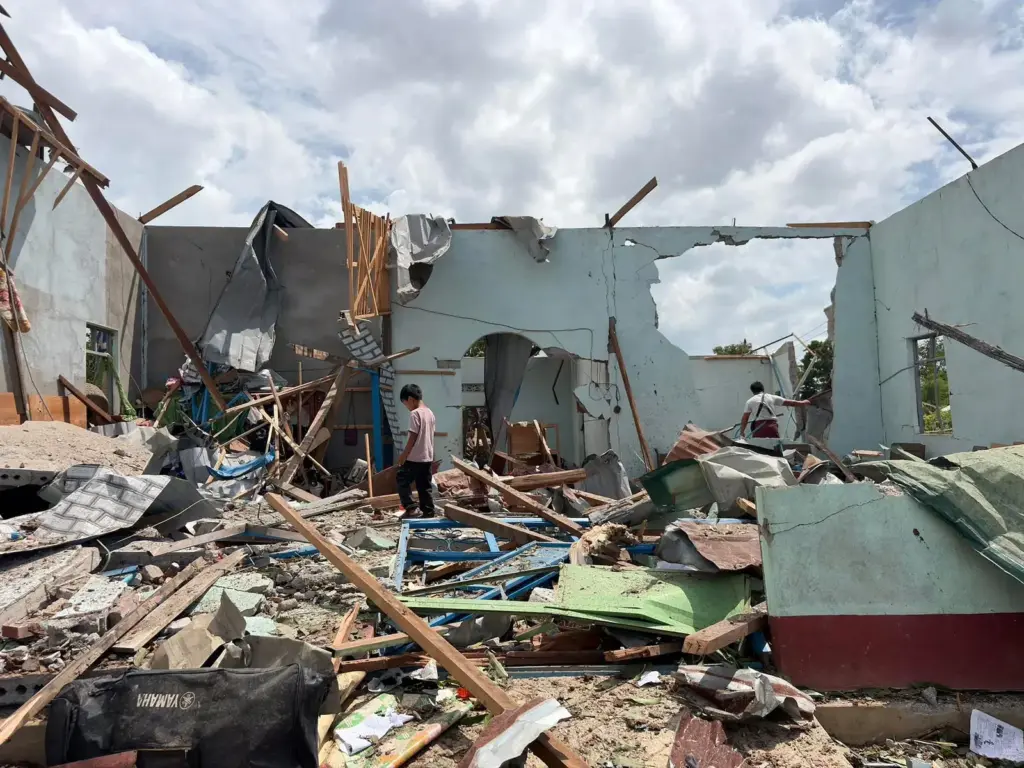
The TNLA explained that its economic department had stored gelignite in Kaung Tat, an explosive commonly used for mining blasts and quarry work. Although the use of this type of dynamite is common, the explosive can become very unstable over time if not stored properly. In its statement, the organization assured it will investigate what happened, hold those responsible accountable, and provide assistance, medical care, and support for the rehabilitation of those affected.
Kaung Tat is located in a particularly sensitive area due to its proximity to China. It is a strategic strip, marked for years by fighting between the Burmese army and ethnic guerrillas, where the civil war has intertwined with the dispute over control of trade routes and mining operations.
Former Burma has large mineral reserves, such as rare earths, jade, and other metals, which have become an important source of income both for the military-backed government and for various armed groups. In many areas under ethnic militia control, mining—often with little regulation and limited safety measures—supports part of their economic and military structures.
“Everything has been completely destroyed, unrecognizable,” a neighbor identified as Moe Z. told Reuters, who was about 2.4 kilometers from the site of the detonation. Moe saw a mushroom-shaped column of smoke rise over the village, which at first made him think it was an airstrike, a tactic the military junta has recurrently used since the 2021 coup.
A neighbor who lost her home summarized the randomness of the tragedy on social media: “My phone saved my life,” she wrote in a post picked up by the BBC. “I was sitting in my room eating noodles and looking at the screen. If I had been in the kitchen, I probably wouldn’t be alive.”
What came next, she describes, was a horror movie in which people screamed and searched for their relatives. “It felt like the world was ending,” she recounts. The woman, who suffered a minor leg injury, questions why explosives were stored so close to a residential area.
The TNLA, linked to the Palaung ethnicity, is part of the powerful Brotherhood Alliance along with the Arakan Army and the Myanmar Alliance Army. At the end of 2023, this coalition launched an offensive against the army that was one of the biggest setbacks for the military junta, which had seized power by force two and a half years earlier.
Rebel advances in areas near China have since increased pressure on a strategic border for trade and Beijing’s interests. The ceasefire between the TNLA and the Burmese army was reached last October after talks mediated by China, although relations between the two sides remain tense.
The explosion occurred at a time when the Burmese army is trying to consolidate its power under a new institutional framework, following elections in which there was no real opposition and which much of the international community rejected due to lack of guarantees. Min Aung Hlaing, the general who led the 2021 coup and ended attempts at democratic transition in the country, was appointed president in April by a Parliament dominated by forces close to the military. Since the uprising, Myanmar has been plunged into a spiral of war, repression, and international isolation.
Read more X-ray of mobile video games: 300 million people play in Europe, and the vast majority do so for free