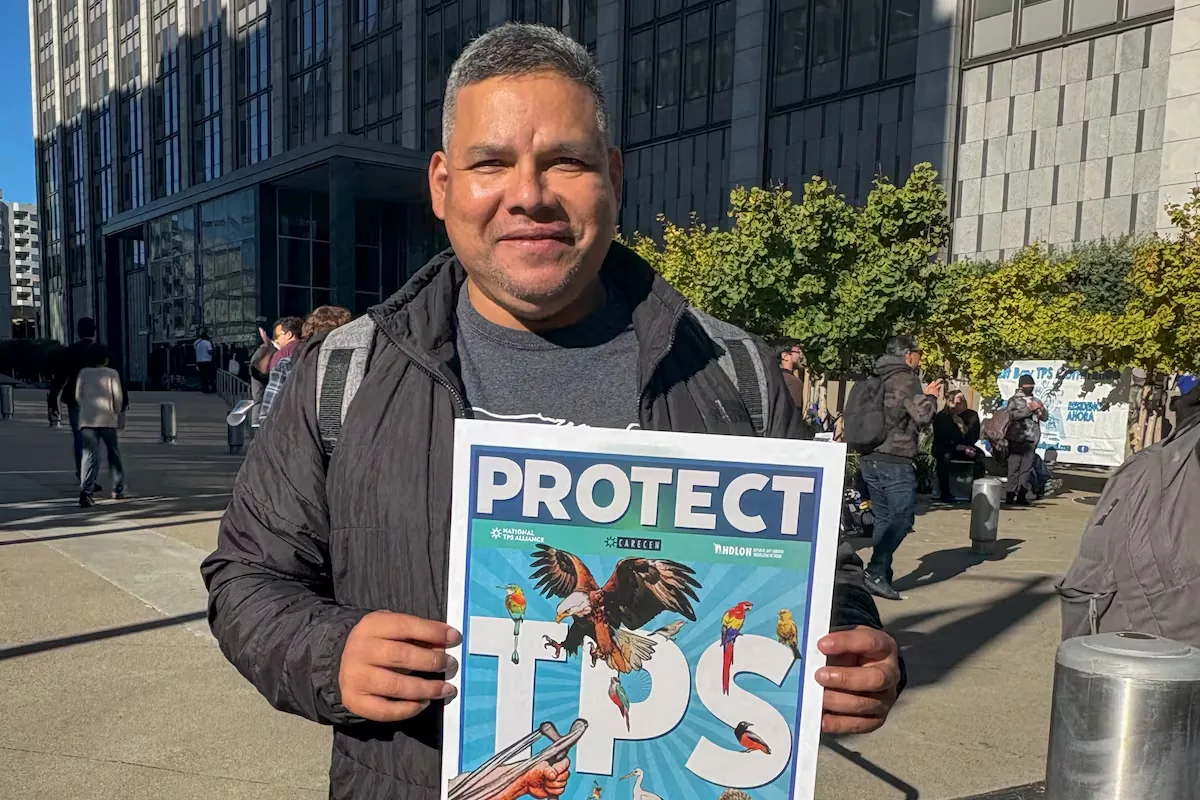
José Palma has spent more than half of his life in the United States. Now, at 49 years old, everything he has built in what he considers his country hangs by a thread. This September 9, the Temporary Protected Status (TPS) program for El Salvador expires, and the intention of the Donald Trump Administration is to eliminate it, as it has already done with TPS for other countries like Venezuela and Haiti. Without renewal, Palma will be one of the 170,000 Salvadorans who, after spending a quarter of a century in the United States, will no longer be protected from deportation.
Read more The still unexplored political links of the Navy’s fuel smuggling network
Its first beneficiaries fled a country devastated by a civil war, and the US granted them TPS in the 1990s. In 2001, after two devastating earthquakes, the US again granted its citizens TPS so Salvadorans could legally reside and work. The Central American country was the first nation to receive this legal pathway designed for people fleeing their country due to natural disasters, extreme violence, or armed conflicts.
Now, the Trump Administration wants to bury it. Obsessed with the idea of expelling migrants from the country, it already tried to end the program during its first term, so those affected united to fight it and in 2017 founded the National TPS Alliance, of which Palma is the national coordinator and spokesperson.
From the platform, this activist tries to convince the Government and Congress that the tens of thousands of Salvadorans who have been in the United States for more than two decades should remain. The Government argues that the program is temporary and must end. “After a family has lived 25 years in the country… is that temporary?” he asks rhetorically in an interview with EL PAÍS.
“TPS does not open any opportunity to apply for permanent status. It does not open opportunities, it only offers a year and a half of protection. So, there is no reason to say, why haven’t they applied for permanent residency or citizenship?” he explains.
“After a family has lived 25 years in the country… is that temporary?”
Palma arrived in the United States in 1998, undocumented. “El Salvador had gone through a 12-year civil war in which the US was investing a million dollars a day. The country was devastated, and one had to look for an opportunity elsewhere,” he explains. He chose the United States, where over the years he got married, had four children, worked in various jobs (from milk delivery to a law firm), acquired assets, and paid taxes. He lives in Houston (Texas) and has renewed his residence permit every year and a half, complying with the program’s rules.
After Trump’s electoral victory, his life changed. He gave up some activities he used to do, such as being a soccer coach and studying at university (he wanted to earn a law degree) to dedicate himself to defending TPS.
“Since the attack against the TPS program began, we have had to fight. During President Biden’s time, we managed to have some peace, for about two years. But we always had to campaign because even President Biden himself had to be explained why the community should remain protected,” he says. So far, the program has been renewed. “Every year and a half, the program must be reviewed, and Democratic and Republican administrations over 25 years have found that conditions, whether due to the earthquake, natural disasters, crime, or economic conditions, have determined that the country was not suitable to receive all Salvadorans,” he recounts.
Now the situation is different. The aggressiveness of Trump’s immigration policy since he returned to the White House and the goal of achieving the largest deportation in history have led to harassment of Salvadorans and foreigners in general. “Hatred towards the migrant community has grown, specifically against the Latin American community. In detentions, ICE agents, who are not well-trained agents but contractors paid per detained person, practically have a green light to detain those who do not appear to be Americans. It is psychological torture for the Latin American immigrant community and currently the Black community, especially Haitians,” he points out.
On Thursday, he accompanied several congress members to the Capitol to launch the petition to renew the program in the face of its imminent end and to open a pathway to permanent residency and, ultimately, citizenship. The US immigration system is considered broken by all sectors, but there have been no advances to reform it.
Battle in Congress
This week a step forward was made by getting three Republican representatives to join Democrats to present the Dream and Promising Act for a vote, a bill that would open a pathway for those with temporary residence permits. Only one more Republican signature is needed to present it in the House of Representatives. “And what is circulating in the news is that the White House is pressuring Republicans not to sign it. Then comes the almost impossible battle of getting 13 Republican senators to support it so it can reach President Trump’s desk and for him to sign it, another battle,” he details.
Additionally, Palma adds that there is an economic and political interest in continuing migrant detentions. “Prison companies invest heavily in politics. Many legislators receive funds from these companies during their political campaigns. Many elected Republican officials are afraid to take actions that would anger President Trump and cause him not to support their reelection,” he says referring to the midterm elections held in November. “Those of us who have lived here for decades can see that in the past, important national issues were discussed in the US. At this moment, that debate, that democracy, that freedom of expression has somewhat been lost,” he adds.
The NTPSA has gone to court several times to defend TPS, but the recent Supreme Court ruling in favor of the Government, which resulted in the elimination of the program for 350,000 Haitians and Syrians, leaves little room for hope. “Democracy in the US is deteriorating. American society is losing trust in the three branches of government, in the judiciary. For many, the Supreme Court is becoming just a circle that approves whatever the president is doing,” he maintains.
In just four days, the uncertainty will end about whether the 170,000 Salvadorans will lose their protection or not. If there is no TPS renewal, the outcome is expected to be dramatic. “For many, it will be a situation of family destruction. For some, it is a possible death sentence, literally, because some people, by having a migratory status, can have jobs and provide health insurance to their families, for example. They might support their children who are suffering from serious medical conditions. Losing their TPS means losing their job, losing health insurance,” he insists.
The problem will also extend to El Salvador, he warns. “TPS holders have about 150,000 children who are US citizens. Many are already adults, but let’s say 75,000 return. El Salvador does not have an educational system that can support them, and many of them don’t even speak Spanish well. El Salvador’s economy is fragile; it could not absorb this entire population, and furthermore, families in El Salvador would no longer be receiving remittances.”
Palma, although not losing hope, recommends being prepared for the worst in Trump’s world. “Keep fighting for what is best for our families and have a plan B.”
Read more Video|De la Espriella bets on better relations between Justice and the Presidency