









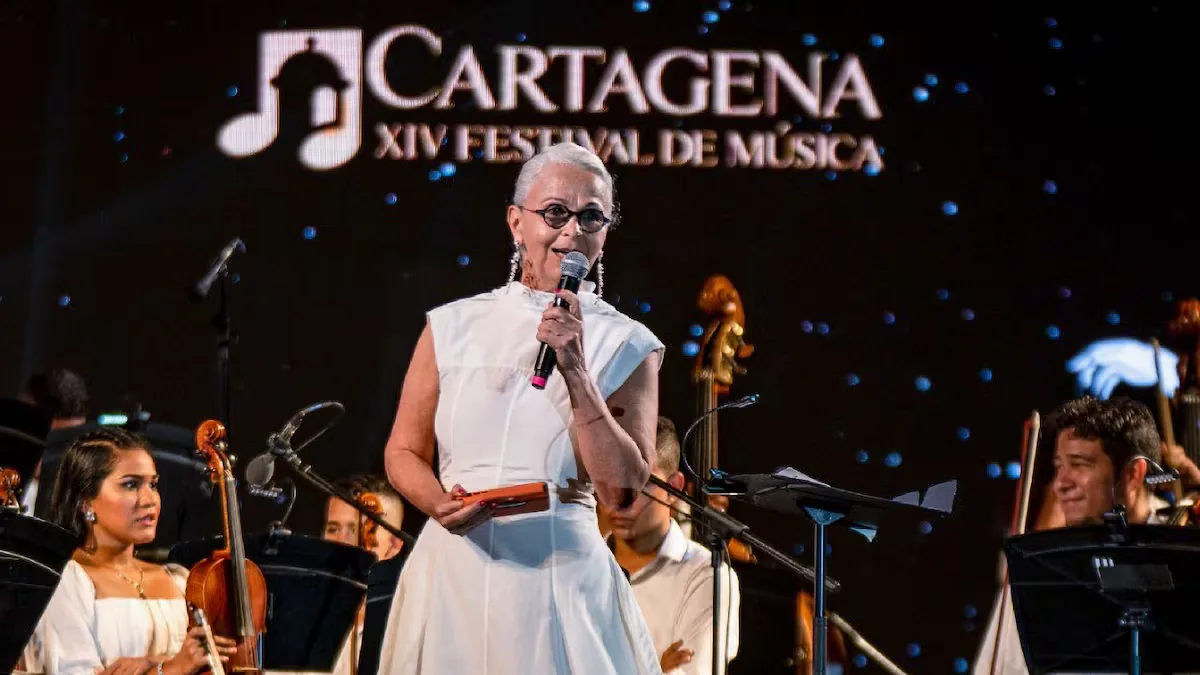
At the beginning of the century, talking about an international classical music competition in Colombia, and even more so in the Caribbean, was as incredible as it was unlikely. Today, however, the Cartagena Music Festival celebrates 20 uninterrupted years of work and three years since it was declared a National Cultural Heritage. More than 15,000 tourists converge on its stages each year. They come to enjoy the highest level of national and global talent and to listen to some of the most emblematic works of classical music. An expression that, besides bringing us closer to art, proposes a new way of relating as a society: from pause, listening, and harmony among differences.
Read more Manuela Álvarez and the ‘MAZ Effect’ with which she conquered the world
The person responsible for this great feat is its director, Julia Salvi (Cali, 71 years old), also the creator of the Salvi Foundation. In her attitude, and even in the tone of her voice, Salvi has adopted the warmth of the music that has accompanied her all her life. At a very young age, when that music sounded like guitars and accordions, she left the Economics career at the Javeriana University of Bogotá and went to London to study English.
Salvi is reflective, rigorous, ambitious, and determined; in her own words, “she insists a lot when she deeply believes in something.” That insistence led her, along with her husband Víctor Salvi — an Italian-American luthier and harpist who passed away in 2015, the one who introduced her to the European musical universe — to pursue a conviction after 30 years of marriage: that Colombia deserved to connect with the highest levels of excellence in the world, both in artistic performances and in academic and cultural training. “The Festival was born around music, but very soon we understood that it could become the meeting point of something much greater: education, discipline, knowledge, exchange between generations, a sense of belonging, and real growth opportunities,” explains Salvi.
Throughout its 20 editions, the Foundation has brought together 3,920 artists, presented 529 concerts, offered more than 2,700 hours of master classes, and attracted more than 509,000 spectators. Additionally, it has trained 13,000 people in its lutherie centers and has generated impact in 80 neighborhoods of Cartagena.
On the other hand, the Foundation, together with allied companies, develops the project Harmony in PROgress in La Boquilla, which teaches young people in the area to play instruments. An effort that has achieved, among other results, a scholarship for the Berklee School of Music in Boston, another for the Italian Umbria Jazz festival, and the formation of a jazz big band and a symphonic band. It also created the Ibagué Festival, which in its six editions has already attracted nearly 40,000 attendees.
Achievements like these led Julia to receive, in 2019, the Order of the Star of Italy from the Government of that country. In turn, the prestigious European magazine Classic FM chose the Festival as one of the 10 most magical on the planet. But, far from titles and distinctions, Salvi prefers to be remembered for something simpler: for never having been afraid of the word “demanding” and for putting “chords of humanity” into every project.
She is clear that her work transcends her. “When something you have helped build stops being just a project and is recognized as Heritage, you understand that it no longer belongs to you. It belongs to the city, the country, and, in some way, to the generations to come,” she assures. Cases like those of cellist Santiago Cañón, violinist Laura Hoyos, and soprano Julieth Lozano, now recognized worldwide, are an example of how far an opportunity can go when talent, discipline, and support converge.
She maintains that her leadership was not born from theories but from the challenges she has faced as a woman, cultural ambassador, and mother of two children: “When there are not enough resources, when something seems impossible, when a door closes, when you have to start again or admit a mistake, you really discover what you are made of,” she says. Perhaps that ability to overcome and insist, accompanied by the warmth of her characteristic maternal attitude, made her an example for those who bet on cultural management as a tool to transform society.
Salvi defines herself as a music lover who enjoys popular music and vallenato as much as classical music. That is why, she says, she does not like it to be associated with certain social strata, nor does she consider it superior to other genres. But she does maintain that it has the virtue of teaching us to coexist: “It invites us to wait and pay attention; to recognize when a voice should appear or not. Each musician can be extraordinary individually, but there is only an orchestra when everyone learns to listen to each other. Hopefully, as a country, we could learn something from that,” she comments.
This woman, who at 16 told her parents she wanted to be a nun to face social injustices, says she has found in classical music the kind of leadership Colombia needs: one capable of listening before speaking, bringing together rather than dividing, and thinking beyond the immediate result. “Leadership appears when we are capable of putting our abilities at the service of something that transcends us. A country progresses when each generation can start a little further ahead of where the previous one ended,” she says. Her work, without a doubt, turned that conviction into social transformations that will remain in our collective memory, like a melody that finds a way to keep playing after the last chord.
Read more Hernán Penagos, the registrar who upheld trust in democracy