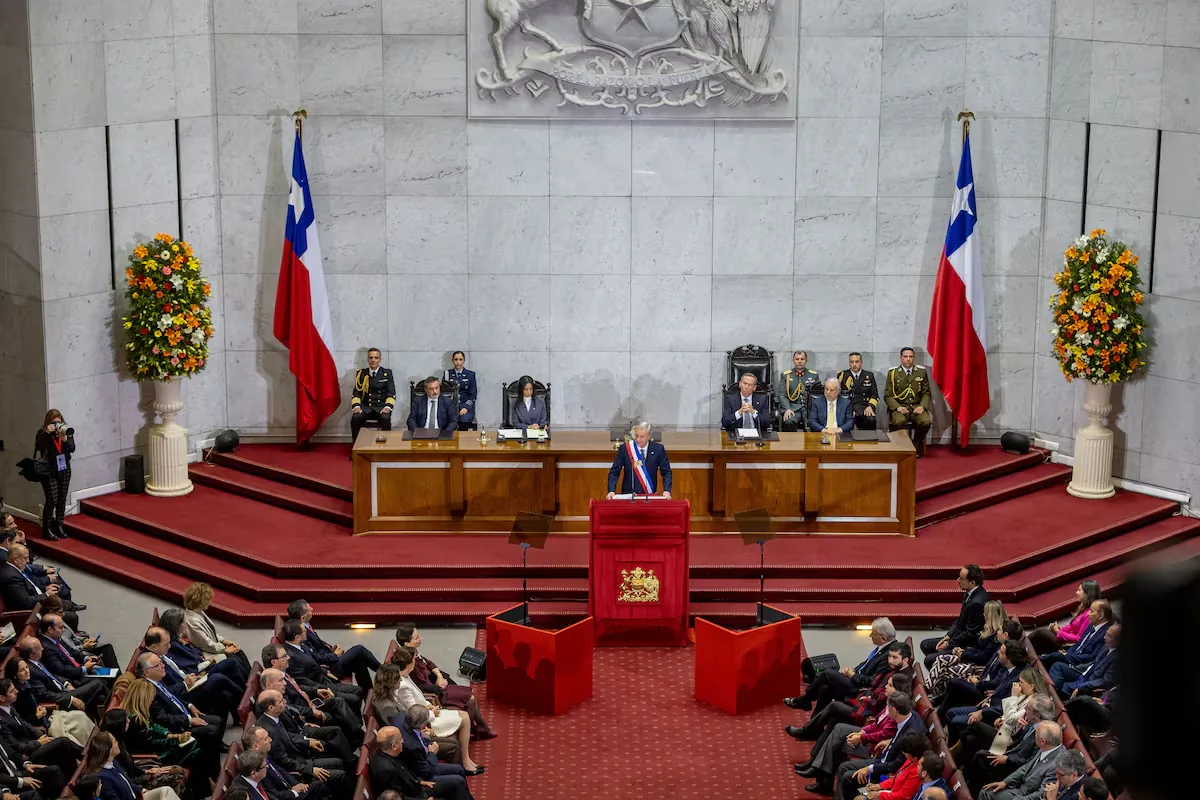










President José Antonio Kast, in his first Public Account delivered this Monday before Congress, 82 days after taking office at La Moneda, began his speech, as expected, with security, since it was a campaign promise. According to polls, however, it is his weakest area, and where he has lost credibility. “Security is not something that changes overnight,” he said in Parliament, referring to the fact that as of May 31, Chile has recorded 378 homicide victims, while in the same period last year there were 444. “These are still very high numbers (…), but they show that better results are beginning to consolidate,” he said. Previously, on Sunday, the president had paved the way for his intervention, given the high expectations generated by his commitments among his voters, who demand rapid changes. Therefore, before a group of residents of Villa Alemana, a city about 130 kilometers from Santiago, he spoke in the same vein: he told them that everything they proposed in the campaign will be fulfilled, but “step by step. We will face illegal immigration step by step, and we will go after criminals step by step.”
Read more Video analysis| A transcendental first lap
“We were told that insecurity was just a feeling. It is not. Behind every number there is a person, a family, a community that is affected. Insecurity, for a long time, has stolen our freedom,” said the president.

Kast reviewed actions that are already underway. He made only a few announcements, although he disclosed them this Sunday. Among them, the submission to Congress of a bill to create the Registry of Vandals and Incivilities and an Intervention Plan in 50 critical neighborhoods. It is understood that he did not provide more details largely because Martín Arrau, the government’s second Minister of Public Security in less than three months, will present his strategy to the Senate on June 2. Additionally, on Monday afternoon, the president will meet at the presidential palace Cerro Castillo, in Viña del Mar, with the La Moneda Security Committee, headed by Arrau.
The ambiguity that the right-wing administration has had regarding the existence or not of a security plan, which has persisted since Trinidad Steinert, Kast’s first Minister of Security, has cost Kast dearly. According to the Pulso Ciudadano poll, released this Sunday, 65.7% of those surveyed believe there is no concrete plan and only 19.5% think there is one. Another survey, Criteria, showed a similar picture but also revealed that the president dropped six points since May 10 in the question about whether he knows how to tackle crime, where he registered 38%, the steepest decline.
“Security is not decreed on paper, it is built neighborhood by neighborhood, street by street, with presence, technology, and measurable results,” Kast said in that context. He announced that in the coming weeks the Intensive Neighborhood Intervention Plan will be deployed in 50 critical neighborhoods, where “there will be directed police occupation, preventive patrols, and targeted operations against illicit markets and criminal organizations.”
He also said that seven task forces will be created to work coordinated and focused on “borders and ports. Kidnapping and contract killing. Cybercrime. Organized crime. Illicit markets. Criminal finances and violence in the Southern Macrozone. All with monthly goals and responsible parties who report. We want to leave behind fragmented responses and move to coordinated and permanent offensives that pursue gangs in their leadership, integration, territory, and money.”
Kast’s speech before Congress had a strong component of support especially for Carabineros; for the Investigations Police (PDI) and for Gendarmerie, the prison service. Part of the imprint his administration tries to convey is that it has a change of attitude towards law enforcement forces. “When a carabinero, a detective, or a gendarme, fulfilling their duty, uses legitimate force, this government supports them and will always support them. Let us think for a moment about what they do. While an entire city sleeps, a few thousand watch over the peaceful sleep of millions. And that recognition, which was denied to them for years, this government returns to them, in full and without any ambiguity,” said the president.
Read more A fragment from EL PAÍS columnist Lola Pons opens the 2026 Selectividad in Madrid

Specifically, regarding the uniformed police, Kast spoke of an announcement he had already made: the submission, in the coming weeks, of a bill to Congress “to improve the conditions and stipends of Carabinero cadets,” as well as a proposal to incorporate a quarterly allowance to improve police salaries.
For prisons, he said the process of strengthening maximum security regimes will soon begin, which he did not detail. He also said they will implement the Prison Infrastructure Plan, projected until 2030, “the greatest modernization of the prison system in more than 30 years” and that “will initially allow the incorporation of more than 20,000 new places throughout Chile, reducing overcrowding.” He added: “Building modern, safe, and sufficient prisons is not an expense, it is an investment in the security of all Chileans. But a prison that only confines and does not focus on rehabilitation ends up returning more dangerous criminals to the streets than when they entered.” Therefore, he said his model combines “maximum security with real reintegration programs, including education, job training, addiction treatment, and specialized intervention, in a partnership between the State and the private sector.”
National registry of vandals
Although he socialized it over the weekend in several interviews, Kast announced in his Public Account that he will send to Congress a bill to create the Registry of Vandals and Incivilities. The initiative is intended to sanction, with the loss of social rights such as free education, the Universal Guaranteed Pension, or rental subsidies, those who commit crimes such as attacking Carabineros, health service personnel, obstructing public transport, drug trafficking, and others, such as damage to national monuments so that “they are held accountable for their actions,” said Kast.
He announced that there are other behaviors that, although not constituting crimes, will be classified as incivilities. He mentioned “illegal alcohol sales, drug use in public spaces, unauthorized graffiti on public and private property, or destruction of community equipment.”
According to Kast, whose campaign speech is based on the word order, in Chile “it is not enough to fight organized crime and delinquency, but also to protect our neighbors from those behaviors that erode our neighborhoods, damage our historical and cultural heritage, disturb family tranquility, and deteriorate public infrastructure.”
Chile faces a security crisis marked by the emergence of new, much more violent crime. To local gangs, mainly specialized in assaults and car thefts through methods like carjackings and gatecrashings, the situation has worsened with the presence of transnational criminal organizations such as the Tren de Aragua, detected in the South American country approximately since 2020, first in the far north and then advancing south. Crimes that were previously rare are now committed, such as contract killings, extortion kidnappings, migrant trafficking for sexual exploitation, and contract killings. Security is also the main concern of citizens after the economy.
Read more Sergio Ramos: “I keep extending my hand so the operation can be done”