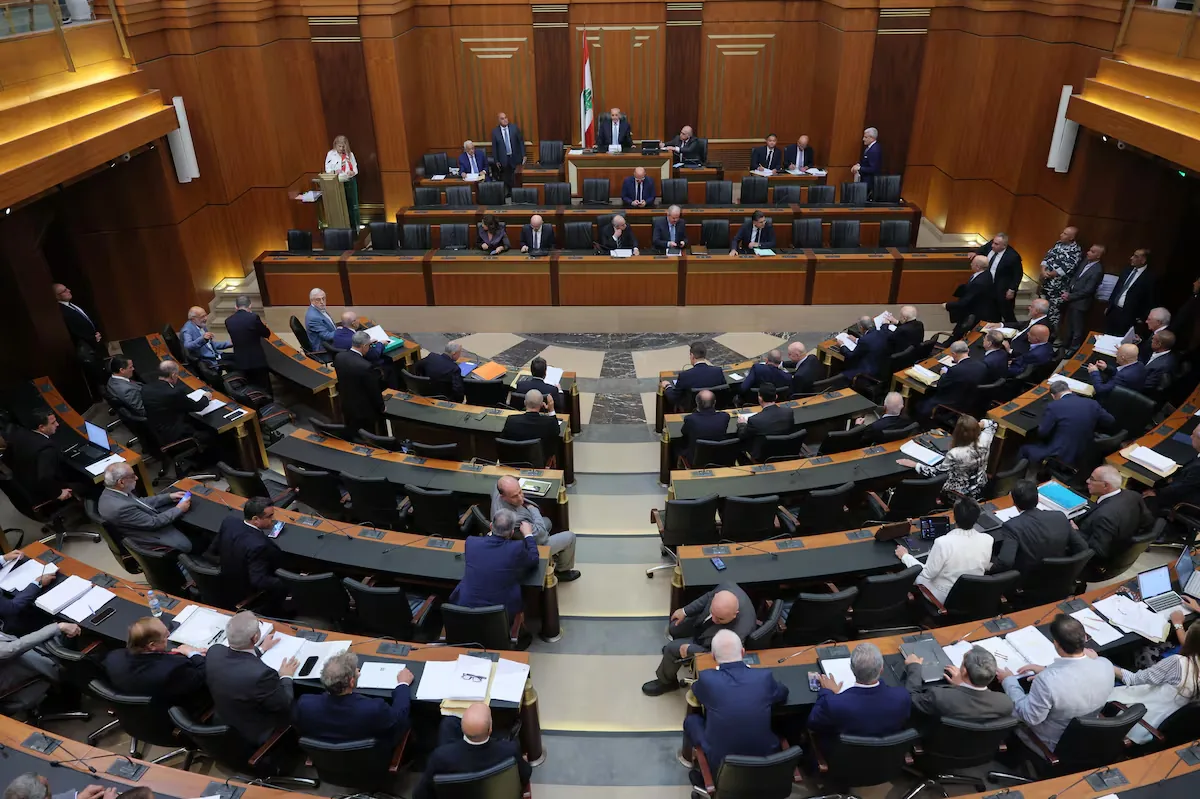
The Lebanese Parliament approved on Tuesday the abolition of the death penalty, making the country the first in the Arab world and the Middle East to formally ban executions. Lebanese authorities had applied an unofficial moratorium on the use of the death penalty since 2004. Now, the removal of this concept from the legislation will retroactively benefit dozens of prisoners.
Read more The Chilean frog defended by Leonardo DiCaprio that faces an electric project
Human rights groups have welcomed the parliamentary vote, after warning for years that the practical suspension of the death penalty was easily reversible as long as executions were contemplated by law, something that allowed judges to continue issuing such sentences.
The Lebanese abolition clashes with the region’s regression on the matter. For example, in March, Israel approved sentencing Palestinians accused of killing Israelis to the death penalty, and in June, Jordan carried out the first executions since 2017 by hanging six men.
“Lebanon today regains its pioneering role in the region as a defender of human rights,” claimed Justice Minister Adel Nassar in a statement. “In a world, and particularly in a region, where human rights are increasingly marginalized, Lebanon has sent an essential message in favor of fundamental rights,” he emphasized.
According to the organization Human Rights Watch (HRW), which had access to the bill, it prohibited the death penalty “wherever it is mentioned in Lebanese laws,” and replaced it with a newly created penalty: “life imprisonment with aggravated forced labor.” The Lebanese association Agenda Legal, dedicated to strengthening the rule of law, considers in an analysis that this innovation “has no practical effect,” since Lebanon does not apply provisions on forced labor.
Lebanese authorities, who in July held the first parliamentary sessions since March — when the bloody war between Israel and the Lebanese party-militia Hezbollah broke out, which also led to the postponement of parliamentary elections that were to be held in May — had already shown signs of moving towards abolition. Over the last six years, Beirut has voted three times in favor of a United Nations General Assembly resolution urging “all States to establish a moratorium on executions, with a view to abolishing the death penalty.”
The Lebanese Association for Civil Rights (LACR), the group that presented the bill, estimates that the death penalty weighs on at least 84 prisoners in the country. The award-winning 70-year-old activist and sociologist who leads the entity, Ogarit Younan, sees Tuesday as the culmination of a journey that began in 1997, when she founded the National Campaign to Abolish the Death Penalty in Lebanon. “Our struggle continues: this law must be developed to eliminate insulting provisions, including those of aggravated forced labor,” she said.
More executions in fewer hands
The campaign gained notoriety in 1998, when a group of activists dressed in black appeared at dawn at the execution of two people in a municipality north of Beirut, as Younan recalls to the newspaper L’Orient-Le Jour. While the victims’ families celebrated the executions of the condemned, the activists turned their backs on the event while holding a banner: “We mourn the death of the victims of the first crime and that of the victims of the execution.”
The scene dominated television debates where Ogarit argued the difference between justice and revenge. The first political support came shortly after, when then Prime Minister Salim Hoss refused to sign two execution decrees in 2000. Lebanon carried out its last execution in January 2004.
Lebanon joins 14 other countries that have banned the death penalty in the last decade, making abolitionist states increase from 16 to 114 in 50 years, according to Amnesty International (AI) data. However, this step places it at the opposite end of regional neighbors such as Iran or Saudi Arabia.
Both increased in 2025 the highest global number of executions recorded by AI since 1981, with 2,707 maximum penalties in 17 countries (78% more than the previous year), according to the group’s report in May. Iranian authorities, who have faced cyclical anti-government protests for years that they repress with an iron fist, were responsible for 2,159 executions in 12 months, more than double the 972 people executed in 2024. Riyadh, whose authorities strive to project an image of modernity, carried out 356 executions. To a lesser extent, Yemen (51 executions) and the United States (47; almost half in Florida) are also among the five states that execute the most, along with China, where the international organization has no data but suspects thousands of executions exist.
Read more Live video | Rescue efforts after the earthquake in Colombia