
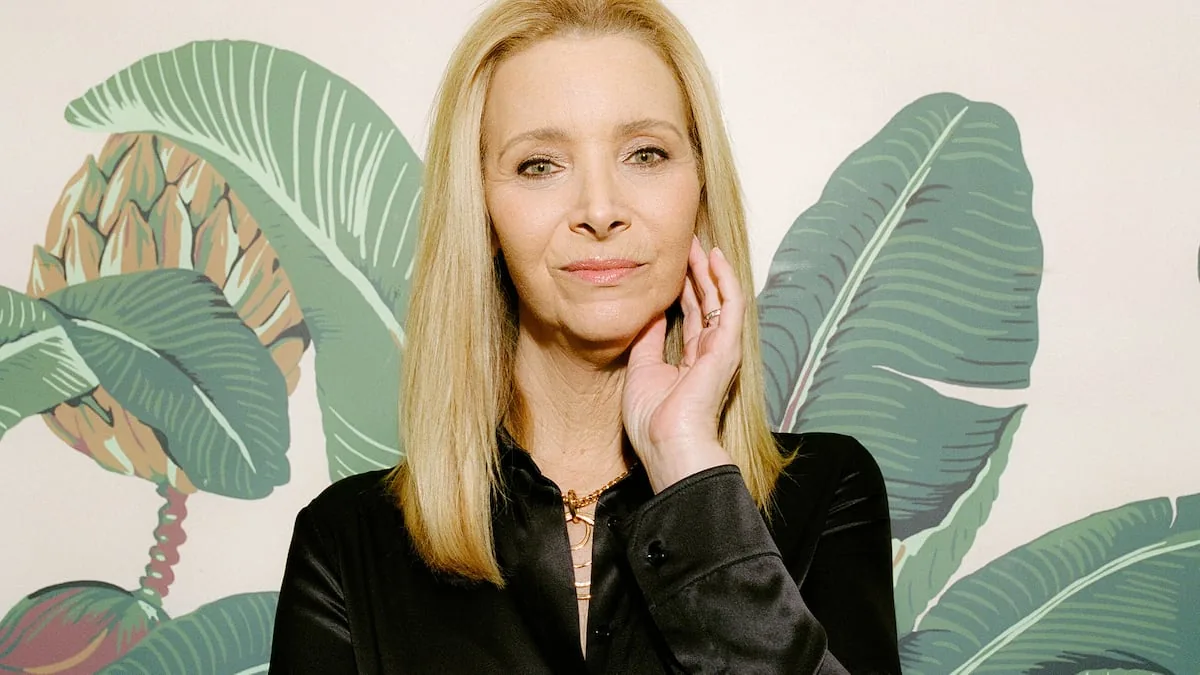
Lisa Kudrow (Los Angeles, 62 years old) will always be Phoebe, but for many, also Valerie Cherish, the protagonist of ‘The Comeback’ (HBO Max), a series created and starring herself, in which she plays a mature actress trying to get back into the entertainment industry, putting on a brave face for all kinds of humiliations. Its first season, in 2005, did not achieve massive success, but that slightly pathetic yet endearing woman with a glorious past who tried to revive her career in a reality show won over the most discerning palates. In real life, the series was canceled, but 10 years later it was revived, with a second season in which the tragicomic perspective of what show business represents for a “woman of a certain age” provided great humorous moments. Again a decade later, Valerie returns, for the third and final time: this time she embarks on a television production scripted by artificial intelligence in the midst of a writers’ strike. “Before, only certain people got it and loved it. Now I have the feeling that most of the people I talk to understand what it’s about,” explains Lisa Kudrow with her characteristic and disconcerting laugh via video call from her living room in Los Angeles.
Read more Are Spanish dams safe? This is how a more extreme climate affects these constructions
Question. Why do you think that change has occurred?
Answer. In our first season, in 2005, there weren’t many reality shows yet, there were no Housewives of anything, so there wasn’t really such a common point of reference. Nowadays, moreover, with social media, everyone is constantly putting on their own reality show. Also, 10 years ago, the general public didn’t know how badly people were treated, how abusive some of those in power could be. When we created this series, we weren’t exaggerating, but informing. People found it hard to see how that woman was treated, but the truth is that any actress who has had some success has had to endure it, overcome it, and deal with it.
Q. Do you think movements like Time’s Up and even the new perception of feminism have played a role?
A. Yes, absolutely. On the other hand, I also think the series works like a Rorschach test: what you see in it that particularly hurts you is your greatest fear. You see Valerie and you say: “If someone were that horrible to me, I hope I would defend myself better.” Or, “Do I also keep talking when I should stop just out of fear of silence?” It has a very “me too” aspect, but not a “me too” of “Me Too,” but of “it could be me.”
Q. Are you still concerned about how others perceive you?
A. When I started, I realized that the press sometimes misinterpreted things, misreported, or outright invented, and I was very anxious about what people would think. Then I understood that it only matters that my friends, my family, and I know the truth, and that I had to move on.
Q. And physically? Do you feel more confident or more insecure?
A. Well, both at once. I mean, now when they take photos of me for interviews, I look at myself and think: “Wow, yeah, wow, look at that.” On the other hand, honestly, I’m too scared to do anything drastic [she touches her double chin]. I’m very scared. I don’t want to look too changed. So then I tell myself: “Well, okay, I’ve gotten older. Sorry for not having died.”
Q. You’ve said there’s a fine line between coping and living in denial. Have there been periods in your life when you lived in denial?
A. Perhaps regarding my appearance sometimes. I was convinced I was super thin, and although I was never morbidly obese, apparently I wasn’t that thin. And suddenly someone suggested I wear something that “fit me better,” and then I found myself thinking: “Ah, I get it now. Okay, yes, I’m not what I thought… I don’t look the way I thought I did. Okay, I get it.” For me, denial is fine until things start to go wrong, and then you have to stop and review. But deep down, you always know if you’re in denial. You feel it, there’s a sense of unease. The other thing we call denial, but it’s not so much that as it is that you don’t care.
Q. James Burrows [creator of great TV hits like Friends, Frasier, or Cheers] makes a cameo in the series and gives Valerie bad news about her role. Has he ever said anything to you in real life that was hard to digest?
A. Well, I’ve heard him say some things, but he’s very diplomatic. He knows how to express himself with great objectivity, and I haven’t seen him try to hurt anyone or try to exert power. He just conveys information.
Q. And could you give me an example of a time when he told you something difficult to accept?
Read more Chinese robots smash records and crush humans in the Beijing half marathon
A. Well, I was cast in the pilot episode of Frasier and was fired the week of rehearsals, before they shot it. They had already chosen someone else to replace me, Peri Gilpin, I didn’t know that. I just thought: “Finally! This series is going to be a hit.” And one day during rehearsal, Jimmy said: “This isn’t working. It’s not working. But, well, the writers will fix it.”
Q. Did you accept it? Did you deny it? What did you do?
A. At that moment I thought: “Oh, he hates me.” But it has nothing to do with hate. He sees that there’s a chemistry that isn’t working, so it’s not the script’s fault; it’s that they’ve chosen someone with a different vision of the character than what’s required. It hurt me, but that’s because I added other things of my own. But he didn’t hate me. It was just that I wasn’t the right fit. And he didn’t even say it like that; it was more delicate.
Q. In Friends, did you find it difficult to express what you wanted?
A. Sometimes it was difficult because it’s hard to express complex topics. I’m not even referring to an interpersonal problem, but rather asking yourself: “What am I saying with this joke? Or with this sentence?” I don’t know what I’m saying to get the most out of it. That is, regarding the relationships between us, communication was fundamental and very welcome, and that same dynamic occurred among the six of us: when we needed to talk, we would say “Can we talk?”, “you said something that made me feel a certain way,” and then it would be corrected: “Oh, no, that’s not at all what I meant,” and things would be clarified immediately. It was a very healthy relationship. Among six people. That’s very difficult to achieve.
Q. And despite that good communication, is there anything you regret not having told Matthew Perry?
A. No, no, no, I think I made things clear to him, very clear. That I loved him. I love him, and he knew it. And if he didn’t know it then, he knows it now, because now he knows everything.
Q. This season of The Comeback was filmed in the Friends studio. How would you exactly define what you felt returning there?
A. At first I thought: “How cool. We’re going to shoot on the main stage. What a thoughtful gesture from Warner Brothers.” But then there I realized that the situation carried much more weight. Nine years of a life-changing experience where we also said goodbye and cried buckets on the last night. Also where the reunion took place, which was huge and momentous. And now I’m saying goodbye to The Comeback and Valerie Cherish, which for me is only surpassed by Friends and, in a way, not even, because I was co-creator and co-writer of The Comeback. And on top of that, my son is in the cast! I was pregnant with him while filming Friends and he was five years old when we finished it.
Q. The truth is, he nails the role of the company’s IT staff and artificial intelligence expert…
A. He certainly does. And I assure you, he’s none of that.
Q. Do you use artificial intelligence?
A. I don’t want to, and yet it appears when I go online to ask a question. I’m convinced it will have fantastic uses, but I assure you that Michael and I haven’t used it to write the series. Although they suggested it just so we could say it and make the joke. We refused precisely so we could say we didn’t use it.
Q. Are you one to argue as a screenwriter?
A. I don’t like to argue because emotions are introduced and nothing gets resolved.
Q. Your husband just walked by, so I’m going to ask if you’ve ever used that excuse on him that you usually give your husband in the series when he wants to have sex: “Don’t bother me. I’m reading my lines.”
Read more Spanish entrepreneurs on regularization: “It’s a necessary measure”
A. Let’s just say that’s never been a problem [laughs].