







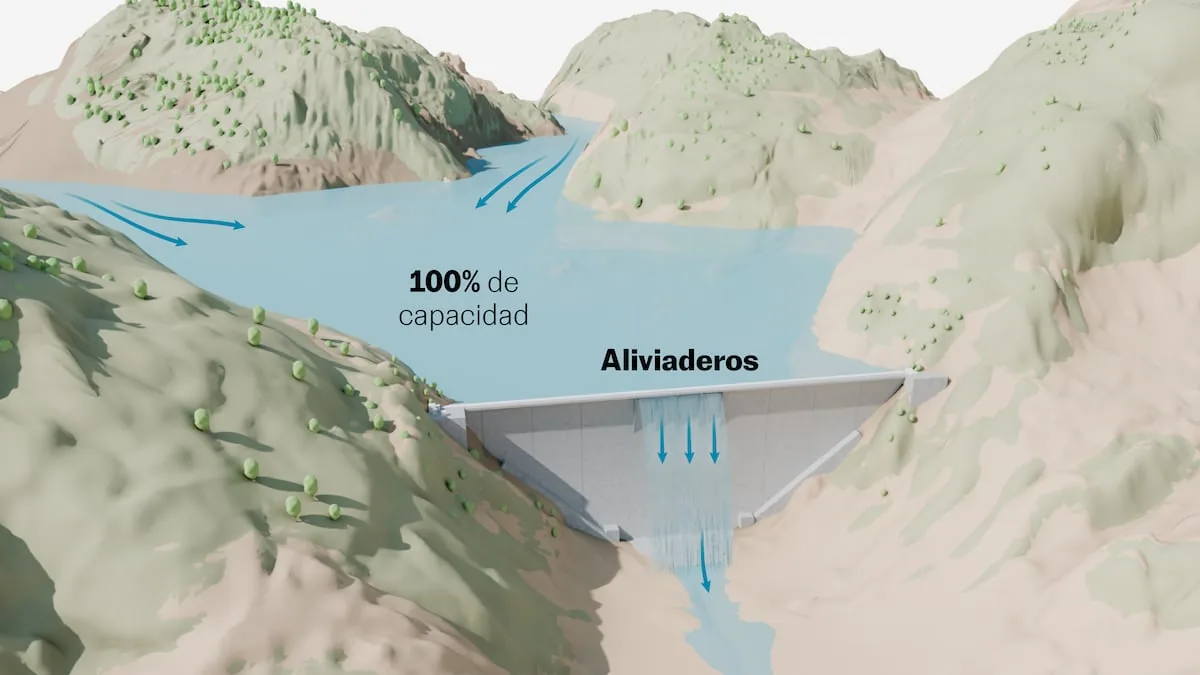
Dams are designed so that, when they reach their filling point, excess water exits through the spillways, just like in a bathtub. For the engineers who build them, it is very important to prevent the level from continuing to rise and overflowing from the top, causing what is called an overtopping, which in some cases can be very dangerous. However, many dams in Spain built decades ago were not designed for torrential rains like those already occurring and which will increase with global warming: water overflowing over the wall will cease to be a remote possibility. As Miguel Ángel Toledo, Professor of Hydraulic Engineering at the Polytechnic University of Madrid (UPM), explains, “this has always been considered a heresy,” but by carrying out some modifications, overtopping can now even be considered a solution for constructions with spillways too small for the extreme climate to come.
Read more Chinese robots smash records and crush humans in the Beijing half marathon
The droughts and floods of recent years have shown the crucial role of these infrastructures, both for accumulating water reserves to draw upon when needed and for curbing floods that would otherwise be catastrophic. However, climate change also increases pressure on constructions with an average age of 55-60 years, some of which are over a century old, at a time when debate about their condition is growing. “Today, many dams in the country do not meet the safety coefficients they should have,” says Jesús Contreras, spokesperson for the Association of Civil Engineers, Canals and Ports, the organization most alerting about their situation. He emphasizes, “evidently, climate change influences dam safety.” Nowadays, these constructions are classified into three categories based on their risk in case of breakage or incorrect operation: Type A can affect urban areas and cause the most severe damage. Type B would cause significant impacts or affect a small number of homes. And Type C implies moderate effects.
“Is a dam going to fall tomorrow?” Contreras asks. “The answer is no, but in an accidental situation where extraordinary rains combine with a reservoir with a lot of water, a spillway problem, and a minimum safety coefficient, we are going to have a serious emergency,” he warns. “The government is not aware of the situation, or they don’t want to be aware,” he criticizes. “Until one day something big happens; it will be like with the railways here.”
For its part, the Government considers that the reality is by no means so serious, but admits that it is currently evaluating the resistance of dams, considering the threats of climate change. As Juan Carlos de Cea, area coordinator at the General Sub-directorate for Hydraulic Public Domain and Infrastructures of the Ministry for Ecological Transition (Miteco), details, “we are precisely analyzing the real situation of dam safety as of today and we are making a prognosis [forecast] of what would happen with different climate change contexts, depending on how severe it is.”
Although these works will not be finished until the end of June, De Cea already acknowledges that measures will have to be taken in some areas of the country. “I can anticipate that things will surely have to be done on the eastern slope, because these are dams for flood lamination [reduction] with old safety criteria.” “What we are seeing day by day is that our elders fell very short with their predictions,” highlights the Miteco representative, explaining that this may require both works and changes in the management of these infrastructures. “Evidently, something is happening with the climate,” De Cea emphasizes.
Climate change has various effects on Spanish dams. According to Luis Mediero, Professor at the ETSI de Caminos of the Polytechnic University of Madrid, the first of all is that in the future reservoirs will probably be emptier. As this researcher, who studies how global warming influences these constructions, points out, climate models predict that it will rain less and the temperature will be higher, so it is expected that water levels will drop. This is bad for water reserves, but good as protection against extreme rains. “In the DANA of Valencia [in 2024], thank God the Forata dam was half empty and was able to laminate that flood, protecting downstream from floods,” Mediero states.
However, from what is already being seen, it is also foreseeable that extreme rains will fall with reservoirs full, which is delicate for safety. Especially for dams that are not made of concrete, but of loose materials, very common in Spain.
“More torrential rains can cause floods entering reservoirs to be of greater magnitude, which can affect the dam’s evacuation organs, especially the spillways, which have been dimensioned with forecasts that may be partially exceeded,” details Ángel Fernández, coordinator of the Water Group of the College of Civil Engineers, Canals and Ports. He points out that “torrential rains and extreme meteorological effects, in general, should not be a problem for our dam park as long as sufficient investment is made in modernizing, maintaining, and adapting the dams.” He even gives a figure: 4,644 million euros, which is the estimate by the Association of Construction and Infrastructure Concession Companies (SEOPAN) to adapt existing state-owned dams. Then, there are still more from local or private administrations.
In 2021, a new safety regulation was approved that increases the magnitude of floods that dams must withstand: Type A dams (which pose more risks) must be prepared for floods that occur once every 1,000 years regarding the operational elements of the construction (such as spillways) and for extreme floods of 5,000 years in the case of concrete and 10,000 years in the case of loose materials regarding their general resistance. As De Cea comments, when it was approved, it seemed more than sufficient margin, until three years later, in 2024, the catastrophic DANA of Valencia exposed the Forata reservoir to a 10,000-year flood: “It doubled the forecasts of the worst flood we consider for design purposes for concrete dams,” points out the Ministry representative.
Read more Spanish entrepreneurs on regularization: “It’s a necessary measure”

Against this, the reality is that the vast majority of these constructions in Spain were designed with older regulations, which contemplated evacuating 500-year floods, which sometimes causes spillways to be too small for what is to come. Until now, the conventional solution was to enlarge them or build new ones, very costly and complex works. However, the dimension of the problem requires more innovative and easy-to-apply options. This is precisely what the SERPA research group at the Polytechnic University of Madrid, led by Professor Miguel Ángel Toledo, is studying. He explains that it is no longer so extravagant to let water overflow over the dam, preparing it to resist. “I did my doctoral thesis on this topic in 1997, and those I talked to about it told me: ‘You’re crazy, why are you studying this?’ Now the situation has completely changed,” he points out. In the case of loose material dams, overtopping is very dangerous because it can directly erode the construction and break it. However, to prevent this, there are already examples where the dam has been covered with harder materials or, even for not very large spills, with vegetation.
In the case of concrete constructions, which are usually the largest in Spain, overtopping does not erode the wall, but it can cause damage to the base of the construction, this being the point that needs to be reinforced. As Toledo explains, another alternative to overtopping is the placement of labyrinth or piano-key shaped additions in the spillways, which lengthen the wall line (weir) where the water falls, thus accelerating its evacuation. He emphasizes that although all this allows more water to pass, “as long as the dam does not break, there is always a laminating effect” to curb floods.
Another effect of the increase in extreme rainfall due to climate change is the greater dragging of sediments by water currents that end up accumulating at the bottom of reservoirs, leading to the silting up of these infrastructures. As the specialist from the College of Civil Engineers, Canals and Ports points out, “we currently lose about 300 hm³ of useful capacity each year due to silting.” This implies losing space to store water, but it can also obstruct bottom drains. In fact, according to Contreras, spokesperson for the Association of Civil Engineers, Canals and Ports, there are about forty state dams with inoperative drains due to being buried, which prevents evacuating water to make space for possible floods. For his part, De Cea, the Miteco representative, reduces these figures and argues that the affected infrastructures are small, but acknowledges that sediment accumulation is “an pending issue for the Ministry.” “Each year, we lose the equivalent of a small reservoir, especially, again, on the eastern slope,” he details. “There, waters circulate at higher speeds, these are very deforested areas and, therefore, drag a lot of material.”
Here, the traditional solution involves dredging the reservoirs, although the Ministry is also testing a system with vacuum cleaners that clean the bottoms and emphasizes the importance of preventing sediment dragging through forest restoration, as vegetation helps support the terrain and reduces erosion. “This is a serious problem that the country has to address at some point, and many people from outside are waiting to see what Spain does,” De Cea highlights.
Finally, another impact that can be aggravated by climate change is the evaporation of water from reservoirs during periods of higher heat. As Mediero has studied, although it depends on the surface area it occupies, in a summer month, a reservoir can lose about 20 centimeters of water due to evaporation. Approximately, in an average reservoir of between 50 and 100 cubic hectometers, this means that one cubic hectometer of water vanishes. And, with greater warming, it is foreseeable that this will worsen.
The placement of covers or even photovoltaic panels can reduce evaporation. However, this is only viable in small agricultural ponds, but not for larger water reserves. As De Cea specifies, “all reservoirs would have to be covered, and it is extremely expensive; this practically has no solution.”
Of the nearly 2,400 dams in the country, most of what is known about their condition comes from large state-owned ones, but much information is missing about 1,600 owned by municipalities, farmers, and companies. “That is a world we are starting to work on, because in the past there has been a certain neglect from everyone,” De Cea acknowledges. “Large concessionaires, such as Iberdrola, Endesa, Canal de Isabel II… keep them in good condition. But we are concerned about the situation of others owned by small holders, basically municipalities, with excessively limited budgets, as dam maintenance is expensive.”