






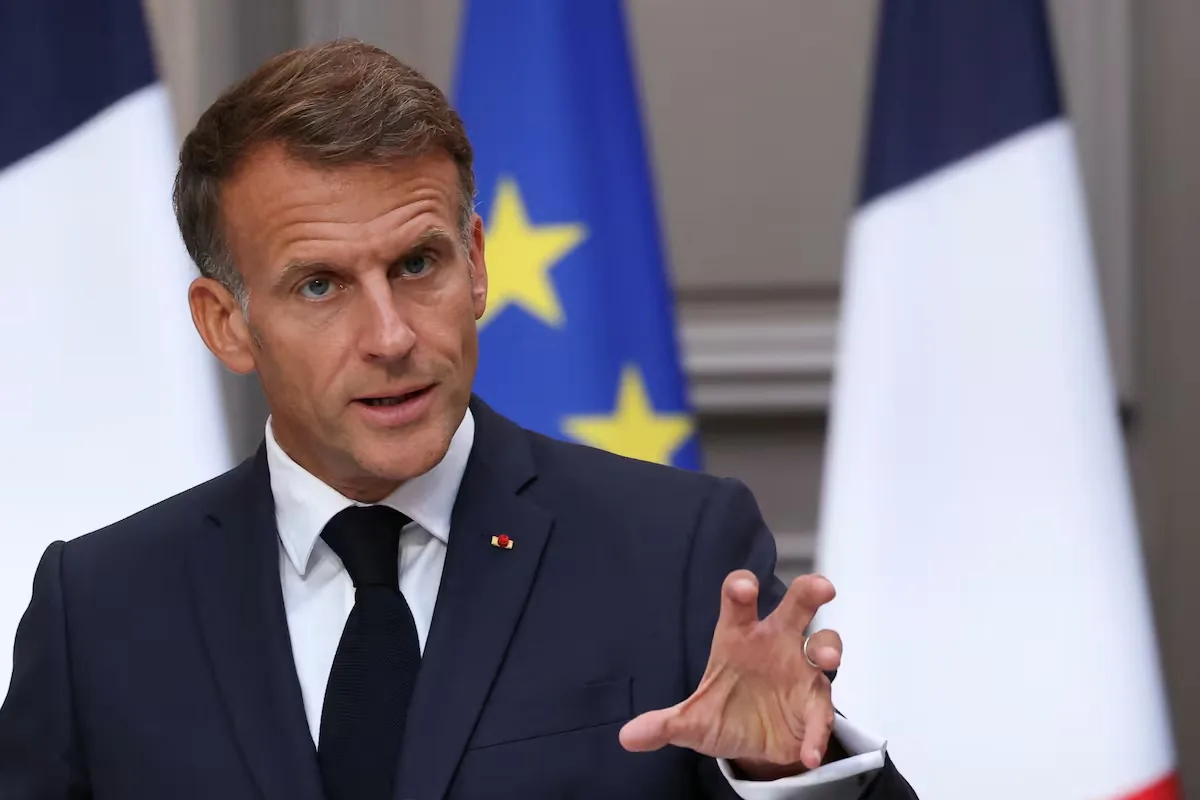
France is watching with great concern the Russian hybrid attacks in allied countries such as Germany and Poland, as well as the signs that have recently appeared within its borders, and has decided not to dissociate itself from them. That is why President Emmanuel Macron, in an unprecedented statement, announced on Friday that he has ordered the protection of infrastructures. “I have asked the Government to prepare a plan to protect our critical infrastructures, as well as the most sensitive places of our defense industrial and technological base, against drone attacks and cyberattacks,” he said. “The Russian hybrid threat to Europeans and France has intensified,” he warned.
The head of the French State appeared before the press after a confidential meeting at the Élysée with the main candidates for the 2027 presidential elections, dedicated to the deterioration of the international situation and the impact it may have on France in terms of security and rising energy prices. But the tone became more serious as he delved into the issue of the Russian threat. “No one is safe,” the president said after the meeting. “We must all be alert, act, and do everything possible to anticipate, plan, and protect ourselves,” he insisted.
Macron’s announcement comes after incidents with unidentified drones over European territory have multiplied in recent weeks, with recent episodes in Germany, Denmark, and Lithuania, and after the Russian drone attack on the border between Ukraine and Poland last weekend, which even reached a train with more than 200 passengers.
The German precedent is especially painful at the Élysée, which describes it as extremely serious and considers it a turning point. The Leipzig incident occurred in the early hours of August 4 to 5, when an airport employee discovered a drone loaded with explosives near a cargo plane of the Ukrainian company Antonov Airlines, used for transporting military material to Kiev. A bomb disposal robot managed to remove the detonator before the device exploded, and a second unidentified object collided that same night with a DHL plane, which had to divert to Hanover. After several weeks of investigation, the German Interior Minister, Alexander Dobrindt, concluded in early September that Russia was responsible for the hybrid attack, calling it “a new dimension of threat” as it was the first time an armed drone was located on European soil far from the Ukrainian border.
It is still complicated to determine, they believe in the Élysée environment, whether the Leipzig attack was a message or a failed attack. An element that substantially changes the severity and level of alert. In any case, France considers that the threat of drone attacks against civilian infrastructures is much more serious today. Macron, diplomatic sources say, has requested that these be taken into account to update protection systems and the national threat assessment.
Russian hybrid attacks “will not go unanswered,” warned the French head of state in the morning. “It would be a mistake on Russia’s part to continue acting this way against Europeans,” he added. The French president referred both to the attempted attack at Leipzig airport and to recent statements by Polish Prime Minister Donald Tusk, who announced that Russia could carry out “hybrid attacks” against Ukraine’s allies in Europe.
Tusk stated that NATO, Ukraine, and Poland intelligence assessments indicated that “the most likely scenario for the coming months” is that Russia will intensify attacks against Ukraine and its allies, including Poland. Furthermore, the Polish prime minister pointed out that Russia’s goal is “to weaken NATO’s integrity” and convince its members that “Article 5 [which obliges other member countries to intervene when an ally is attacked] is more theoretical than practical.” In this regard, Macron also took advantage of the appearance to reaffirm French support for Kiev, calling it more indispensable than ever as a condition for European security itself and for the return to lasting peace, in a context where formations such as the far-right National Rally (RN) demand reducing that aid for budgetary reasons.
Beyond France
The concern is not limited to France. The Swiss Federal Council has adopted its 2026 Security Policy Strategy, setting three objectives: strengthening national resilience, improving the protection of its infrastructures, and enhancing its defense capabilities, in line with the reinforcement of its anti-drone systems after detecting unidentified devices flying over military installations in Bern.
Meanwhile, in the United Kingdom, the Chief of the Defence Staff himself, Sir Richard Knighton, has warned in recent days that the Russian threat places the country in the “most dangerous” period of his 35-year military career. And the Ministry of Defence released a message on social media this Friday stating: “The United Kingdom does not seek confrontation. But together with our allies, we are ready to defend every inch of NATO territory.” The message is accompanied by a speech from Defence Secretary Wes Streeting, delivered in the House of Commons last week, where he warned: “Russia is constantly testing us. (…) We are prepared to defend every inch of NATO if Russia attacks.”
Macron warned that the situation is “serious” and that France is in a moment of “vigilance,” but avoided announcing what kind of response there might be, although all consulted sources assure it would be proportional. “The essence of deterrence is not to give visibility to what we will do. The intention behind this is to intimidate us and break the support effort for the Ukrainians. The consequence will be the opposite. We are not intimidated because we know that in Ukraine our security today and tomorrow is at stake,” he added.
The alert level at which France is installed is the highest possible in peacetime, but not only because of the Ukraine conflict, diplomatic sources say. The rating also includes other types of threats such as terrorism. But the plan that the president has ordered to be implemented now includes hospitals, airports, or nuclear power plants. An uncomfortable situation seven months before crucial elections in which Marine Le Pen, traditionally close to Russia and opposed to increasing contributions to Ukraine, is closer than ever to reaching the office in the Élysée Palace currently occupied by Macron.
The French announcement does not come in isolation but is part of a broader European effort that has been brewing for months. Brussels has been working since October on a “European Defence Initiative against Drones” — the so-called “anti-drone wall” — which the European Commission wants to see operational by the end of 2027, after successive incursions of unidentified devices in the airspace of Poland, Estonia, Denmark, and Lithuania.
Macron himself was cautious about the concept at the time, considering that the European response should combine detection, early warning, and deterrence capabilities — including nuclear — rather than being limited to a single defensive “dome.” That discussion will return to the table at the next formal European Council summit, scheduled for late October in Brussels, where the Twenty-Seven must advance the defense roadmap presented by the Commission, aiming for 40% of joint defense material purchases to be coordinated at the European level before 2027.
The plan that Macron commissioned from the French Government this Friday is thus part of that shared race to shield critical infrastructures before the next incident, like the one in Leipzig, stops being a warning and becomes something more serious. In fact, France fully supports the initiative proposed by European Commission President Ursula Von der Leyen to create a kind of permanent European Union security council in which the United Kingdom could participate. In the Élysée environment, they emphasize that this is an old idea that Macron himself put on the table when Brexit occurred to avoid cutting security ties with London.