







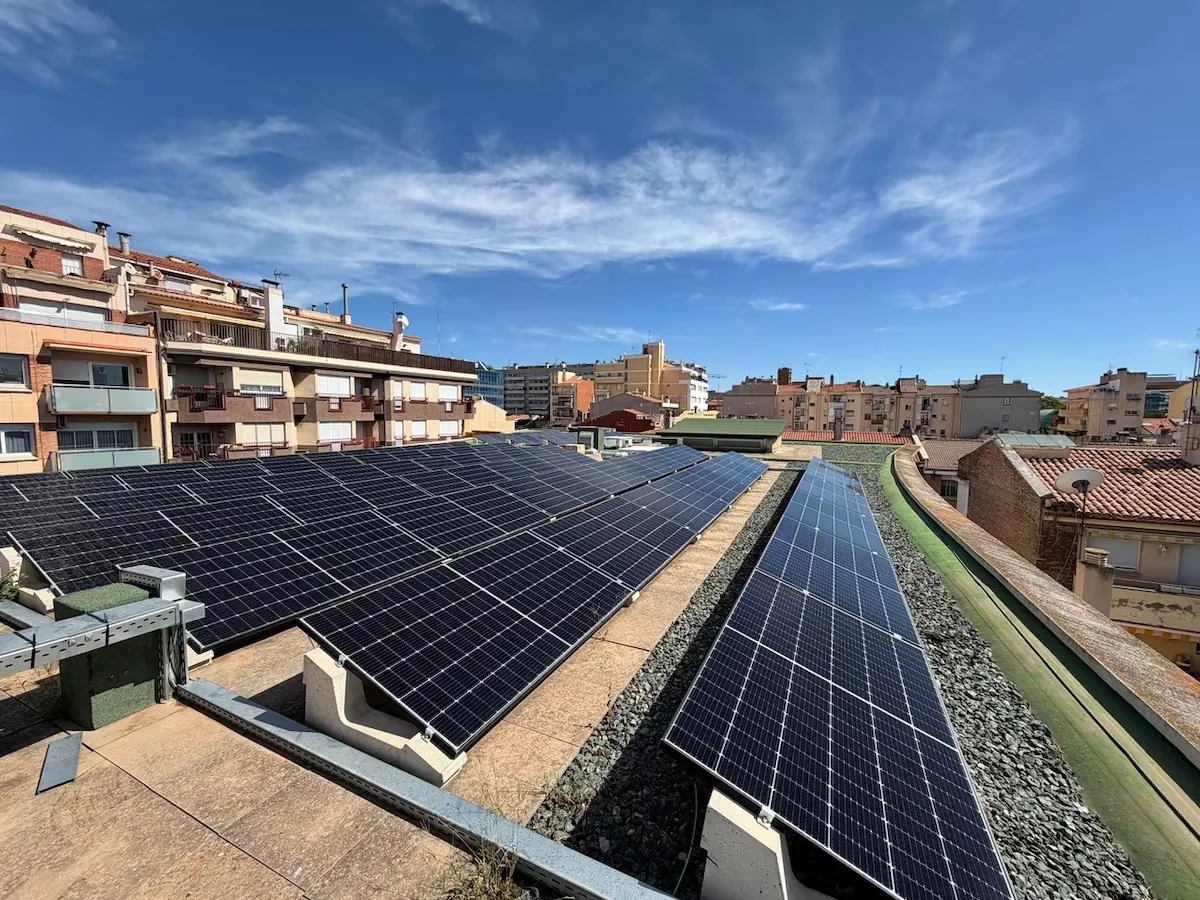
The debate about the energy transition in Catalonia towards renewable energies is marked by a significant obstacle: the rejection by part of the territory to occupy land and landscape to install solar panels or wind turbines. The Renovem-nos collective, made up of personalities from the scientific world and civil society, presented a report this Thursday that dismantles the idea — defended, for example, in a report commissioned by the CUP in the Girona regions — that installing solar panels only on rooftops and on low ecological impact land would be enough to cover Catalonia’s electricity demand. Renovem-nos assures that, over the years, electricity demand will increase, and that if solar panels are only installed on these lands and rooftops, no more than 6% of the demand needed in 2050 will be covered.
The debate about the future of renewable energy is on the Govern’s table. This summer, at the meeting that the President of the Generalitat, Salvador Illa, held with his ministers at the Les Avellanes monastery, Illa marked the energy transition and the implementation of renewable energies as one of the priorities for this second part of the legislature. Catalonia is at the bottom of Spain and the European Union in renewables: the share of green energies in covering total energy demand fell by nine tenths last year, down to 15.3%, which widens the gap to reach the 50% renewables target by 2030, a milestone set by Catalonia’s Energy Outlook (Proencat). The Generalitat has a plan to implement more renewable energy installations throughout the territory, the Plater plan, but it has received criticism and rejection from mayors and environmental entities in different parts of the autonomous community.
One of the arguments for rejection is that it would not be necessary to occupy land with photovoltaic panels that could have other uses such as agriculture. According to various studies, it would be enough to place panels on rooftops and lands with low agricultural intensity and low ecological impact, and with that, 75% of the demand would be met. According to the Renovem-nos collective’s report, these studies published so far have overestimated the capacity of urban, degraded, or low agricultural value lands to produce photovoltaic energy.
The Renovem-nos report highlights that the photovoltaic installations that can be deployed over the next decades on this type of land would only concentrate a power of between 2,970 and 4,580 megawatts of electricity, while the Plater plan’s goal is to reach a photovoltaic power on land of 22,100 MW by 2050. The collective reminds that future demand cannot be calculated based on current electricity consumption, but it must be taken into account that electricity from fossil fuels will no longer be used.
Furthermore, the collective recalls that there are limitations to installing solar panels on rooftops: neighbors may not agree, the weight may be excessive, or the financing too high. For the roofs of industrial plants, there is another problem, according to the report: many of these buildings have insulating foam covers, and insurers would not cover the risks of these surfaces catching fire. Also, placing panels on the margins of roads or railways is complicated because, being very long surfaces, control and security are more difficult. Finally, the possibility of installing solar panels on the surface of reservoirs or on urban and peri-urban lands would present difficulties in covering the entirety.
The entity, therefore, defends placing panels on natural and agricultural land “inevitably.” The potential of solar panels on surfaces of little ecological value is “very insufficient” and will have a deployment pace that is “too slow.”
Read more Robles goes to the CNI in redress for the criticism she has received over the Ceuta crisis