
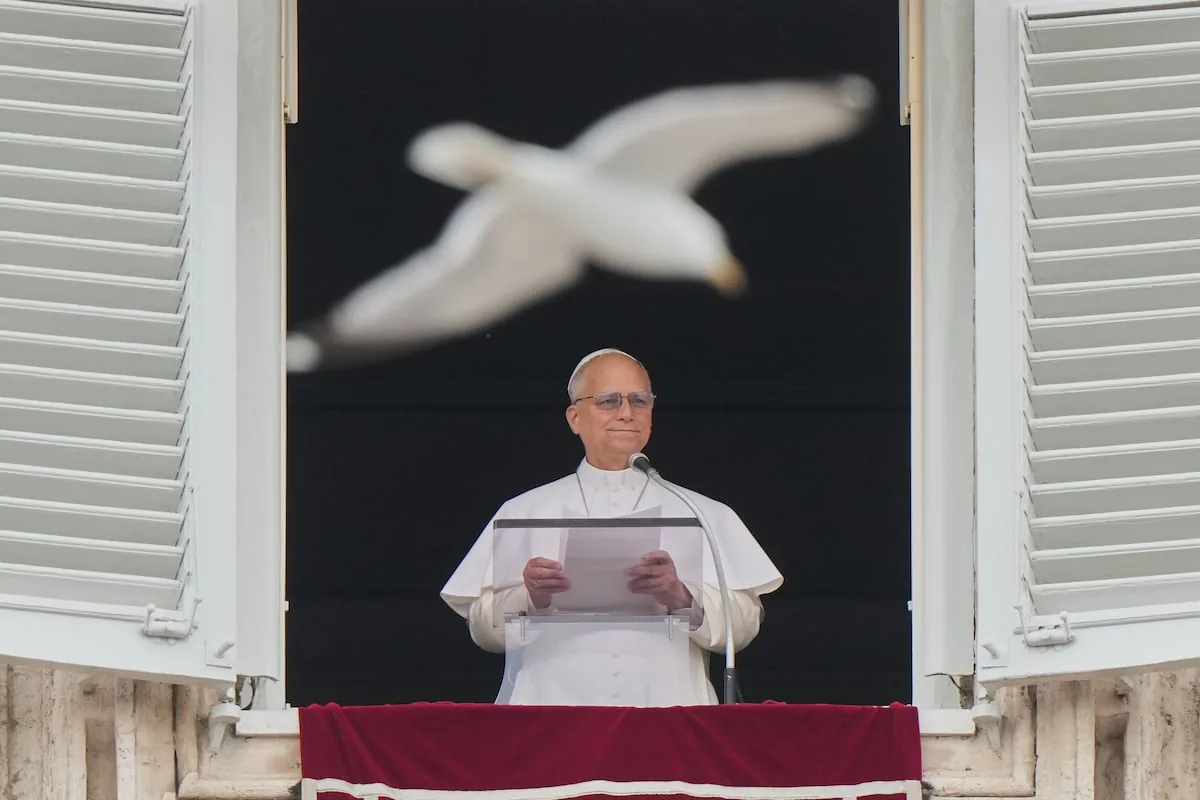
Pope Leo XIV will publish his first encyclical on May 25, titled Magnifica humanitas and dealing with “the protection of the human person in the era of artificial intelligence,” as stated on Monday by the Holy See Press Office in a statement. It will be the first major doctrinal document of his pontificate.
Read more Hansi Flick signs his renewal with FC Barcelona until 2028
This document is expected to establish the Church’s official position on the use of artificial intelligence, which the Pope has already indicated on several occasions must serve the human being and not replace their dignity or moral responsibility.
As a novelty, the pontiff himself will present this papal text next week, on the 25th, at an event to be held in the Vatican and attended by personalities from the academic world and the Diplomatic Corps as guests. This is an exceptional and practically unprecedented gesture in recent history, as none of the recent popes have personally presented one of their documents. Usually, the encyclicals written by popes are presented by the prefect of the relevant Vatican dicastery regarding the document’s subject, by cardinals, or by the director of the Holy See Press Office. The Pope signs the text and commonly comments on it with the faithful during the Angelus or the general audiences he holds weekly, but he usually does not personally participate in the official presentation event, which is generally a press conference.
In this case, Cardinals Víctor Manuel Fernández, prefect of the Dicastery for the Doctrine of the Faith, and Michael Czerny, prefect of the Dicastery for the Service of Integral Human Development, will accompany the Pope and introduce the text.
Also participating will be Christopher Olah, co-founder of the American company Anthropic and research director on the interpretability of artificial intelligence, as well as professors Anna Rowlands, theologian and professor at Durham University in the United Kingdom, and Leocadie Lushombo, professor of Political Theology and Catholic Social Thought at the Jesuit School of Theology of Santa Clara University in California.
The closing words of the presentation event will be given by Cardinal Secretary of State Pietro Parolin, followed by a speech by Pope Leo XIV.
Rerum novarum
Leo XIV signed the encyclical on May 15, coinciding with the 135th anniversary of the promulgation of Rerum novarum by Pope Leo XIII, the text considered the precursor of the modern social doctrine of the Church and which addresses the major challenges of the Industrial Revolution.
With that document, the Church offered a moral and social response to the technological and economic changes of its time. Now, the Pope wants to do something similar in the 21st century. If Leo XIII sought a response to the challenges of industrialization, Leo XIV intends to respond to the challenges of artificial intelligence and the digital revolution. The underlying idea is the same: to emphasize that technological progress must serve the human being and the common good.
The current pontiff has explained on several occasions that he chose his papal name to continue the path marked by Leo XIII. “Today, the Church offers everyone its heritage of social doctrine to respond to another industrial revolution and the advances of artificial intelligence, which pose new challenges for the defense of human dignity, justice, and work,” Leo XIV said in a meeting with cardinals the day after his election, in May last year. He added: “However, today, in an economy dominated by algorithms, platforms, and automation, how can this principle be realized when millions of jobs are at risk of disappearing?”
Read more Dani Carvajal will leave Real Madrid at the end of the season
Magnifica humanitas is Leo XIV’s second major document, after Dilexit te (I have loved you), the first apostolic exhortation of his pontificate, which deals with care for the poor and in which he concluded the work begun by Francis.
Leo XIV has also recently encouraged “commitment to promoting forms of communication that always respect the truth of the human being” in the face of artificial intelligence, in an appeal at the end of the Regina Coeli prayer from the Apostolic Palace last Sunday. “In this era of artificial intelligence, I encourage everyone to commit to promoting forms of communication that always respect the truth of the human being, towards which all technological innovation must be directed,” the pontiff emphasized before the thousands of faithful gathered in St. Peter’s Square.
Leo XIV has made the evolution of artificial intelligence one of the great priorities of his young pontificate. Last week he approved the creation of a commission made up of members from various Vatican dicasteries (ministries) to facilitate the exchange of information and projects on artificial intelligence, including policies for its internal use.
On the other hand, Anthropic has presented itself as one of the artificial intelligence companies most committed to safety and reducing the risks associated with this technology. Therefore, Christopher Olah’s participation in this event at the Vatican alongside the Pope is especially significant and suggests that Leo XIV wants to rely on voices from the sector that advocate for a more cautious and ethical development of AI.
This detail also points to a possible new difference in criteria with the Donald Trump administration.
In February, the U.S. government ordered federal agencies to stop using Anthropic’s technology and took other measures against the company. The reason for the conflict was that Anthropic refused to allow the U.S. military to use its artificial intelligence models without restrictions. The case has reached the courts.
In this context, the presence of an Anthropic representative at the Vatican can be interpreted as a sign that the Pope shares the idea that artificial intelligence must be developed with clear ethical limits and not be put at the service of any purpose without controls.