






While the president of the Junta de Andalucía and candidate for re-election, Juan Manuel Moreno, strives to differentiate himself from Vox and from the governance pacts reached with his party in Extremadura and Aragón, and points to the ultra-right formation as a destabilizing threat to the stability granted by his absolute majority, the federal coordinator of IU and aspirant to the Andalusian presidency, Antonio Maíllo, warned this morning that the useful vote to prevent the “national priority” from being applied in the community does not involve voting for the PP, as his leader preaches, but for left-wing parties. “If Moreno has to pact with Vox to stay in the Junta and has to sign the national priority, he will do it,” said the communist leader. “There is no more useless vote to prevent Vox from governing than voting for the PP,” he stressed.
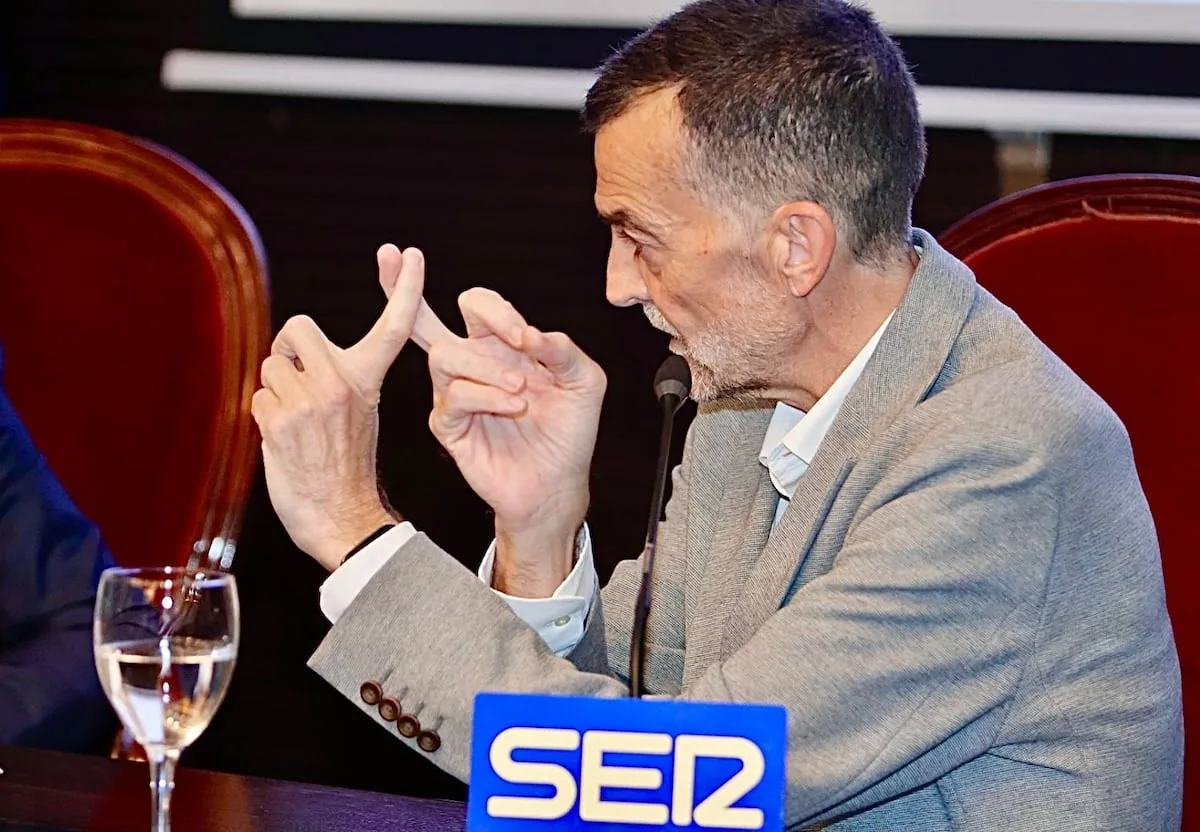
That useful vote is what allowed Moreno to achieve an absolute majority four years ago. A large part of the center-left electorate, disillusioned with the PSOE and faced with the prospect of Macarena Olona, the Vox candidate, becoming vice-president of Andalusia, opted for the PP. “The first time he gave it, the second time he won’t,” Maíllo predicted about that strategy during an interview on Radio Sevilla, Cadena SER. Por Andalucía, like the rest of the left-wing parties, seeks to recover and mobilize that discontented electorate, and its candidate has identified the policies developed by Moreno with those of Abascal, and recalled that he was the first leader to pact with Vox to access the presidency of the Junta in 2018.
“He signed a very transparent pact that had three principles that have been meticulously fulfilled: massive tax cuts for the upper classes, privatization of public services, and an open bar with vulture and investment funds, and he has fulfilled it,” Maíllo stated, pointing out Moreno’s “lack of scruples to achieve his government” and questioning his claim that he wished “not to find himself in the predicament” of having to talk to Vox. “Asking Andalusians not to make him go through that predicament shows immaturity and a lack of stature in the face of the challenge of what the solemnity of a presidency of the Junta de Andalucía entails.”
Maíllo has also defended the proposals in defense of public services in his electoral program, which he presented this Monday. Healthcare —“Moreno’s black hole,” he said— will be a major focus of the campaign, and among the measures he highlighted is the full utilization of public health infrastructures and investment in a 100% public hospital network to end outsourcing. This strategy would include the “acquisition of temporary use of private hospitals” until a public one is built in areas where none exist. An “expropriation of use, not ownership,” the IU leader stressed, in exchange for fair compensation. Another proposal, in addition to hiring 8,000 healthcare professionals, is to prevent service chiefs from combining their positions with work in private healthcare and to limit the compatibility of other doctors to those units whose demand is met. “As long as the public service is not guaranteed, there is no compatibility with the private sector.”
Read more French fries: eight mistakes to avoid and a technique that works
The candidate for Por Andalucía has also assured that if elected, the drug auction will be eliminated, stating that it is a “debt Moreno owes to pharmaceutical companies” and has promised to clarify everything related to the splitting of contracts for the provincial services of the SAS, which are under investigation in the courts, and with failures in breast cancer screening.
Maíllo has also focused on the proliferation of private vocational training offers to guarantee “a public and free place for anyone who wants to complete a training cycle.”
The federal coordinator of IU is optimistic about a mobilization on May 17 that will overturn the polls that agree on Moreno as the winner. Maíllo has appealed to the same spirit that kept Pedro Sánchez in La Moncloa in July 2023, driven, in the case of Andalusia, by citizens’ discontent over the healthcare situation. “Perhaps on May 17, ’16, there will be a July ’23. The key was mobilization, and that is our great challenge: to convince people who have doubts or are undecided to go and vote.”