









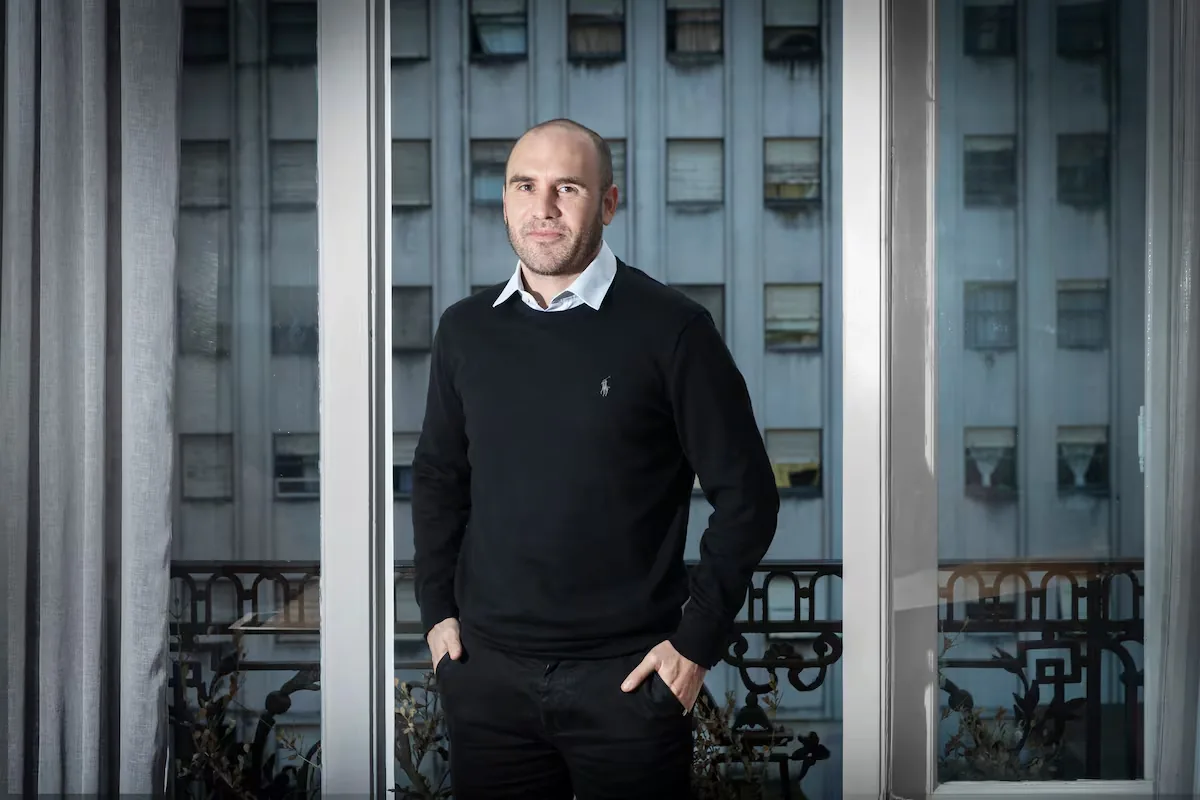
There are 8,500 kilometers of distance and a difference in pronunciation between the two places where Martín Guzmán (La Plata, 1982) lives: Hudson and Hudson. The former Argentine economy minister spends part of his time in a house in that neighborhood in the south of Greater Buenos Aires — which he pronounces udson — and part in an apartment in New York, across the river jadson. In the United States, he is a full-time professor at Columbia University, where he also directs an institute; in Argentina, he teaches at the University of La Plata (a town 60 kilometers south of Buenos Aires) and leads a consultancy that allows him to maintain ties with the main economic and political actors in the country.
In December 2019, a call from the president-elect, the Peronist Alberto Fernández, made him leave his career abroad and return to Argentina, where he went from being an unknown — at most, an academic associated with Nobel Prize-winning economist Joseph Stiglitz, his mentor — to leading the hottest ministry in the country. From there, Guzmán’s vision began to open an internal rift with the vice president and architect of the presidential ticket, Cristina Fernández de Kirchner. While Kirchner prioritized maintaining spending as a tool to preserve demand and social welfare, Guzmán believed that lowering inflation and stabilization required moving towards greater balance in public accounts. The tension between these two views turned into an open war and hindered the management’s progress until it ended with Guzmán’s forced resignation in July 2022.
Question: Javier Milei managed to instill in Argentine society the idea that pursuing fiscal balance is desirable. At the same time, there is growing discomfort over the consequences of adjustment. Is there a way to reconcile a progressive approach to the economy and the order of public accounts?
Answer: It is possible and necessary because fiscal sustainability is a condition for the economy to function well. In Milei’s case, the adjustment was concentrated in items with consequences for productivity, such as investment in public works and university education. At the same time, he reduced taxes on the segment with the greatest ability to pay. In 2021 [during his administration, after the first year of the Covid-19 pandemic], the reduction of the fiscal deficit occurred with a recomposition of public spending, even increasing investment in public works, but decreasing other expenses — operating costs and also extraordinary pandemic items — and an improvement in tax collection. The desirable thing would have been to continue in that direction, advancing more quickly with the reduction of subsidies for energy consumption.
Q: Is there a difficulty for progressive governments to talk about fiscal order?
A: The problem has been more visible in Argentina, but it was not all of progressivism. In our government, one part insisted a lot on that and another did not see the problem of poorly financing fiscal deficits, which generated a conflict. But more cohesion is needed in the principle that fiscal sustainability is also a guiding principle of any scheme aimed at social justice. Otherwise, the most vulnerable end up paying with inflation, which affects those with the least ability to protect themselves the most.
Q: Is there anything Milei did that you would have liked to do?
A: In the general scheme, the differences with Milei are very large, but the premise that it was necessary to reduce the deficit is something I supported during the administration. We also agreed that inflation should be at the center of economic policy objectives and that issuing currency, when it does not improve demand for money, generates inflationary pressures. However, I believe there is an exaggeration in the weight given to the purely monetary issue as a determinant of inflation; other factors such as expectations or inertia also have an impact. In fact, Argentina currently has inflation of around 2% monthly despite there being no Central Bank financing to the Treasury.
Q: What do you think are the limits of this economic scheme?
A: The fundamental problem with Milei’s economic policy scheme is that it does not generate prosperity for the real economy. Today we have a real economy in urban areas that is stagnant or declining. The economy grows a little — the expectation is for growth close to 2% this year — but this is mainly explained by four sectors whose growth does not result in increased employment: agriculture, energy, mining, and financial intermediation. The rest of the economy is suffering, and three sectors that are engines of employment and activity in urban areas are in decline or stagnation: industry, construction, and commerce. So the economy grows a little, but many people are worse off than before.
Q: On what basis do you say that people are worse off?
A: Real wages in these sectors are below the level they were at the beginning of Milei’s government. We see that millions of people have gone into debt and there is a record delinquency rate for personal loans in Argentina: 12.5% of bank portfolios and more than 30% of virtual wallets and fintech portfolios are delinquent. This is because people took on debt to maintain their consumption levels or to make small investments that would allow them to work in informal sectors (for example, buying equipment to cut hair or a motorcycle for delivery), but then their income was not compatible with repaying those debts due to the very high interest rates they have.
Q: How could the rest of the economy be linked to those four growing sectors?
A: It does not happen by itself; that growth will not spill over. Today we see that, despite GDP growth, tax collection falls precisely because the sectors driving economic growth are paying less tax. And the tax burden will continue to be reduced because the government has granted them special regimes, such as the RIGI. This means that these sectors do not share their profitability, which limits the state’s ability to invest in infrastructure or education, which increase productivity.
Q: The government would say that those sectors grow precisely because they were incentivized to invest with favorable frameworks.
A: Not at all. Those sectors were growing before the RIGI, especially hydrocarbons. The point that triggers the sector’s transformation is the nationalization of YPF in 2012. I think they would be growing regardless of the government’s political orientation, and I also know this because I was close to this situation. Many projects announced under the RIGI were going to happen anyway; they were already planned. With the sector’s level of productivity and competitiveness, it is profitable even if it pays 5%, 10%, or 20% income tax. The sector’s demands never revolved around that; they were about clear rules for profit remittance and access to the foreign exchange market for currency purchase.
Q: The official version says we are suffering the consequences of the transition from one model to another and that we will find a new equilibrium scenario in which industries that were not profitable, such as textiles, will be reconverted or adjust their size to real demand. Would you support those industries that are currently in crisis again?
A: I don’t see the point in protecting industries solely for job creation, but to have that discussion and evaluate which sectors are viable or not, we would need an economy that is functioning reasonably, where there is demand. What I see today is disinvestment in those sectors that determine what economists call “dynamic comparative advantage.” The discussion is not whether development comes from protecting a sector or not but what role the state will have in supporting investments in technology, infrastructure, and knowledge, key for the private sector to have better productivity conditions.
Q: You renegotiated the $45 billion debt with the IMF contracted by Mauricio Macri in 2018, and then Milei added another $20 billion loan with the organization in 2025. How should a new debt reduction process be approached?
A: Today the country pays very low interest rates on external public debt with the private sector, averaging 3% in dollars, and maturities are being refinanced via the local market. For now, the situation remains manageable. With the fund, there will be a problem. Argentina is the world’s largest debtor to the IMF, owing approximately $56 billion, explained by the loans agreed upon by Macri and Milei. Both, from my understanding, violated the IMF’s own rules and were politically motivated loans to help these individuals win elections. They did not have the broad political support required by the organization nor, in Milei’s case, the backing of Congress mandated by law.
Q: Would that argument serve to disavow the debt?
A: I would not go that far because these debts were taken on by governments elected by the people, and the concept of odious debt has a different definition. However, I do think negotiations should be conducted so that there is no imposition of conditions that worsen how Argentine society lives, because here there are two parties responsible for this situation: the debtor and the creditor. Conditioning a sovereign country’s government for a debt given to influence an electoral outcome is unacceptable.
Q: How important is it for political and economic leaders to understand this new power ecosystem in which technomagnates have great influence?
A: Today we have a huge, defining problem for humanity, which is inequality. It has escalated to unprecedented levels and has political and geopolitical consequences, inequality in power. I see it necessary to tax wealth because otherwise, we will have much more unstable societies. There is no way to address the social imbalances generated by technological evolution and the distribution of its gains without sensibly taxing wealth. This must be at the center of the world leaders’ agenda, and I believe organized action by peoples through governments is fundamental.
Q: Learning from the past, and looking ahead to the 2027 presidential elections, should progressivism be working on a unified vision on these issues?
A: There are three things necessary to win an election and govern Argentina well: leadership, message, and teams. The message is what the vision is, what the program is. What often happens is that there is leadership, even if ephemeral, but there is no unified message. Then, sooner or later, conflicts begin to appear when reaching government.
Q: Would you be interested in having a role in public administration again?
A: Without a doubt, I will be involved as long as there is a project with which I identify. It is in my DNA, and my motivation has to do with how we can organize ourselves and be better in Argentina.