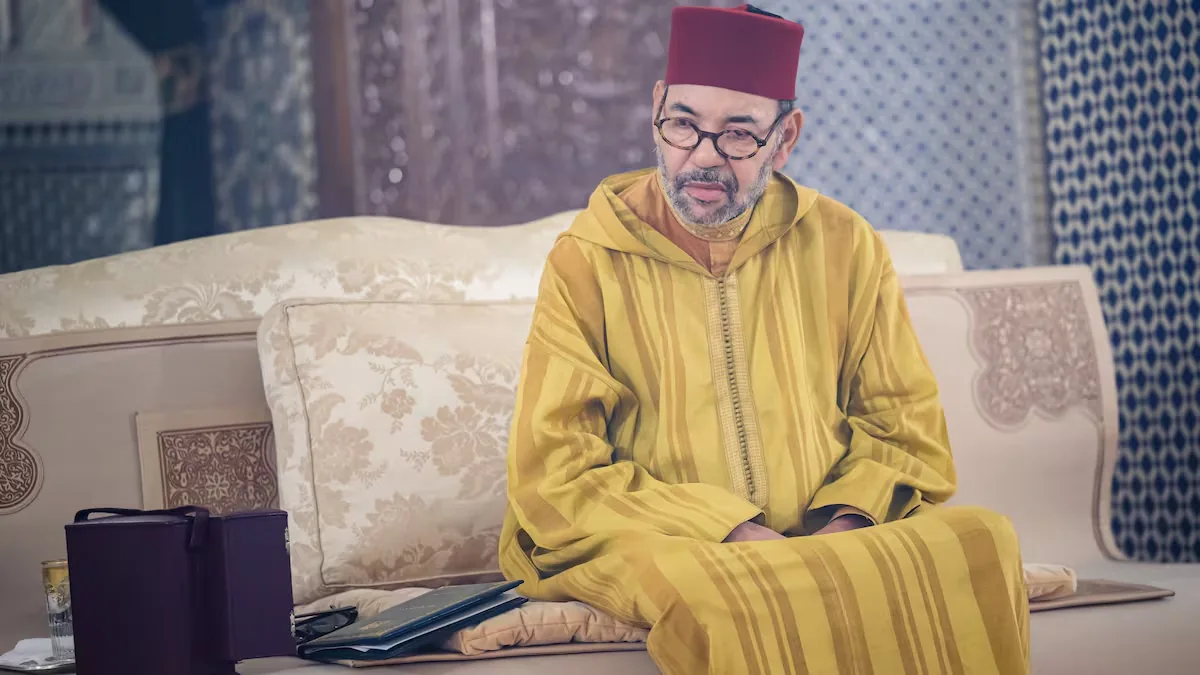
After staying for nearly two months in northern Morocco —mostly at his summer residence in Mdiq (Rincón during the Spanish Protectorate era, just 30 kilometers from Ceuta)— King Mohamed VI returned to Rabat to participate on Monday night in an Islamic celebration. In his capacity as Commander of the Faithful, the sovereign of the Alaouite dynasty presided over a religious evening at the royal palace mosque in the capital for the Al Mawlid festival, which commemorates the birth of the prophet Muhammad, accompanied by his son and heir to the throne, Mulay Hasan, and by his brother Mulay Rachid, second in the line of succession.
In a speech delivered during the religious event, the Minister of Islamic Affairs, Ahmed Tufiq, alluded to Morocco’s historic claim over Ceuta and Melilla, according to the state news agency MAP, cited by Europa Press. Tufiq subtly referred to the two autonomous cities by mentioning Islamic scholars born in Ceuta at a time before that North African territory came under Spanish sovereignty, in 1580. He cited the caid Ayyad, who died in 1149, and Abu al Abbas al Zafi, who died in 1236. He also mentioned Imam Mohamed Al Jazuli, who died in 1465, whose works inspired Moroccans, according to the minister of religious affairs, “in their sacred struggle to liberate the occupied cities,” at a time when Portugal controlled several ports on the Atlantic, such as those of present-day Al Jadida and Essaouira, and since 1415 Ceuta, a place that passed into Spanish hands more than a century later.
While the monarch, who has just turned 63, has returned to Rabat, the parties forming the government coalition are taking positions on the migration crisis triggered in Ceuta on July 30 and 31, as the legislative elections scheduled for September 23 approach in the Maghreb country. Prime Minister Aziz Ajanuch, who attended the religious ceremony on Monday alongside the monarch, has remained silent since the beginning of the crisis. After it was revealed that he traveled on a private flight to Mallorca shortly after up to 80,000 irregular migrants overwhelmed the Ceuta border due to the inaction of Moroccan security forces, he has made no significant public statements during the crisis.
Ajanuch, whose family controls Morocco’s second-largest fortune, behind the Al Mada group, which is in the hands of the Alaouite royal family, has positioned himself as the candidate of his conservative party, the National Rally of Independents, to once again head the Cabinet after the elections. The Moroccan press has recently placed him on a tour of the Atlas region in the south of the country, where nearly three years ago a strong earthquake claimed almost 3,000 lives and damaged more than 60,000 homes. After the massive social protests of Generation Z last fall, in which thousands of young people demanded the king to dismiss the ruler, the prime minister has seen his already low political profile reduced.
The leading voice on the crisis
The one leading Morocco’s voice on the migration crisis is neither the head of government nor the government spokesperson. The Ministries of Interior and Foreign Affairs, whose heads are appointed by the monarch and not by the prime minister, have issued statements or directly informed news agencies, without entering the political debate.
The one speaking about Ceuta from the government is the Minister of Justice, Abdelatif Uahbi, the same who has demanded that Spain hand over “all” unaccompanied minors of Moroccan nationality who remain in the autonomous city. He has also linked the acceptance of the bodies of deceased migrants (up to 141, according to estimates by Moroccan NGOs) when trying to reach Ceuta’s territory to the effective return of children and adolescents. The request for the return of minors was already made in the last three weeks by the Ministries of Interior and Foreign Affairs, which invoked “royal instructions.”
As leader of the second force in the tripartite Cabinet, the Minister of Justice is in full campaign for the legislative elections on September 23, supporting his party’s candidate who aspires to become prime minister. This is Fuzi Lekjaa, a technocratic-profile Budget Minister and also president of the Royal Moroccan Football Federation for 12 years, expected to lead the government of the 2030 World Cup according to Moroccan press analysts.
When asked on Saturday by Al Arabiya whether Morocco had investigated the images showing tens of thousands of young people crossing the Tarajal breakwater before the impassive gaze of Moroccan border agents, Uahbi said: “We are following the matter. I saw many young people, children, and adolescents heading towards Ceuta (…) but if we had clashed with them, we could have caused many deaths. That is why we prefer to manage the crisis prudently.” “Some young people said: ‘I want to enter Ceuta because Ceuta is Moroccan.’ How could I prevent them from thinking that way?” the minister added.
Uahbi was involved last year in a scandal of alleged real estate fraud and tax evasion. After revelations by a group of hackers about his bank accounts, opposition parties accused the Minister of Justice of having transferred one of his properties to his wife for a tenth of its real value: one million euros. He then declared himself a victim of “a settling of scores” by a “fifth column” that manipulates leaks from foreign actors “spread without verification from obscure places,” evoking a silent internal power struggle.
The “occupied presidios”
The third member of the coalition in power since 2021 is the historic Istiqlal Party (Independence), with a marked conservative and nationalist tendency. The claim of the “Moroccan-ness” of Ceuta and Melilla as “occupied presidios” by Spain is part of its political DNA, although in the current migration crisis it has chosen to remain in the background. Its traditional mouthpiece, the newspaper L’Opinion, has limited itself to cheering the statements about Ceuta by Minister of Justice Uahbi.
Three years ago, Enaam Mayara — president of the Moroccan Chamber of Advisors (equivalent to the Spanish Senate) and a senior Istiqlal leader — had to backtrack after stating at an event of his political organization that Morocco would someday recover those “occupied cities through negotiation.”
Mayara then received criticism from the official Moroccan press for his slip in front of the Spanish government, which had carried out a diplomatic rapprochement with Morocco a year earlier with a shift in favor of the autonomy plan for Western Sahara. The following year he left his position in the Upper Chamber. From Barlamane, an information portal attributed with close ties to security services, he was accused of not having lived up to the obligations of his high office.