









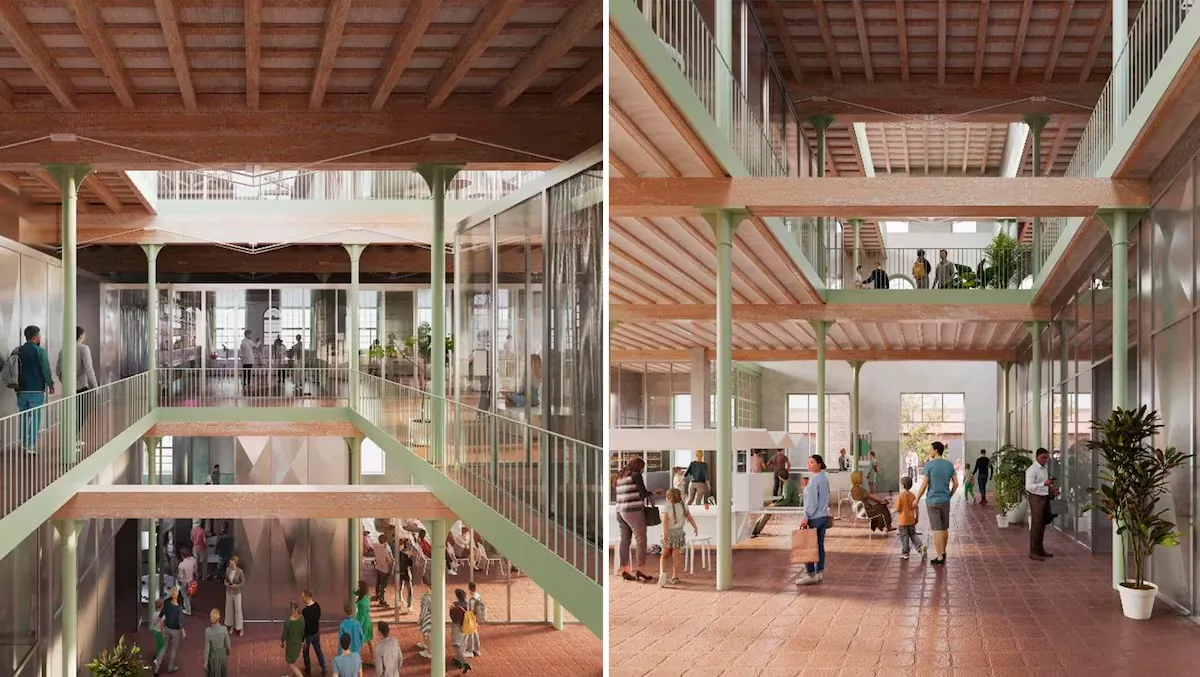
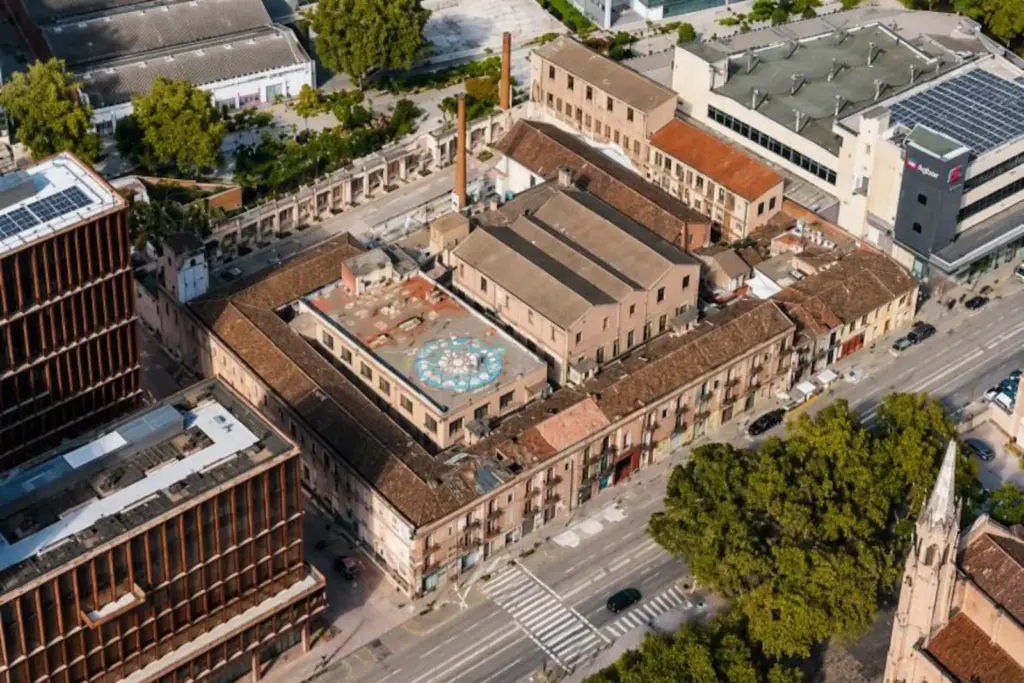
The former industrial site of La Escocesa, in Poblenou, Barcelona, municipally owned and where the only current activity is an artistic creation center, will be rehabilitated to host a mix of uses: cultural, social inclusion, employment, food research, residential, and educational. The complex, covering 11,500 square meters across seven warehouses, two of which are for the residence and artistic creation center, was purchased by the government of former mayor Ada Colau in 2017 with the idea of creating housing, but it had stalled. The total planned “minimum” investment is nearly 52 million euros, half of which is contributed by the city and the rest by public or private entities that will participate. The idea is for private initiative to invest, with concessions of up to 40 years, but at prices far from the market rates in the area. The schedule foresees completion in 2029.
Mayor Jaume Collboni has presented the project “in the final stretch of the term” and highlighted that “it has been many years in the making, hand in hand with people, entities, and administrations.” “It is a leap from an industrial project to a collective one,” completed over a space located on Pere IV street, in what is known as 22@ Nord, the part of the technology district that is less developed, but where large office buildings have recently been constructed and are not fully occupied.
“It is an area with very significant potential and we want the projects of La Escocesa to represent different ways of making the city, with a more social and cooperative character,” he celebrated about a space whose transformation is “highly anticipated by the Poblenou neighborhood.” Between the rehabilitation and the activity, up to 500 jobs could be generated, both direct and long-term indirect. Among the institutions participating in the project are Mercabarna and the Generalitat, and the Ampans foundation, which works with people with disabilities.
La Escocesa manufactured textiles and chemicals for the industry itself until the 1980s and partly remained active until the late 90s with a workers’ cooperative for the industry itself. Like many others, it was saved by neighborhood pressure until the city bought it.
Getting into specifics, the Johnston and Foseco warehouses will maintain activity as a space for creation and artistic residence (currently there are 30 resident artists with workshops and 40 members who use the common spaces). The Steegmann Birkhead and Paul warehouses will host an innovative inclusion center managed by the Ampans foundation where there will be housing (72 units) for people with disabilities, labor insertion activities, and an inclusive art center. The Klein warehouse will be a hub for social and solidarity economy linked to the ecosocial transition. And in the Shield warehouse will be the Barcelona Foodlab for innovation in agri-food technology.
Deputy mayor Raquel Gil has pointed out that “the project has the virtue” of combining public investment or intervention, but also private or from entities. “The entities commit to making their project viable, but also to investing in the rehabilitation.”
Over the last 20 years, and like many industrial spaces in Poblenou, La Escocesa has been illegally occupied for living. The last occupants were evicted by the City Council last October.