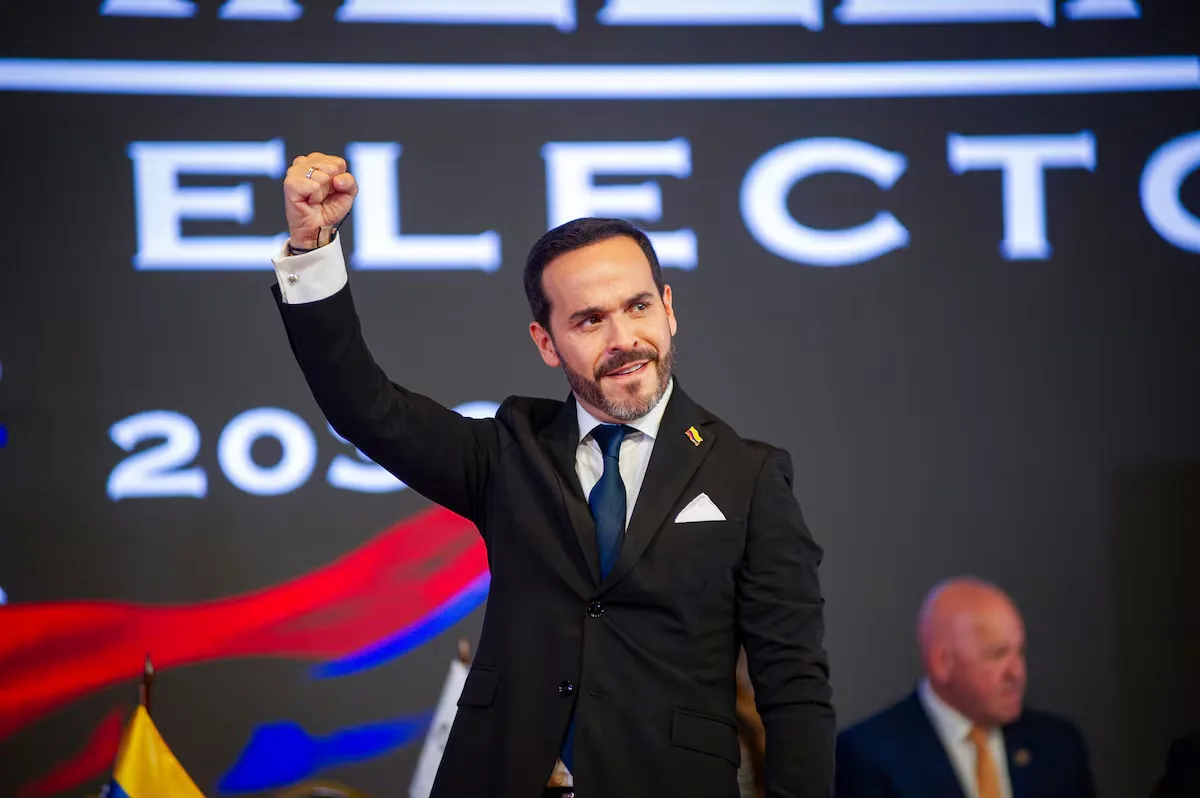







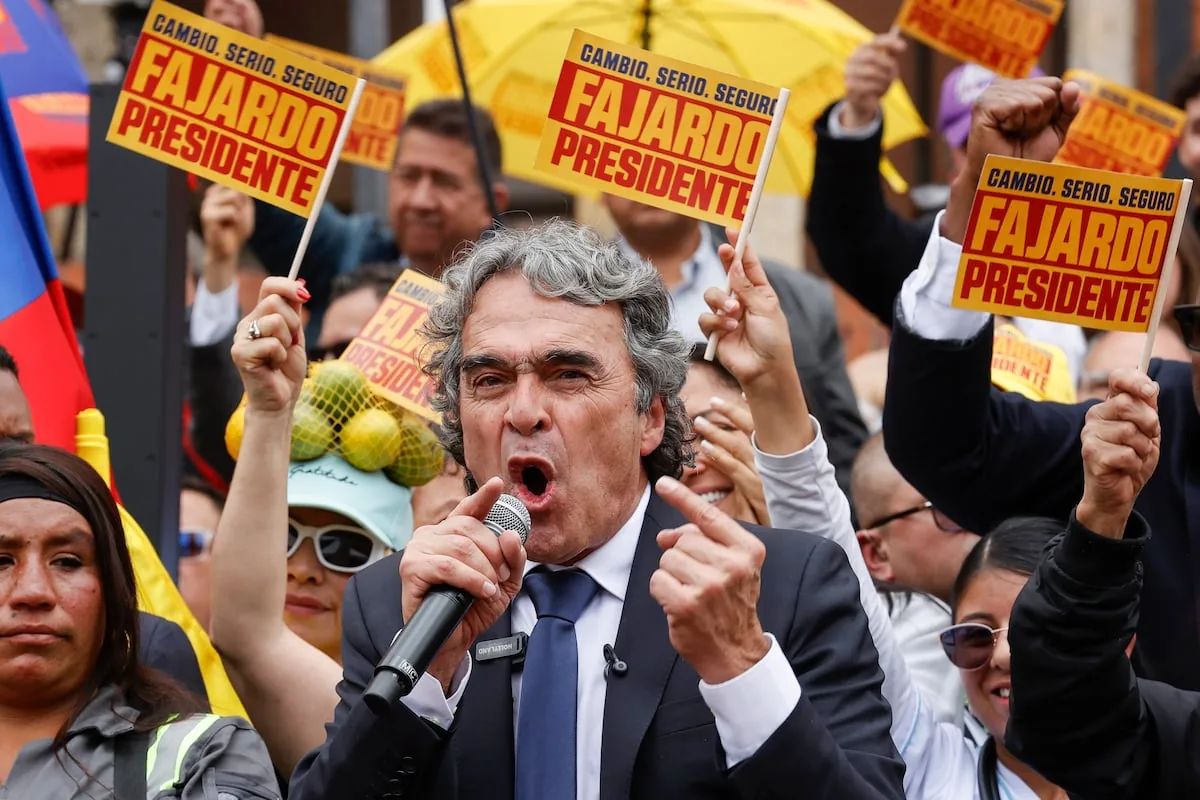
Presidential candidate Sergio Fajardo seeks to break the polarization between Uribismo and Petrismo. “I am convinced that there are valuable and committed people on the left, center, and right,” he says in his government program for the elections on May 31. His proposals stem from a harsh criticism of Gustavo Petro’s Government, especially on issues such as security, health, and fiscal policy. “The first priority is to restore the country’s stability,” he emphasizes, with solutions such as training 40,000 police officers, strengthening funding for Health Promoting Entities (EPS), and adjusting public accounts. On the other hand, he presents a social agenda that takes up some of the Executive’s achievements and goes as far as proposing a universal basic income. Neither Uribista nor Petrista, the centrist wants to challenge the right on security and the left on equality.
Read more Sheinbaum and the Progressive International
“Petro’s Government has had more failures than successes, especially on issues like total peace. But we also try to rescue the good, such as advances in land delivery,” comments Juan José Echavarría by phone, an economist who serves as the campaign’s programmatic chief and who will be the Minister of Finance if Fajardo reaches the Casa de Nariño. Some issues that passionate the centrist candidate, such as education, have taken a back seat. “From the supply side, it’s a lifelong passion for Sergio. But, from the demand side, in terms of how people see their needs, security now occupies a more prominent place,” he comments.
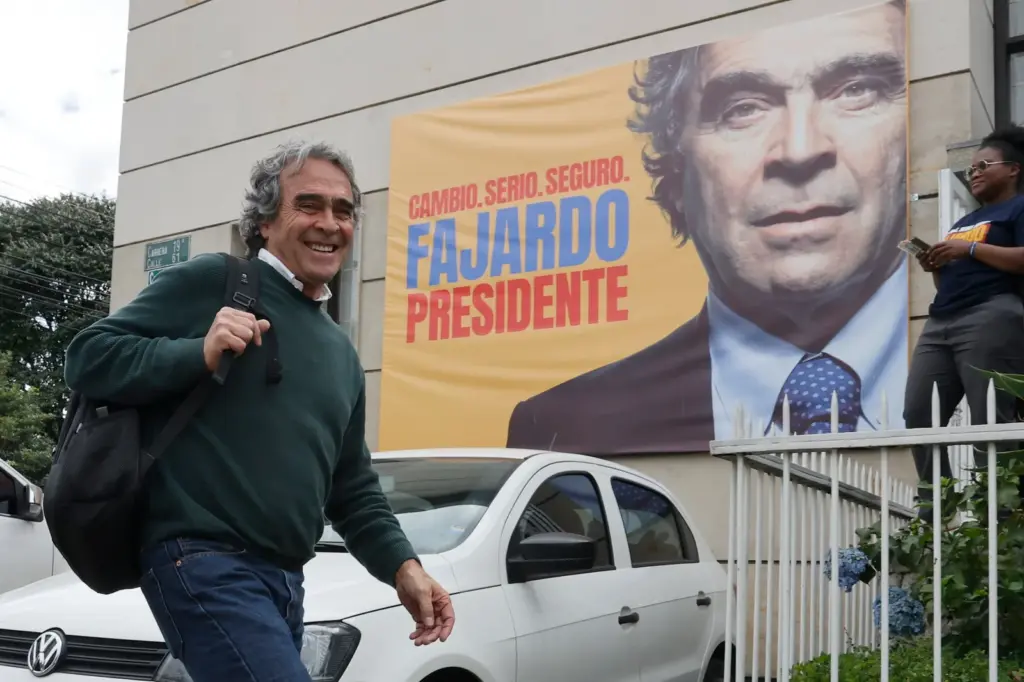
The program, a 62-page document, bears the new hallmarks of the now three-time presidential candidate: the color yellow has displaced green, and the motto is “Change. Serious. Secure.” A hundred people worked for a year on 21 topics, grouped into three sections. The first chapter is titled Crisis. Secure Recovery and focuses on how to address the problems that Petro’s Government will leave in sectors such as health and energy. The second, Hope. Colombia Forward, revisits Fajardo’s historical commitments to develop the country, with an emphasis on education and artificial intelligence. The closing, Dignity. Serious Social Commitment, focuses on the pursuit of equality and promises to prioritize historically excluded groups —women, indigenous people, Afro-Colombians, LGBTI population—.
Security, a banner that Fajardo seeks to challenge the right on, occupies the first place on the list of priorities after the Government’s failed total peace policy and the crisis of intelligence services. “In the first 100 days, we will recover strategic intelligence and joint work between the Attorney General’s Office, the Financial Information and Analysis Unit (UIAF), the Military Forces, and the National Police to attack the finances of organized crime,” the program assures. It also promises to increase the police force by 40,000 uniformed officers and build five new prisons “to reduce overcrowding and free up more than 3,000 police officers who currently guard detainees in stations and judicial units.”
Health, an issue that has gained prominence in this campaign due to the system’s crisis, has more nuances. On the one hand, Fajardo distances himself from the Government by pointing to state underfunding as one of the main problems. “The Capitation Payment Unit (UPC) will be recalculated with technical criteria, and an independent institution will be created for its calculation and monitoring,” the text says, referring to the amount the State transfers to EPS for each affiliate and which the Constitutional Court has ordered to increase. At the same time, the centrist candidate addresses concerns about the inefficiencies of insurers and even corruption. “We will conduct independent audits of the EPS and strengthen the Superintendency of Health,” he promises, while also stating that he will pay “legitimate” debts. Also, in line with the Executive, he advocates for Primary Health Care centers to strengthen disease prevention.
Something similar occurs in energy policy. Like Petro, Fajardo seeks a transition towards “an even cleaner matrix.” He promises to unblock wind and solar projects in La Guajira and there are no mentions of coal. The big difference with the Government is that he emphasizes that the transition must be “gradual” and he will support initiatives that expand gas and oil reserves. Issues such as “responsible hydrocarbon exploration,” he believes, are not antagonistic to clean energies, but complementary. “Resources from oil and gas will be key to financing the energy transition and the country’s development.” Unlike a few years ago, the candidate has now opened up to fracking (hydraulic fracturing), with pilot projects that “can be developed under strict independent technical and environmental evaluations.” Ecopetrol will seek to add international projects such as that of the Permian basin in the United States, which uses fracking.
One of the major concerns is the fiscal deficit, which reached 6.4% of the Gross Domestic Product (GDP) in 2025. Fajardo promises “an adjustment plan” to cut state spending without having to increase taxes. The main bet is a gradual reduction of gasoline and diesel subsidies. Other specific sectors are not mentioned, but rather ambiguous references to “items without social impact” and “unnecessary administrative expenses,” such as the excessive use of official vehicles. The program also proposes combating evasion with more robust sanctions.
Economist Echavarría acknowledges that it may not be enough to resolve the fiscal crisis, especially due to the investments required to also meet ambitious goals in security, health, or education. “If we don’t achieve the deficit targets with the adjustment, we could consider taxes. But that would be the last resort,” he says. He emphasizes, however, that for now “a credible adjustment plan for investors” is the priority and that administrative expenses have gotten out of control in Petro’s Government.
Read more The murder of Edith Guadalupe Valdés shakes the feminism of the 4T
Traditional Banners
Fajardo has also championed his traditional banner of fighting corruption, which he has sought to symbolize on social media through brooms that, he promises, will sweep away the rot in the State. He has included this axis in the crisis and stabilization section, an implicit reference to the numerous scandals that have marked Petro’s Government. It includes proposals such as a law to regulate lobbying, a system so that all contracts can be monitored “in real time” by citizens, and the transformation of the Secretariat of Transparency into an Anti-Corruption Agency, with personnel selection “based solely on merit and integrity.”
Education has been relegated to a more secondary role. Although it was showcased as the main banner when Fajardo presented Edna Bonilla as his vice-presidential running mate at the National University, it now doesn’t even appear in a proposals section on his website. The program mentions measures such as creating kindergartens, strengthening Icetex credits, and adding 150,000 students to the National Learning Service (Sena). It questions the emphasis Petro’s Government placed on expanding higher education coverage and points out that improving teaching quality is a priority. In line with Fajardo’s profile as a mathematics professor, there is a specific point on strengthening the teaching of this subject and another on prioritizing STEM (Science, Technology, Engineering, and Mathematics) areas. Humanities are not mentioned, while arts education appears in the culture section.

The foreign policy section is limited to general guidelines. It promises to reestablish “a solid and trusting relationship with the United States,” while consolidating “a strategic alliance” with the European Union, a “pragmatic relationship” with China, and greater integration with Latin America. With Venezuela, it proposes “democratic pragmatism: zero complicity with the regime, but open diplomatic channels” to promote a transition and take advantage of trade opportunities. It also promises to restore the diplomatic career “with merit-based appointments,” in a veiled criticism of the current Government’s political designations.
One of the most innovative sections is the Guaranteed Minimum Income, a clear nod to the left. It will build upon the existing Citizen Income, a Petro Government program with periodic subsidies of 500,000 pesos to combat extreme poverty. It will improve this program, he assures, with “clear rules for access, permanence, and graduation.” It will prioritize children, youth, and older adults, and will have a variant of temporary support for unemployed people or those facing emergencies. Economist Echavarría points out that its universal aspiration, as proposed in several European countries, may be too ambitious: “No one in the world has it yet. So I see it as an idea for the future, something that will be considered long-term.”
Another novelty is a proposal to reform the mechanisms for electing the attorney general, prosecutor, comptroller, and magistrates. The program states that there will be “public calls and independent technical evaluation,” without going into further details. Echavarría clarifies that the objective is for the president to stop participating in the composition of candidate shortlists to avoid politicization, but there are still no definitions on the alternatives.
The battery of measures is completed with the reduction of procedures for creating companies, the launch of a tourism program for low-income children and adolescents to travel the country, the creation of National Artificial Intelligence Olympiads for students, and the promise to expand health coverage for trans people. Meanwhile, the campaign has opened a new front beyond the program: collecting signatures to call for a referendum to prevent a Constituent Assembly, as proposed by Petrismo. For Fajardo, Colombia does not require an epic refoundation. The necessary changes, he assures, are already in his government program.