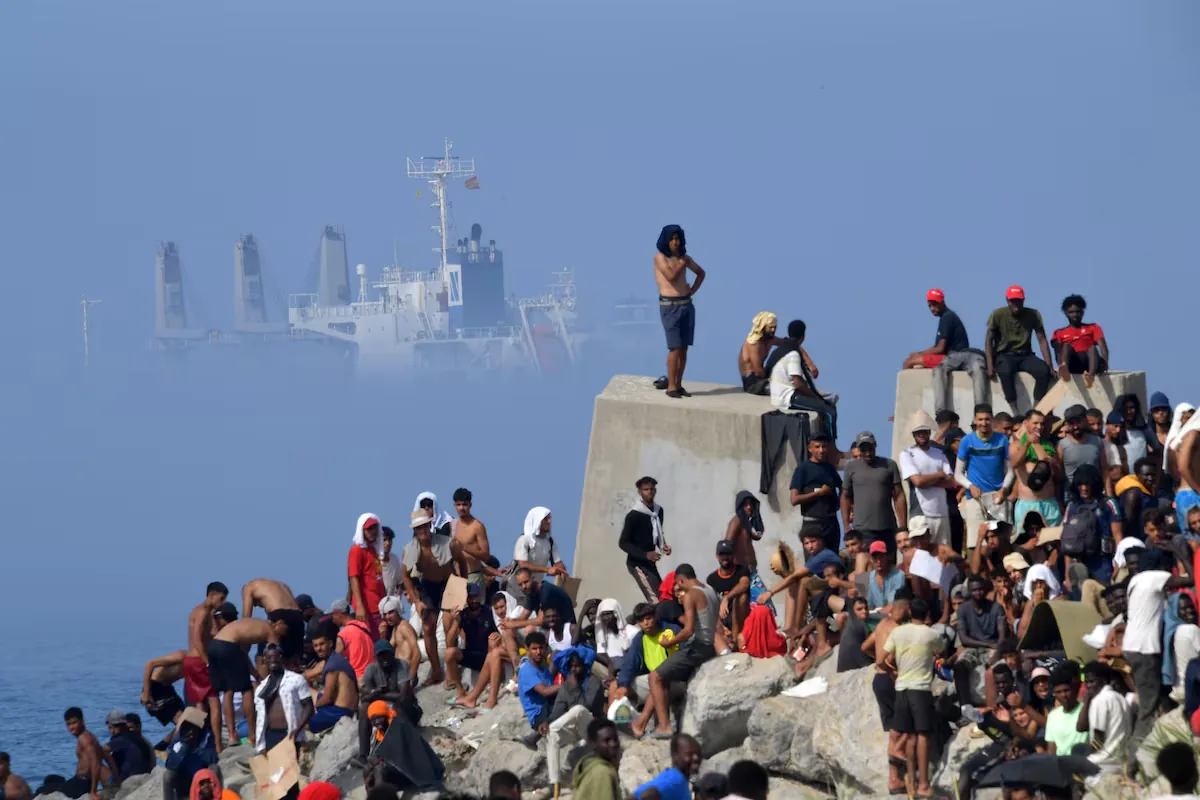
This Saturday is marked in red on the calendar of the Ministry of the Interior officials, but also on that of the Moroccan authorities. For days, messages have been circulating on social media encouraging a repeat of the scenes experienced on July 30 and 31, with thousands of migrants entering Ceuta irregularly by swimming, skirting the El Tarajal breakwater. “The Ceuta border will be open on the 15th [of August], a holiday in Spain,” some messages spread online say, encouraging participation in a new massive incursion. In response, Rabat has reinforced the Fnideq border post (Castillejos in its Spanish colonial name) with hundreds of security forces supported by military troops, as seen in videos circulating for almost a week on digital media in the Maghreb country. Images have also been shared of the installation of concertinas and barbed wire on the fences marking the border limit on the Moroccan side.
Read more Hunt, 100m and 200m champion, fulfills her wish: “I want it all”
“All necessary measures have been taken to prevent any attempt at illegal crossing and to intercept anyone trying to participate in it,” said Rachid el Jalfi, spokesperson for the Ministry of the Interior, on Wednesday, describing the current deployment as part of a “continuous surveillance system” at the Ceuta and Melilla crossings. El Jalfi urged citizens to ignore calls considered “suspicious and misleading,” which pose “serious risks to people’s safety.” On the other side of the border, Interior Minister Fernando Grande-Marlaska emphasized the same message on Thursday during a press conference on his second visit to the autonomous city: “I tell them not to listen to the mafias that play with their lives. None of them will stay [in Ceuta], none of them will go to the peninsula, none of them will be regularized.”
On the Spanish side of the border, the reinforcement of personnel has also been significant, according to data provided by the minister on Thursday. Since the start of the crisis, the number of police and civil guards deployed has increased from just over 1,100, which made up the staff of both forces, to nearly 1,600 currently. Additionally, 2,000 military personnel have taken on support functions. However, these efforts are not only focused on the border but also aim to make the presence of agents more visible on the streets — the minister admitted that restoring “normality” to Ceuta from July 29 “will obviously take time” amid complaints from residents about insecurity — as well as speeding up the expulsion of the 5,000 irregular migrants still in the city. Marlaska thus once again shows his confidence since the crisis broke out that Morocco will assume much of the responsibility for stopping any attempt to repeat a massive entry this Saturday. “It has always been, is, and will be extraordinary and exceptional,” the minister said when asked about cooperation between Madrid and Rabat, even when reminded of the previous serious incident at the Ceuta border, the entry of 10,000 migrants in May 2021.
As an example of this willingness to prevent a new migration crisis, Moroccan authorities have reported detecting numerous messages on social media organizing and coordinating a new massive crossing this Saturday towards the Spanish autonomous cities. Several people have been arrested and prosecuted after being accused of spreading false information to facilitate irregular migration, according to the Interior spokesperson to the state news agency MAP. However, in line with what was anticipated by Rabat’s Ministries of Foreign Affairs and Justice, the Interior Ministry calls on Spanish authorities to assume their responsibilities and accelerate, for example, the return procedures for the thousands of Moroccan minors who entered Ceuta — Marlaska said on Thursday that 1,898 had already been placed under guardianship — along with tens of thousands of adults. The Moroccan Interior Ministry also insists on the official claim that the fight against irregular migration and human trafficking networks cannot depend on the efforts of one party alone and demands shared responsibility to apply the “immediate return” or shared responsibility mechanism.
While the Ministries of Foreign Affairs and Interior, whose heads are directly appointed by King Mohammed VI, maintain an institutional diplomatic discourse in the current migration crisis, the Minister of Justice, Abdelatif Uahbi, is adopting a confrontational political profile with Spain. As one of the main leaders of the Authenticity and Modernity Party (PAM, center-right), Minister Uahbi is campaigning for the legislative elections to be held on September 23, in which the candidate from that political force, Fuzi Lekjaa, president of the Moroccan Football Federation and Minister of Budgets, is emerging as the winner. The Moroccan Minister of Justice has criticized Spain for accepting irregular migrants while his country, he said, has made efforts to prevent their departure. In an interview with the Efe agency, Uahbi stated: “We prevent the departure of migrants, not only Moroccans but also others, but when they arrive in Spain they are accepted and their situation is regularized.”
Read more Income tax payment in Colombia: these are the new dates due to the earthquake
However, EL PAÍS and other media confirmed during the first days of the crisis that at the Castillejos border, Moroccan security forces refrained from confronting tens of thousands of irregular migrants heading to Ceuta. A government source from Rabat justified this action to Efe three days later, saying the security forces did not confront the crowd to avoid harm. Despite this and dissenting voices from the opposition, but also within his own government, Marlaska insists repeatedly since the outbreak of the crisis that “cooperation and coordination” with Rabat has been “of an unquestionable complicity.” On the same Thursday the crisis broke out, the minister’s environment recalls that he received a phone call from his Moroccan counterpart, Abdelouafi Laftit, to exchange information about what was happening in Ceuta.
After the deployment of the maritime barrier on the El Tarajal breakwater and now another similar one on the southern dyke of Melilla — with a surface height of only between 30 and 70 centimeters, but which authorizes security forces to carry out hot returns of migrants under the recent Supreme Court ruling — Interior’s efforts focus not only on the border limit. On the day of the massive entry, Interior sent nearly 350 agents to support the staff of both forces in the city, which that day were overwhelmed. In the case of the National Police, five teams (225 agents) of the Police Intervention Units (UIP, known as riot police) were deployed, whose main mission now is to control the beaches where many migrants have settled, as well as to monitor other sensitive points.
To make police presence visible on the streets — in recent days, Ceuta judges have sent nine of the migrants who arrived in the massive entry to prison and expelled two others for committing various crimes — Interior has doubled the shifts of the citizen security police. They are now reinforced with 45 members of the Prevention and Reaction Unit (UPR) from the peninsula. They are joined by six from the Central Expulsions and Repatriations Unit (UCER) who arrived in the city hours after the migration crisis broke out to assist in migrant identification, and 20 from the Central Immigration and Borders Brigade who join to speed up expulsions. There are also six members of the General Information Commissariat, responsible for counterterrorism, although the minister denied on Thursday that the situation created has led to an increase in the jihadist threat. “We are monitoring, we are tracking all the people who have entered,” he added.
For its part, the Civil Guard sent 60 agents to reinforce border surveillance and another 160 to carry out citizen security tasks. For coastal line control, the armed institute has sent divers from the Special Group of Underwater Activities (GEAS) and the Duque de Ahumada ship, the largest of the armed institute, with a crew of 12 civil guards. The Air Service has been reinforced with a helicopter. Since last week, agents of the armed institute assigned to Ceuta, but also to Melilla, have not been authorized new “vacations, permits, or leaves” due to “the operational situation derived from the increase in irregular migratory pressure.”