






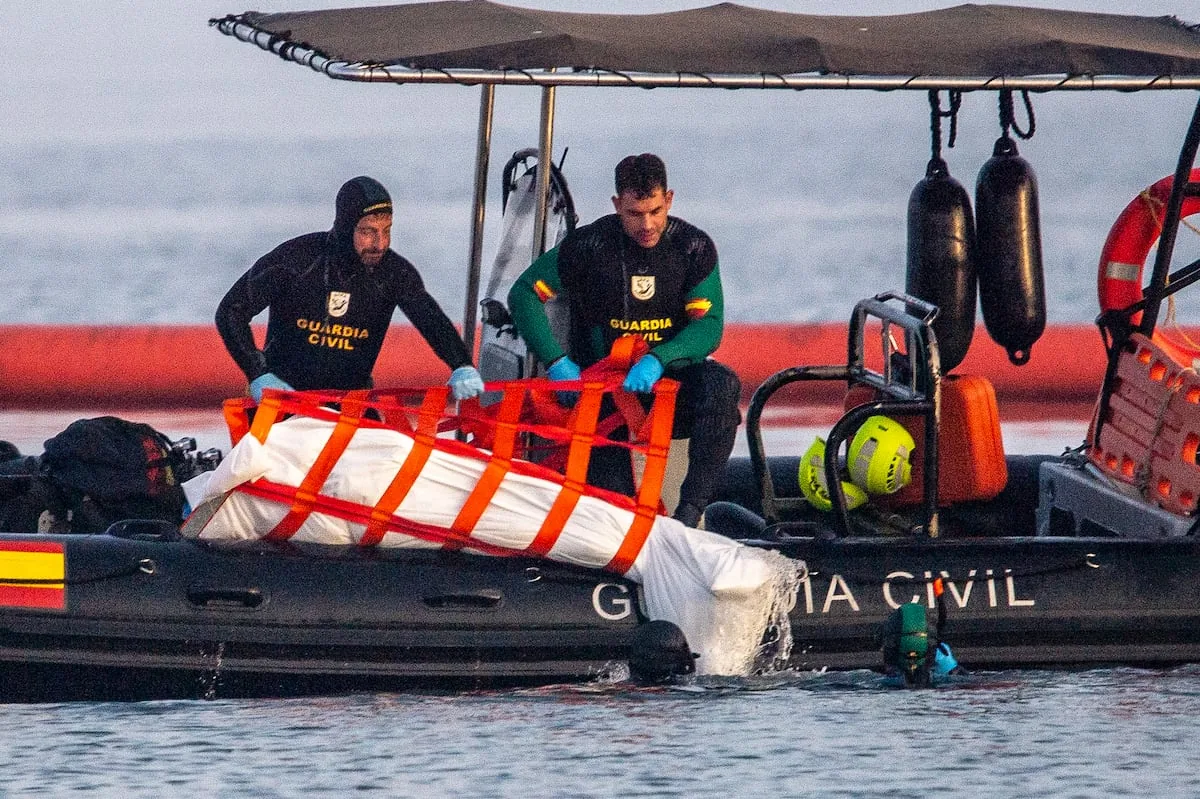
The Government of Morocco continues to remain silent about the sudden arrival of tens of thousands of young irregular migrants in Ceuta three days after the outbreak of the biggest bilateral conflict since the Perejil islet crisis in 2002. Neither the Government headquarters in Rabat, nor the Ministry of Foreign Affairs, nor the Interior Department have said a word about the death of more than 70 drowned people nor the overflow of the Castillejos border with the Spanish autonomous city, before the impassive gaze of the security forces of the Maghreb country. Only left-wing political forces and some progressive media have dared to break the silence about the drama experienced in the turbulent waters and the barbed wire breakwater of Tarajal, the dividing line with the European Union in the north of the African continent.
Read more A thief caught ‘in the act’ causes a fire in the La Vaguada shopping center in Madrid
“The information about the number of dead, rescues of victims, crossings and returns [irregular through the border] essentially comes from the Spanish authorities and media,” denounced the Party for Progress and Socialism (PPS, successor of the Communist Party of Morocco) in a statement that represents the first reaction of a Moroccan political force on the Ceuta migration crisis. The PPS demands that the Government abandon its silence and attributes the mass exodus towards the Spanish autonomous city to the failure of economic, employment, and educational policies, despite the development experienced by Morocco in recent decades.
“The inequality in the distribution of wealth, both between social classes and territories, is behind this drama,” warns the traditional left-wing party with less than two months to go before the legislative elections. The desperation of four million young people between 15 and 35 years old who neither study nor work has triggered, according to the PPS, the migratory avalanche.
Le Desk, a digital media specialized in investigation and economy, warns in turn that the Supreme Court ruling limiting hot returns of irregular migrants could not by itself create in a few days a mass of young people willing to storm the barriers and coasts of Ceuta. “That breeding ground already existed. The World Bank specified in a report last April that between 2000 and 2024 Morocco has failed to create each year the 215,000 jobs necessary to stabilize its employment rate,” reports Le Desk. During the same period, the Moroccan population has grown by 47%, while the working population has only increased by 20%.
Beyond the data, from the progressive left, the digital portal Enass holds the Moroccan Government responsible for maintaining “a sepulchral silence.” “The State has chosen the option of silence in the face of a drama of unprecedented dimensions,” it questions in an editorial article. “It seems to observe a calculated silence of a winner [due to the repercussions of the crisis in Europe],” it argues, “but if so, it is a dangerous mistake: Morocco is losing lives of citizens drowned, sacrificed on the altar of the desire for [geopolitical] power.”
The same media recalls that in the 2021 migration crisis in Ceuta, the Ministry of Foreign Affairs hurried to defend Morocco’s theses, referring to it as a response to the secret hospitalization in Spain of the leader of the Polisario Front, Brahim Gali. “There are acts that have consequences and must be assumed,” warned then the Moroccan ambassador to Spain, Karima Benyaich.
The same diplomat close to King Mohammed VI assured on Thursday in Madrid, at the annual reception of the Moroccan Throne Day, that the current crisis was a situation “not wanted by the Kingdom of Morocco” and occurred “outside its will.” “It is not something that pleases us,” she stressed, as the only official source to speak so far. Benyaich attributed exclusive responsibility for the massive influx of migrants in Ceuta to the “criminal mafias” that deal with human beings. In 2021 she was absent for nearly a year after being called to consultations in Rabat shortly after the public disclosure of the Polisario leader’s admission to a hospital in Logroño. Now she has praised Morocco’s “exemplary collaboration” with Spain.
In official Moroccan media such as Le 360 s there has also been detailed reporting on the massive exodus of young migrants towards the Spanish autonomous city. Le 360 h also emphasizes the “geographical anomaly” represented by the cities of Ceuta and Melilla, bordering Fnideq (Castillejos, in its name under the Spanish Protectorate) and Nador. “The territorial and demographic reality, with a large Muslim population of Moroccan origin, always ends up imposing itself,” the same media holds, “but the question is not whether these enclaves will return to their natural environment, Morocco, but in how much time and after how many other dramas.”
Enclaves on the international table
Ceuta and Melilla have ceased to be remote and distant places for the countries of the European Union. This latest crisis has brought to the table the complex situation of two EU borders in North African territory. The United States is also taking good note of the dispute between two of its main allies in the western Mediterranean.
In the US, Rabat has been preparing the ground in favor of its theses. A Congressional report has placed Ceuta and Melilla in Moroccan territory “under Spanish administration,” in a legislative project of the House of Representatives that urges Washington to encourage a “diplomatic commitment” between Rabat and Madrid on the “future status” of both cities. A paragraph in the budget project report of the United States Congress sparked a debate in April over Morocco’s sovereignty claim over the two Spanish autonomous cities.
In a (funding control) of the House of Representatives, both North African plazas were located “in Moroccan territory,” while encouraging Secretary of State Marco Rubio to mediate on their future status.
Congressman Mario Díaz-Balart, signatory of the report, supported last year a proposal in the House for the US to designate the Polisario Front as a terrorist organization. He is also a member of the Moroccan caucus of Congress, a US parliamentary group that defends Morocco’s interests in the Washington Parliament.
In the US capital, the two autonomous cities have had someone to write for them. A former Pentagon advisor, international analyst Michael Rubin, urged Morocco in March to launch a “Green March” on Ceuta and Melilla. “[It is necessary] to finalize the expulsion of Spanish colonialists from Moroccan soil,” he defended in an article published this week in the Washington-based Middle East Forum Observer magazine.
Read more Five people die in Indonesia in a ferry fire with more than 200 passengers