





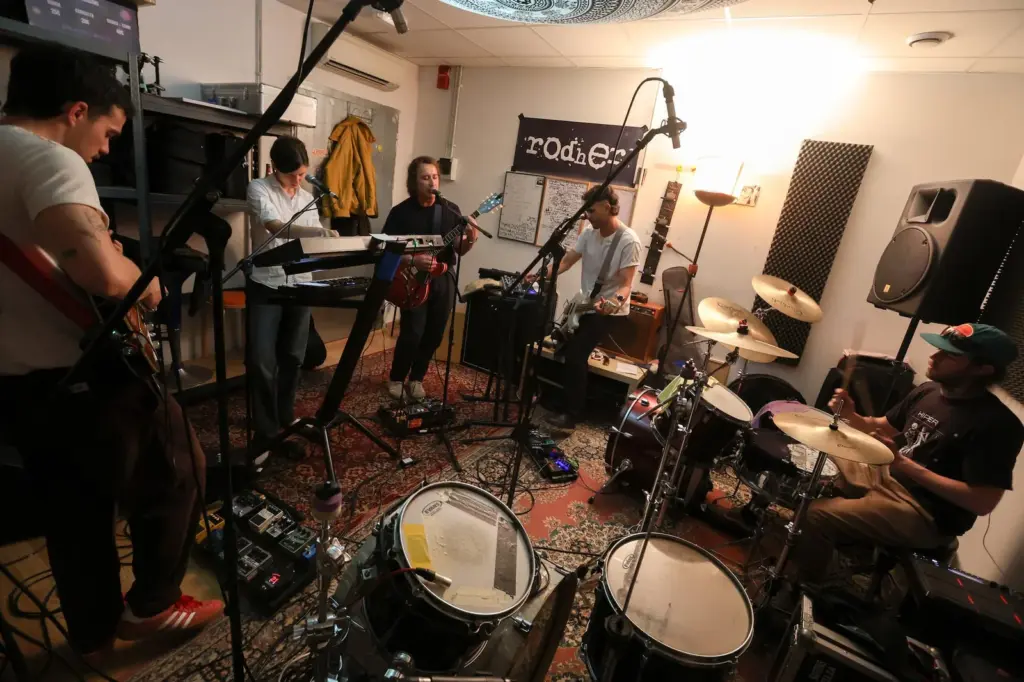
The world doesn’t exist for the members of a band who spend the afternoon playing in their rehearsal space. There are no windows, and to reach the street, you have to walk a fifty-meter corridor and go down two flights of stairs. The thick metal door closes hermetically with a 50-centimeter lever. Crack! There’s no escape. The signal fails, a good time for the phone to rest. The five of them stand in a circle in this musical bunker, in a small space crammed with cables, pedalboards, microphone stands. Technology, metal, and sweat. The sound is unbearable, so much so that an ENT specialist would immediately shut the place down. We put on our headphones, just in case…
Read more From nail to nail: nothing is left to chance when a masterpiece is moved
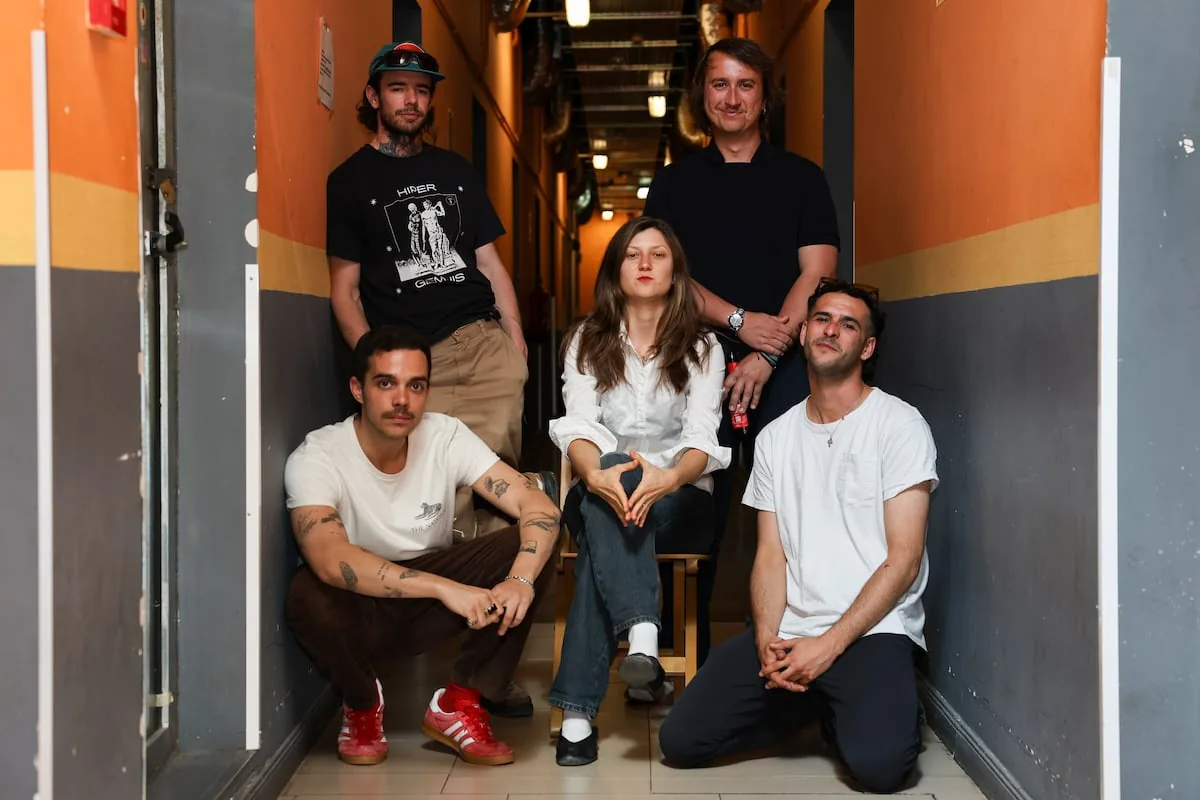
Claudia (27 years old), the keyboardist, prefers to go barefoot; Beto (33), the bassist, has prepared a coffee liqueur; Kobbe (31) struggles with some cables to get his drums working; Rubén (30) extracts elegant sounds from his guitar; and Álvaro Surma (30 years old), the vocalist, sings with such passion that it seems he has 10,000 followers beneath him. After two songs, we cautiously take off our headphones, to go deaf, but at the same time to experience how the sound takes over the body. Something has gone particularly well for them and Surma smiles at Beto; minutes later, things have gotten complicated and they argue: “It’s not my microphone that’s feeding back, damn it; let’s see if it’s yours!” They attack the next piece. It’s a Thursday at 5:00 PM and Niña Polaca is rehearsing the songs from their new album, the third of their career, Where is the UN when you need it most?, which was released last Friday and adds another handful of generational anthems for those twenty-somethings and thirty-somethings anxious about the lack of prospects for accessing housing, with a box of anxiolytics on the nightstand, with irreparable distrust in political institutions, and with the same romantic ups and downs that have been bewildering humanity since it first occupied the earth.
Niña Polaca, a band formed in Madrid but with half of its members from Alicante, reaches the category of a leading Spanish indie-rock band in a scene that includes Carolina Durante, Alcalá Norte, Ginebras, La Paloma, Shego, or Ultraligera. Since music (and life), for better or worse, is about numbers, Niña Polaca says that in 2024 they filled the Madrid venue La Riviera for five days, selling 10,000 tickets. Therefore, their inevitable next step appears on the calendar for January 15, 2027, where they will try to gather 17,000 people at the Movistar Arena, also a venue in the capital.
Álvaro Surma (Alicante, 30 years old), vocalist, guitarist, and lyricist for Niña Polaca, arrives at the meeting with EL PAÍS with an iced coffee in hand, which he will soon replace with a beer, and then others as the afternoon progresses. Just a week ago, Surma left his job as a lawyer at a multinational company. He said goodbye to a “good salary” and an activity he is passionate about. In fact, he could have lived off Niña Polaca for three or four years now, like his bandmates, but he kept the suit-and-tie job because he enjoys it. “I left with regret, to be honest, because I really like law, especially the legal technology part, where I specialize. But the band is reaching a level where it’s impossible to manage both things. Plus, I’ve set up a managers agency with the band’s guitarist. Too much work,” he says.
Álvaro has been in Madrid for 13 years. He arrived in the capital from Alicante to study Law and stayed. His father, Mariusz Surma, is Polish. A sympathizer of Solidarity, Lech Walesa’s union that challenged the communist regime, he had to flee his country, like other militants, when they were persecuted by the Polish communist regime in the eighties. He landed in Alicante, met a Spanish woman, and they married in 1992. A rock fan, he passed his passion on to his son: Álvaro saw Elton John at three years old, then the Rolling Stones (four times), Bruce Springsteen (on three occasions), AC/DC, Judas Priest… His parents separated, and Álvaro was estranged from his father for two or three years. Now reconciled, the leader of Niña Polaca invited his father to see the Rolling Stones at the Metropolitano in 2022, during the last visit of Jagger and Richards’ band. It was a way to thank him for having transmitted his passion for music.
Niña Polaca was formed in 2018. In 2026, already consolidated and with their third hot album, the group defines itself as “a bus on fire driven by drunk monkeys.” The other four members, already reunited with their leader, clarify: “We are friends playing, having fun, and learning how to do things. Now the monkey isn’t so drunk [laughs], so we manage our accounts, take the most viable initiatives… We are five friends making music without thinking too much about where it will take us.”
Read more The Kitchen trial shows the raw entrails of the Police
Niña Polaca’s songs are nothing more than Álvaro’s life. “Luckily or unluckily, it is my diary, yes,” he admits. “At first, when we started, I was shy about exposing so much intimacy. But then you see that people make it their own, and I stopped worrying. I don’t hide. It’s my life, no tricks or pretense.” Thus, we know that his therapist is named Luz, and we are aware of the breakups and reconciliations with Carmen, his partner. The protagonist laughs. “Yes, we have gone through many phases. We are doing very well now, by the way.”
Carmen is also a lawyer and acts as a muse in several lyrics of the new album, Where is the UN when you need it most?; but then the protagonist’s concerns lead to an existential and social disillusionment. Emotional stability prompts Álvaro to look around, and he doesn’t like the panorama, like many young people his age. “I am left-wing, but I am very disillusioned with the left in this country. Accessing housing for a young person is a pipe dream. Traditional parties have not known how to preserve the welfare system we had, and when the first crazy person comes along promising heaven, young people believe him and vote for him. In part, it is the responsibility of the establishment, which does not provide answers to people’s problems. Let’s see where this ends up. I’m quite scared, to be honest,” he explains. He admits influences from protest songs of the sixties and seventies, from Dylan and Springsteen, and also from artists who express themselves in Catalan (he understands and speaks it), such as Serrat, Lluís Llach, La Ludwig Band, Manel, Ferran Palau, Oques Grasses… “The current Catalan music scene seems to me the most interesting thing being done in Spain,” he points out.
In the song The Greed and Capital of Foreign Forces, he denounces “that the essence of our land has been sold.” “Since I’ve been living in Madrid, I’ve been kicked out of three neighborhoods. Cities are depersonalized, they are theme parks. And let’s not talk about Alicante, where the entire center consists of tourist apartments. We have sold the heritage of our cities for peanuts. In Alicante, there is no industry, only tourism. Do we really have nothing else to offer the world?” In the lyrics of CSI Alicante (My Generation), the resignation of Carlos Mazón is called for, and he sings: “The pills for depression in which they have buried my generation.” “I have many friends who have been medicated for a long time, and it makes me very sad and angry,” he asserts. “When a 25-year-old person has to take a ton of pills to survive a daily life that was supposed to be comfortable, it’s a symptom that many things are not working. I was prescribed anxiolytics once because I was going through a period of a lot of anxiety. I carried the pills in my backpack, but I didn’t take them. The fact that pills were the answer to my anxiety made me very angry, and I didn’t want to medicate myself.”
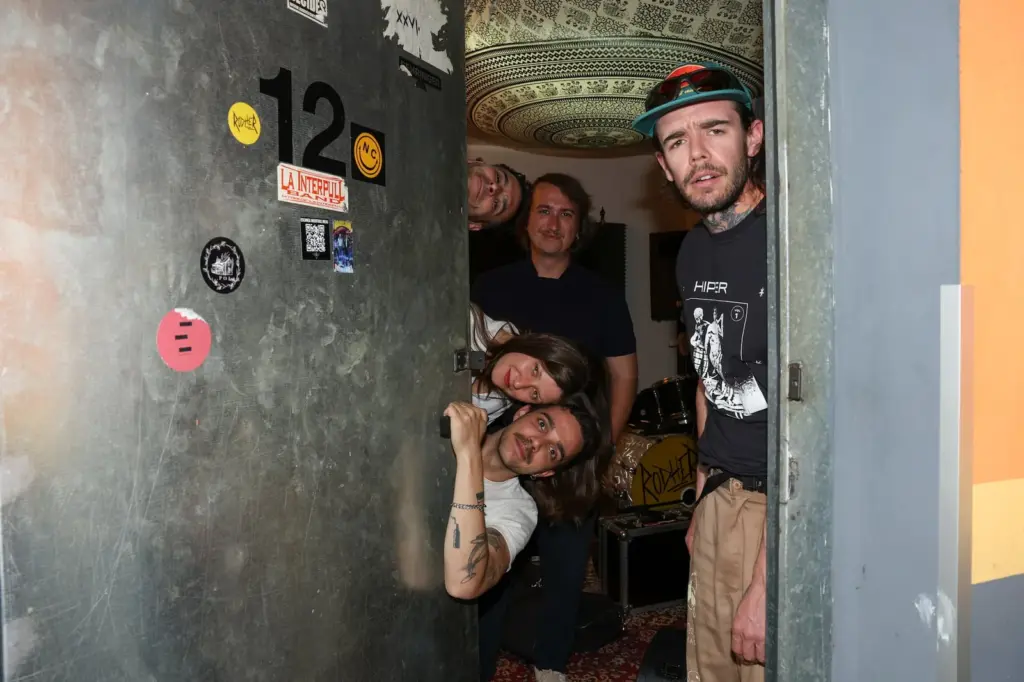
Niña Polaca continues rehearsing for a tour that will not stop all year. The door of their rehearsal space closes as they are heard singing one of their anthems: “And it’s not asking too much or being ambitious. / Not wanting my world in one room. / Talking about the future and not hearing fear in every voice of my generation.”