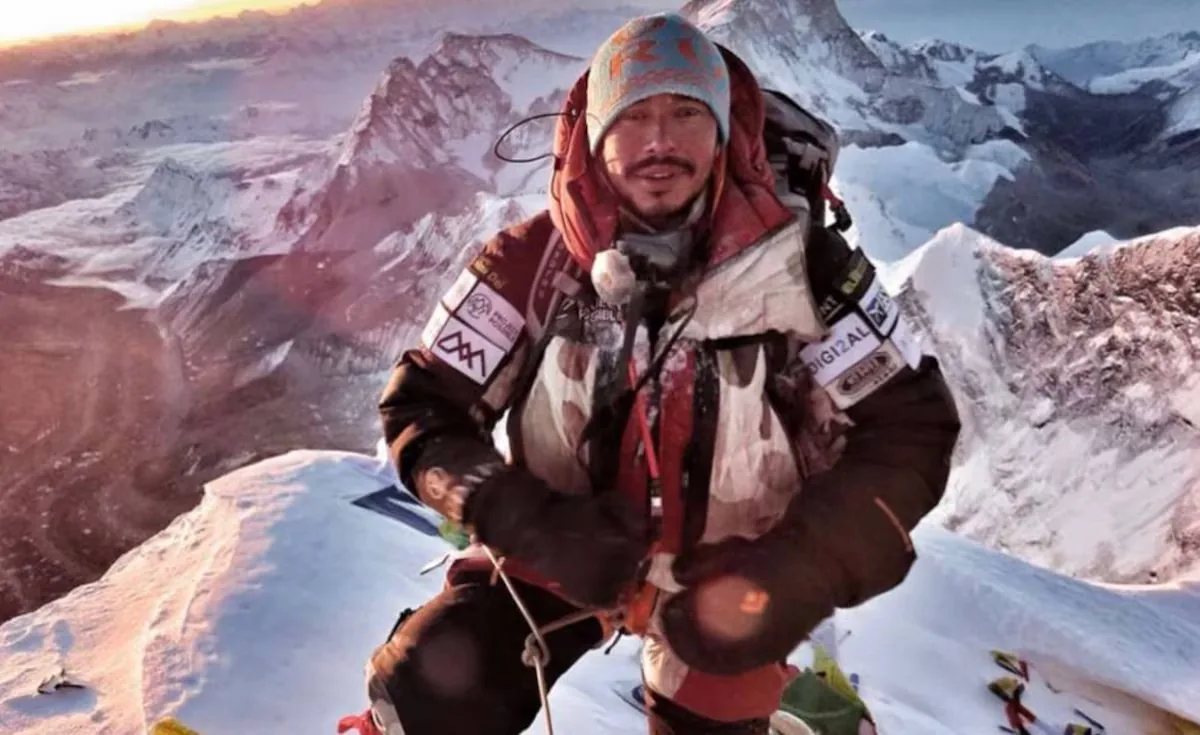










Nirmal Purja, the record-breaking man in the Himalayas and also the one surrounded by controversies, has been missing since Thursday on Broad Peak (8,047 meters, Karakoram), when an avalanche swept away the group of 10 climbers he was with at 9:30 a.m. local time. According to Pakistani authorities, four bodies have already been recovered, located in the lower area of the mountain, of which only two have been identified: the Omani eight-thousander Nadhira Al Harthy (with summits on Everest, K2, and Nanga Parbat) and the Nepali high mountain guide Pur Bahadur Gurung, who worked for Nirmal Purja and his company Elite Exped. The avalanche caught the group, made up of several guides and their clients, at an altitude close to 6,600 meters, shortly after passing the lower part of the mountain, very steep and vertical.
Read more Two more days of intense heat, but on Sunday the thermometers will ease and the heatwave will end
The group had decided to launch their summit attempt that morning on the 12th highest peak on the planet. The avalanche deposit reached the moraine at the base of the mountain, right in front of the base camp. There the remains of Nadhira were found, and very close to those of the other three deceased. At least one army helicopter is flying over the area searching for visual signals among the avalanche debris. At the same time, the GPS beacons carried by several of the victims, including Nirmal Purja, whose locator device registered movement after the disaster following a brutal fall of several hundred meters in elevation, are being tracked. So far, the identity of the 10 buried climbers has not been confirmed, although local sources indicate that six of them were Nepali.
Nirmal Purja, known as Nims, a former Gurkha soldier from the British army elite groups although born in Nepal, came out of nowhere to revolutionize the way the 14 eight-thousanders on the planet are climbed without having any pedigree as a mountaineer. In 2019, he climbed the 14 highest mountains on Earth in six months and six days, ridiculing the previous record of… seven years. His mountaineering ethics did not match his speed: yes, he had broken a record but had contributed nothing to the history of Himalayan climbing except his enormous logistical capacity and his undeniable ability to finance his challenge. Nims always used the classic routes of the eight-thousanders, flew by helicopter from one base camp to another, employed a cohort of Sherpas to break trail, fix ropes, and advance in any scenario, used bottled oxygen without scruples, and came to ridicule the merit of climbing a mountain over 8,000 meters. Over time, the truthfulness of his account was questioned and he is still pursued by controversy over whether he reached the summits of Dhaulagiri and Manaslu. Years later, he returned to both mountains and was able to prove, this time yes, that he reached the highest point.
His enormous fame allowed him to launch his agency, attract numerous clients to take them in spring or autumn to the eight-thousanders located in Nepal. But he also wanted to exploit the summer, the best time to climb the five eight-thousanders located in Pakistan. For this, he reserved an unbeatable coup: to conquer K2 in winter, the last eight-thousander still awaiting a winter ascent. It was in 2021, and although he dressed the expedition as a claim of Nepali power (10 climbers from this country, hand in hand at the summit), the matter turned into a superb self-promotion campaign. Nims even swore he was the only one who did not use artificial oxygen to reach the summit, but he never proved it and the nine witnesses remain silent. What no one can deny him is the mastery with which he took over the Pakistani market.
At the time of the accident suffered on Thursday, Nims was immersed in his third cycle of ascents to the 14 eight-thousanders after completing his second round in 2024, this time without using artificial oxygen. He also now wanted to be the first to climb the 14 three times, which is why apparently he had no clients under his charge but did have the help of the late Pur Bahadur Gurung.
Read more A producer sues Netflix for 105 million over the disappearance of a movie starring Nicolas Cage
Nims also seemed to live outside the accusation of sexual assaults revealed in 2024 by The New York Times and denounced by two women during expeditions and encounters with the press. For now, investigations continue.
Strictly in mountaineering terms, many voices pointed out Nims’ kamikaze style, forcing ascents when the mountain was not in condition and the objective dangers were significant enough for prudence to prevail, an attitude that does not always align well with economic goals.
At the time of the avalanche recorded on Broad Peak, the mountain conditions were not ideal: the heat in the lower area had greatly degraded the first few hundred meters of the ascent, with a lot of loose rock and broken terrain. Above, a huge windstorm recorded days earlier could have left wind slabs (snow transported by the wind that settles on a weaker snow surface), true latent traps.
Read more When a democracy stops meeting