










Francisco Carpe knew that a job contract would soon arrive after graduating. He had studied programming in the nineties. What could go wrong? Trained at the turn of the century, Carpe’s generation watched with excitement as software became the raw material of the global economy and, mainly, a sector synonymous with job stability. This last promise has been shattered, Carpe admits. The launch of ChatGPT and Claude, among other artificial intelligence (AI) tools, has rewritten the rules for tech workers and, in general, for office employees. AI has called into question to what extent certain skills accumulated over time are necessary in a long list of occupations. The 48-year-old programmer, who works for NTTData, recalls that he chose computer science because it was the career of the future. Now the question is: what future was he talking about?
Read more The rise of Racing or the triumph of a new social and collective mentality to reach the top division
So far this year, more than 70 tech companies have cut at least 103,000 jobs worldwide, according to Layoffs.fyi, a platform that tracks layoffs in the sector, almost as many as in all of 2025, when 124,000 cuts were recorded. Meta, Facebook’s parent company, was the last to announce it was laying off 8,000 employees, 10% of its global workforce. Nationally, Capgemini will open a collective dismissal procedure affecting about 750 people, equivalent to 6.5% of its Spanish workforce. Most companies say the decision is driven by the need to free up capital to invest more in AI, without directly pointing to a massive replacement of humans by machines.
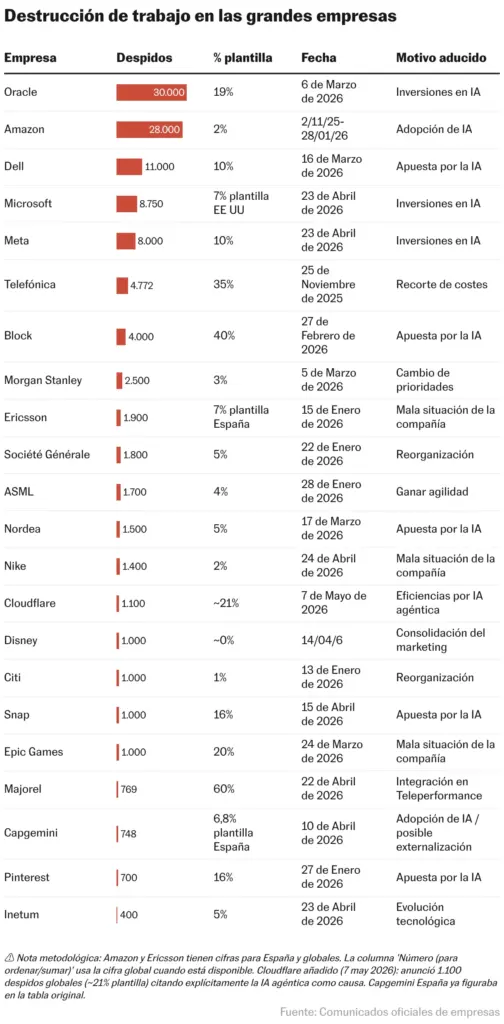
However, there are clear signs that the labor market linked to services no longer reflects the same growth and stability that used to characterize it, at least for now. In Spain, the Active Population Survey for the first quarter of this year reveals that this sector is no longer able to absorb available talent at the same pace as in recent years. In programming, consulting, and other IT services, the Spanish labor market employed 512,100 people in the first quarter, representing a contraction of 23,400 employed compared to the previous year.
The software products launched this year by Carpe’s team, for example, contain code entirely written with AI: “In most cases, it passes all quality tests,” he assures. But AI is not only capable of generating software independently; these systems are beginning to transform the daily work of cooks, architects, doctors, and communicators, who increasingly rely on generative AI tools. According to a study by InfoJobs published in February this year, two out of three Spanish workers already incorporate AI tools into their work routine.
Valencian lawyer Salvador Uixera savors the moment this technology has established in his office. The legal world is no longer the one he discovered on his first day of work, when he graduated five years ago: “That day I entered a room full of young people completing pre-established demand models. Our task was to fill in some data and hit print.” It seems like a lifetime ago, but only five years have passed. In the last year, most large Spanish and international law firms have set aside piles of paper and opted to operate with databases that AI organizes and filters. “Research used to take weeks, and now AI has reduced this phase to minutes,” Uixera acknowledges.
Administrative tasks
“No one expected technology to end up affecting knowledge and reasoning, which seemed an exclusively human territory,” reflects Carlos Rebate, Transformation Director at Securitas, who anticipates that intelligent systems will increasingly gain ground in numerous tasks that make up the bulk of professions, especially repetitive tasks and administrative activities. “Work will be centaur-type, largely driven by artificial intelligence but directed by humans,” summarizes this expert.
In architecture, Carlos Muñoz explains that AI has been fully integrated into 3D modeling programs: “It is opening the possibility for small firms to embark on ambitious projects.” In medicine, surgeon Julio Mayol has forgotten what it is like to work without the support of ChatGPT. The use of AI accounts for approximately 90% of his professional activity, he admits. “With ChatGPT or Gemini, for example, I can review every week what is published in specialized journals, and it gives me a summary of the fundamental ideas I need to know to generate new projects.” Ana Ávila, from the communication agency Wildcom, comments that she has been able to reduce the mental load of writing dozens of press releases and focus on what she considers the core of her work. “Our main task is to build relationships with journalists; you need a special sensitivity for that, and now we have time to deepen it,” she explains.
For Marcel Jansen, professor of Labor Economics at the Autonomous University of Madrid, what distinguishes this wave of automation from previous ones — industrial mechanization, digitalization in the nineties — is that it affects the cognitive core of professional activities. The first big wave of digitalization automated administrative tasks and opened new professions, many of them in the tech sector. In both cases, the transition had a decisive impact on the labor fabric, but the system had decades to absorb the changes. The rapid development of language models does not seem to leave room for this orderly transition. “It affects reasoning, analysis, writing, and therefore people with high levels of qualification,” Jansen explains. The most disconcerting thing is that the change is advancing at a pace that most professionals can barely assimilate.
Carpe, from NTT Data, witnesses this rapid transition. With the launch of AI systems like Cursor or Claude Code, the long days of “coding” are over. Now, he indicates, software engineers have other complementary roles for which they may not be prepared. They will dedicate themselves to leading teams, improving communication with clients, and developing products. Soon they will no longer write code, only supervise it. However, the automation of this task raises an inevitable question: will there be enough work for all professionals in the sector? And for the rest of the professions threatened by AI?
The director of the Princeton Center for Information Technology Policy, Arvind Narayanan, believes that many of the usual arguments about massive worker replacement are based on incorrect premises. “It is not enough to look at whether an AI can do a task; you have to ask: how many times can we trust it to do it correctly?” He cites, for example, the introduction of bots — conversational agents — in customer service, and highlights the need to separate capability and reliability. “Machines may be capable, but there is still a long way to go before we trust them on a call with a customer.” Last year, for example, a judge ordered Air Canada to refund a customer who had received incorrect information from one of these automated systems.
Carmen Pagés, director of the Labor Market and Skills Foresight Unit at the Open University of Catalonia, argues that the available academic evidence points to AI, at least for now, not destroying jobs massively but strongly reconfiguring tasks within existing jobs, citing two relevant studies. The conclusion of the first — which followed the careers of 25,000 workers in AI-exposed occupations two years after adopting conversational assistants — was that there were barely any effects on wages or hours worked. “What did change was the nature of the work, as many employees began to spend more time supervising results, generating content, or integrating automations into their processes,” she adds.
Another study, focused on 7,000 knowledge workers in large companies, found that AI significantly reduced the time spent writing emails and working outside of working hours, although this had no detectable impact on employment or workers’ wages. The most visible signs appear, according to Pagés, among freelance workers on digital platforms, “probably the most vulnerable segment to this technology.” A study by the University of Washington in St. Louis and New York University concluded that after AI implementation, the volume of contracts among self-employed workers fell by 2% and income by 5%. Still, the academic considers that this scenario can hardly be extrapolated to the bulk of salaried employment, where contracts and corporate structures continue to act as guardrails against automation.
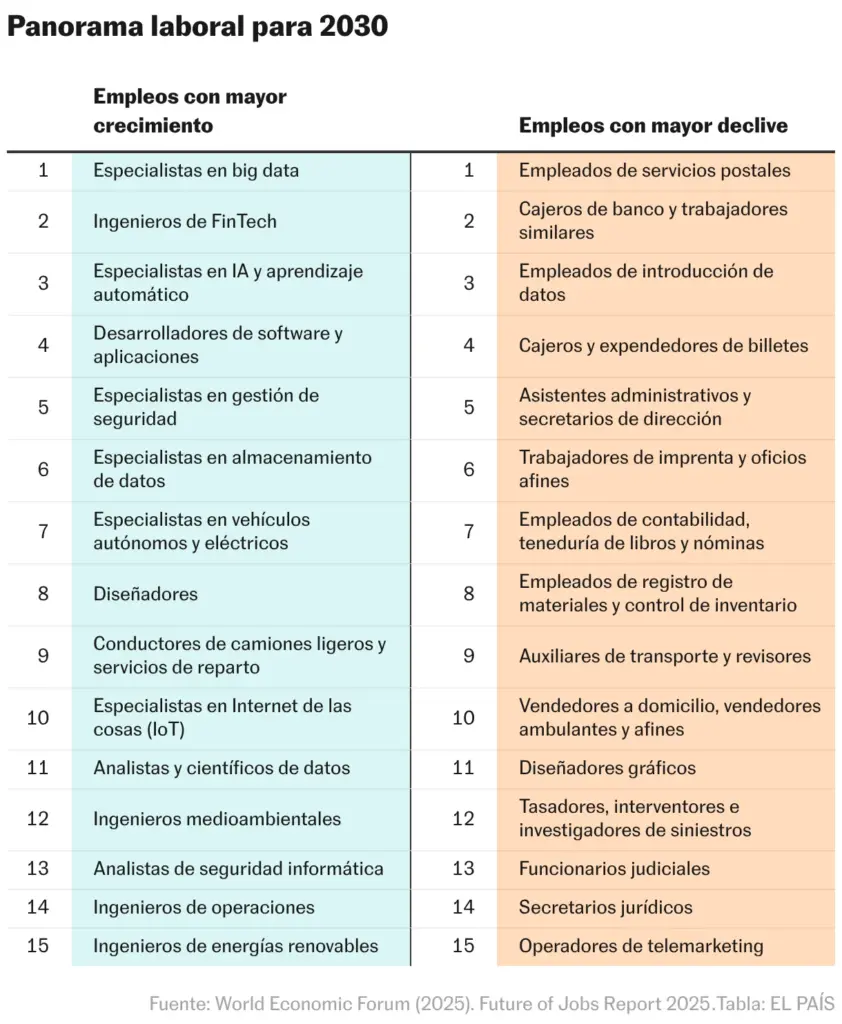
Vulnerability is not distributed evenly. The Brookings Institution warns that occupations with the highest risk of automation are historically represented by women, mainly in administrative and office positions, where tasks are repetitive and easier to automate. This group is joined by older workers who face, at the same time, less capacity for professional retraining and less time to adapt to new market demands.
Social harms
Whether because AI is attracting investments or because it is directly replacing tech labor, Mo Gawdat, former Google executive, considers it necessary to go further and examine the social harms that massive cuts could bring. “Silicon Valley enthusiasts will tell you: this is great, more productivity, easier workdays, and you won’t have to work so hard anymore,” he says ironically. “But the truth is many people will be left without jobs.” According to a study by the Polytechnic University of Valencia, two out of ten jobs (between 18% and 22% of employment) are already exposed to AI, at risk of workforce cuts. “Then the system must find new ways to keep people happy, because work, which had provided identity and purpose, will face a crisis,” predicts this expert, who believes that unemployment of a large part of the population is a tangible reality in the medium term.
Read more A terrifying accident at the MotoGP Catalonia GP ends with Alex Márquez in the hospital
This is an idea that worries Mar Manrique, author of A Dream Job (Península, 2026), who points out that the labor market had already degraded in recent years, marked by instability, hypercompetition, and the need to reinvent oneself, especially among the youngest. “AI could exacerbate these trends. For example, by pushing workers to invest more hours to compete with those who master AI or simply to prove they are competent compared to machines.” Kate Crawford, philosopher and author of Atlas of AI (Ned Ediciones), a book that delves into the economic and social implications of this technology, also fears that AI will enhance labor surveillance systems that already predominate in large organizations, particularly those with large workforces. “We may see a deepening of increased monitoring and algorithmic evaluation. In general, a more invasive mechanism in work management,” Crawford states in her book.
Suspicion
There are workers like Cristina Laguna (26 years old, Ciudad Real) who have directly closed the door to this technology. The risk that a language model makes a mistake is one of the reasons that hold Laguna back, who has worked in a customer service center for a year and a half. “I have the feeling that I can’t trust it because once a colleague received incorrect information when comparing two products in ChatGPT. Also, sometimes I feel like I’m not doing my job well; it’s like I’m taking the easiest route,” describes this operator.
Experts warn about the potential risks these systems pose, especially AI agents, the next step in the development of this technology. Recently, Anthropic — the tech lab led by Dario Amodei that gave birth to Claude — announced it was halting the launch of Mythos, its latest language model, due to its ability to discover vulnerabilities and hidden flaws in government computer systems and software worldwide.
But not everyone is pessimistic about the implementation of this technology. For example, if you ask Mar Pujadas (28 years old, Valencia), she will say that her start-up Omniloy could not function without the agility provided by intelligent systems.
—When you asked me for a quick response for this report, my AI agent was the one who answered you, she says over the phone.
Due to their size and organizational style, experts agree that start-ups are the ones that can make the most of language models like ChatGPT. “We spend a lot of time training AI to know our organization,” Pujadas comments, “and now it’s like having a secretary available all the time.” This approach has allowed AI to permeate internal processes. Omniloy’s own chatbot speeds up internal conversations, answers emails, and can create presentations or business strategies in seconds. But where it is most useful, she says, is in the engineering part dedicated to product development. “All workers — a total of 18 — have a subscription to a language model.”
Many industries continue to search for ways for AI to become a business engine. A tailor-made engine. This group mainly includes freelancers and small businesses, the group that precisely makes up the bulk of the business fabric in Spain. “They are the ones who best take advantage of these tools, used to constantly finding ways to get by,” clarifies Pilar Jericó, leadership expert and author of the book No Fear (Planeta).
AI has allowed the operational chain of offices like those of Milton González and Valeria Moreiro, the heads shaping NotReal studio, a design firm that has closed contracts with brands like Microsoft and Google, to be reconfigured. “It helps us capture a client’s idea instantly to know if we should continue down that path or immediately switch to another,” González recounts. This has meant a turn in the business. But, unlike what was initially predicted, it has not freed up time for leisure or other activities. “AI will not give you more space for your hobbies. In our case, we can spend more hours exploring the creative part of this business or solving other typical problems of a small firm, but there are always things to do.”
The restaurant industry is another world where chatbots have gained authority. David Chamorro, founder of Food Idea Lab and chef focused on innovation, says these systems will boost a sector that has long turned its back on technological advances. Cooking is a field of hits and misses, concept tests that can last weeks. “AI erases those times.” He cites a specific example: “Something as simple as finding the formula to crystallize ice cream can be terribly difficult if you don’t know the process; with ChatGPT, you have little chance of making a mistake.”
Proper training
Where he sees the most transformation possibilities is outside the kitchen: “AI can take care of restaurant management, from staff handling to invoice control or menu variations,” he explains. “Imagine this for a small restaurant that often lives on the edge of its possibilities.” With proper training, a model can tell you if you went into losses for not filling the dining room or if you will do better by hiring an extra waiter, this 37-year-old chef recounts.
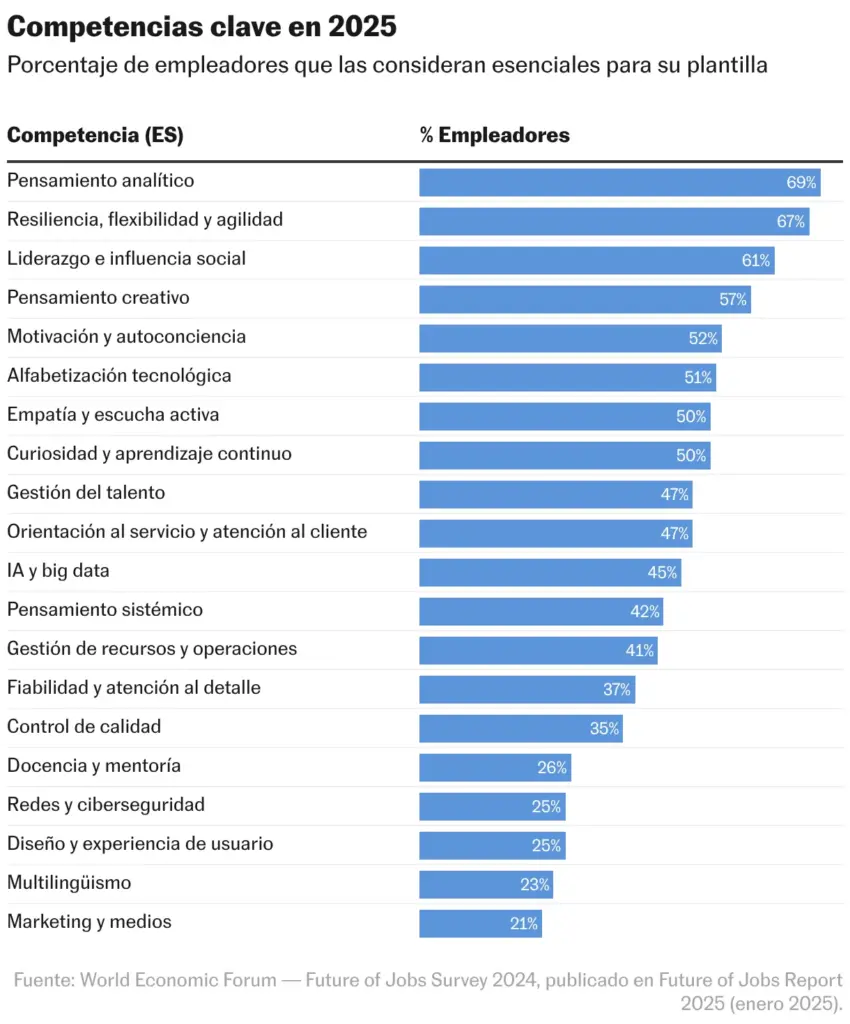
That is the future, according to Pagés: one in which humans will be responsible for designing, verifying, and supervising AI’s work. The problem, Jansen emphasizes, is that universities have long fallen behind in their attempt to train new generations to face these new realities. Now the responsibility falls on companies, which “must strengthen and speed up training that helps a large part of people not to be left behind,” concludes the professor.
Carpe, the computer engineer with whom this report began, does not believe the blow will be lethal for his sector. When he started studying computer science in the nineties, there was an atmosphere of excitement because a revolution without precedent was anticipated thanks to code, of which he is glad to have been part. Has that feeling changed? “Frankly, no, it has rather multiplied,” he comments. But a renunciation will be necessary first, he acknowledges. That will be the most complex part of this great transformation in these times. “We have to admit that we have lost a part of our work that used to belong to us completely,” he concludes resignedly.
Read more Participation in the Andalusian elections remains at levels similar to 2022 at 11:30 AM