





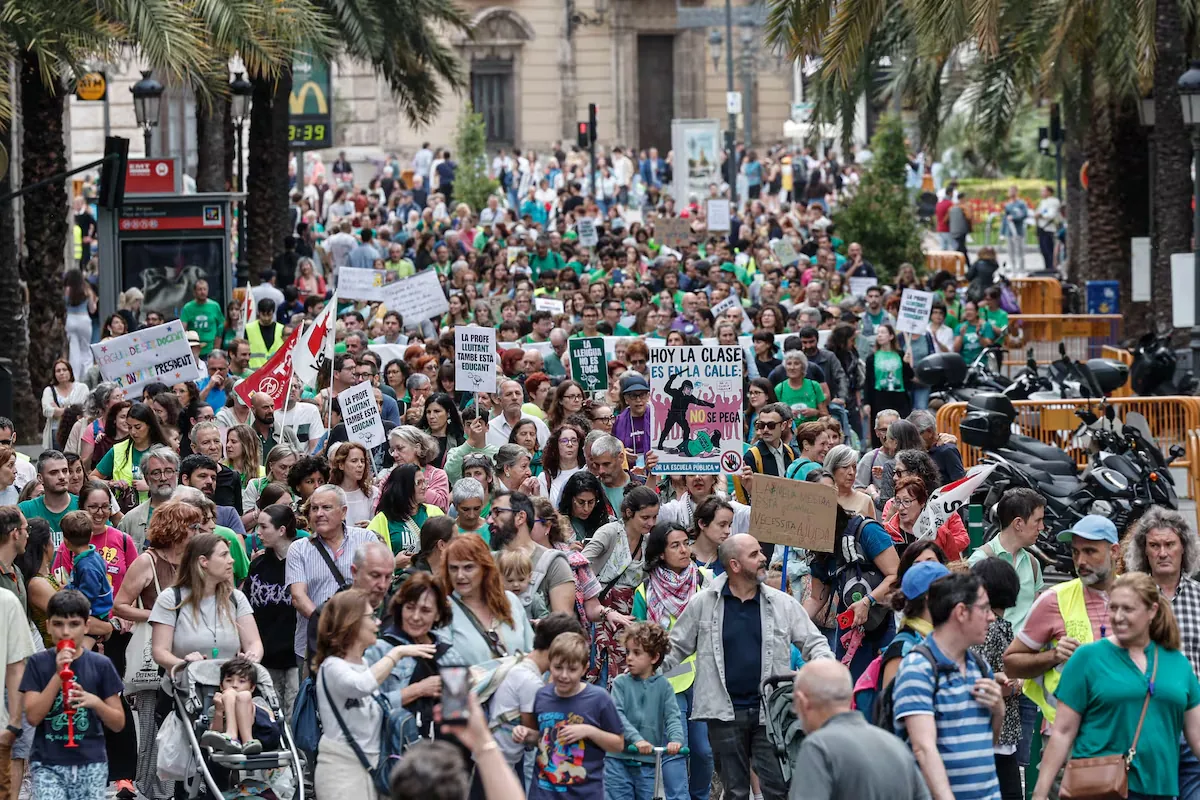
The non-university public education teaching staff in Valencia, some 78,000 teachers, faces its twentieth day of indefinite strike this Friday without an agreement with the Generalitat, presided over by Juanfran Pérez Llorca of the PP, in sight. Fatigue weighs heavily, but the swords remain drawn. The Ministry of Education and the five teaching unions, STEPV, CC OO, UGT, CSIF, and ANPE, met again in the afternoon, after several days of hiatus, to discuss the latest offer from the Valencian Administration, which announces 3.338 million euros for public education until 2029. The negotiation has been complicated by two issues, according to several unions: the surprising live broadcast of the negotiation table to anyone and, above all, the “script changes” by the Generalitat on a key point in the conversations, such as salary remuneration and what amount is updated with the CPI. “It is a document that will have to be studied more calmly, and we will meet again next week,” Education concluded. The unions want to continue this Saturday.
The resumption of negotiations this Friday began with some union bewilderment. The Ministry of Education proposed broadcasting the meeting via streaming so that anyone who wished could follow it [and at times it had more than 3,800 users doing so]. The latest offer has been sent to all public teachers via the corporate email of Education.
Xelo Valls, head of the Federació de l’Ensenyament of CC OO, pointed out that the unions have nothing to hide, but this formula of turning the negotiation into a kind of “reality show” had not occurred in previous meetings, she specified. Later, Beatriu Cardona, from STEPV, described the broadcast as an “advertorial” because the first hours were exclusively dedicated to reading and explaining it aloud, when the unions had been asking for it for 24 hours to study it and make faster progress at today’s table. “This looks more like a press conference than a negotiation,” they criticized.
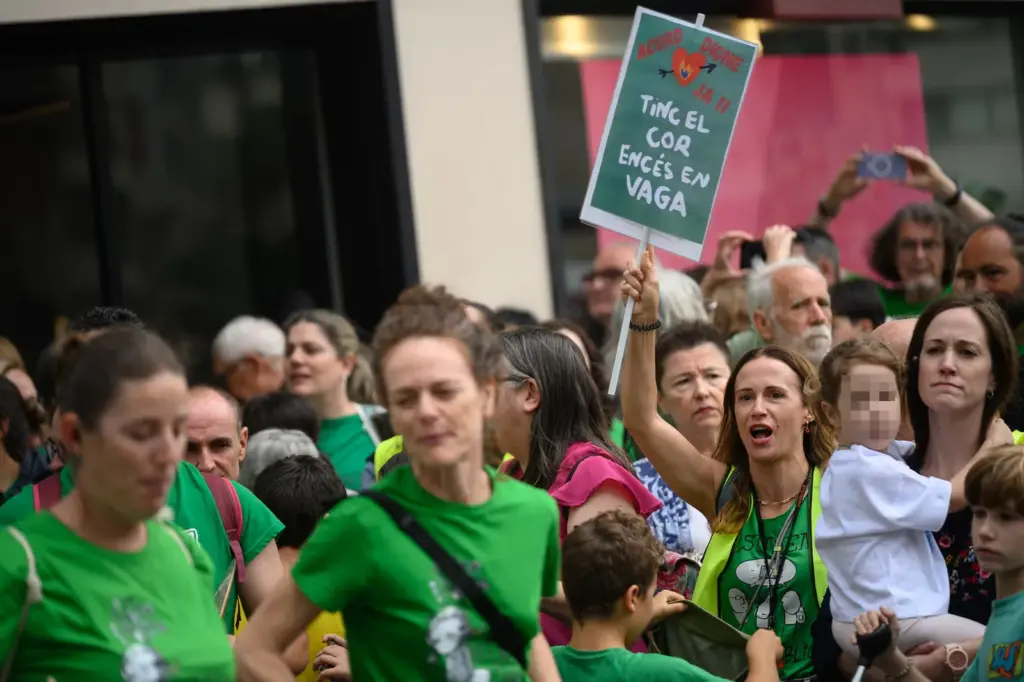
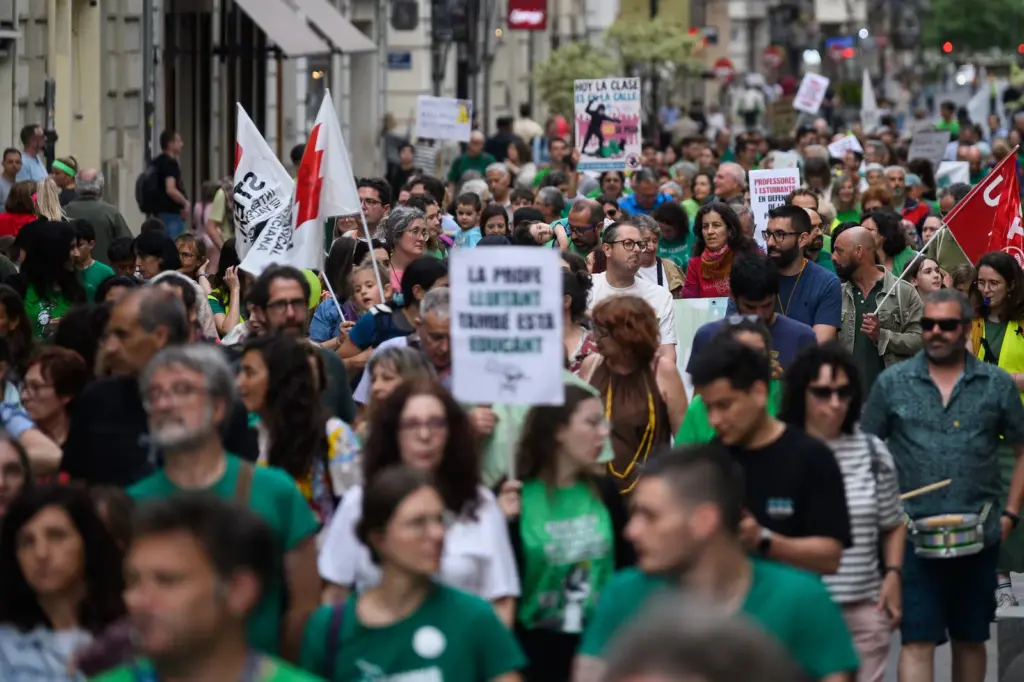
Meanwhile, protests, rallies, and actions in support of teachers have been ongoing for weeks. This Friday, there was a family strike that led to an afternoon demonstration in Valencia, less numerous than the five preceding ones. Eva and Roberto participated in the march for several reasons: “We are affected and stand in solidarity with the teachers. We have a girl who gets very hot in the classrooms; there are many in class, and she has classmates who need special assistance and don’t have support teachers. What’s more, when a teacher is absent, no substitute teacher comes,” explains the 54-year-old woman, alongside her 11-year-old daughter, Maya. They have participated in family strikes whenever possible during the 20 school days of the teachers’ indefinite strike, meaning they have not taken their daughter to school not only this Friday, as explicitly called for.
Elisabet García, spokesperson for the organizing Confederation of Associations of Mothers and Fathers of Students of the Valencian Community Gonzalo Anaya, the most representative in the sector, noted that the family strike had considerable support. “We understand the needs of each family, regarding availability and work-life balance, but even so, attendance has been low in the closest centers we know,” she pointed out. “Today we believe it has been very visible, but we do not have global data,” García added.
Furthermore, a group of teachers remains camped for the fifth consecutive day in the central Plaza de la Virgen in Valencia, in front of the Palau de la Generalitat, to pressure the Consell to reach an agreement as soon as possible.
The mobilization continues on other fronts. The management of educational centers in the Valencian Community and the Gonzalo Anaya Confederation have written to the president of the Generalitat, Juanfran Pérez Llorca, a letter requesting an “urgent meeting” and that he intervene “immediately” to “unblock” the conversations that would allow an end to the indefinite strike. “It is in your hands to drive the necessary decisions for the negotiation to proceed rigorously,” they assert.
Read more Activists from the Gaza aid convoy detained in Libya, on hunger strike
STEPV, CC OO, and UGT, the union bloc that acts united and represents 70% of the teaching collective, have been denouncing for weeks the “wear and tear strategy” undertaken by the Department of Education led by Carmen Ortí, while she emphasizes that much progress has been made since the beginning.
The “jumble” of the salary increase
One of the points stalled from the beginning is that of salary remuneration. CSIF and ANPE, with 30% representation, signed a salary increase of 200 euros per month over three years two weeks into the strike: 75 euros in September of this year, 75 in January 2027, and 50 in January 2028, with doubts from the outset by the majority union bloc about which amount the CPI would be applied to in 2028. The acceptance of this agreement broke union unity with STEPV, CC OO, and UGT, who demand a salary update indexed to the CPI. “We are not on a clear and transparent path,” complained Maite Tarazona of UGT.
The unions’ demands include, in addition to salary increases or staff increases, a reduction in the student-to-class ratio from early childhood to Baccalaureate or vocational training, the improvement of deteriorated educational centers —including those affected by the DANA of 2024—, air conditioning plans against heat in classrooms, or the support and dignification of Valencian after the entry into force of the educational freedom law, approved by PP and Vox, which the opposition denounces “marginalizes” teaching in Valencian.
Regarding ratios, the Generalitat proposes that Early Childhood and Primary education go from 25 to 22 students per classroom. In ESO, the maximum ratio will decrease from 30 to 25 students per classroom, while in Baccalaureate it will be reduced from 35 to 28 students. According to Education, with these reductions, “the Valencian Community advances by one year the application of the ratios contemplated in the bill promoted by the Ministry of Education.”
Regarding staffing, the offer foresees the incorporation of 7,742 teachers, with an investment of 469 million euros and a four-year implementation horizon. Of the total, 2,742 teachers will be linked to ratio reduction, and another 5,000 will be new additions aimed at strengthening the educational system.