




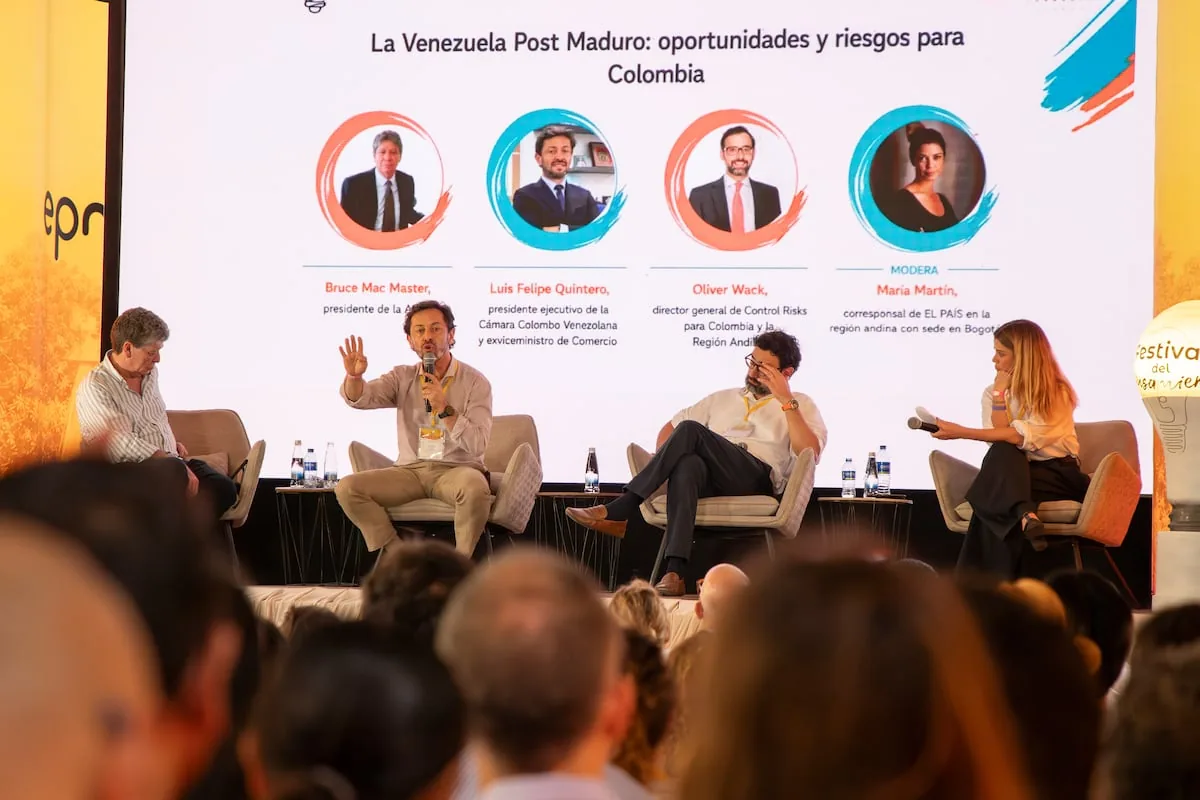
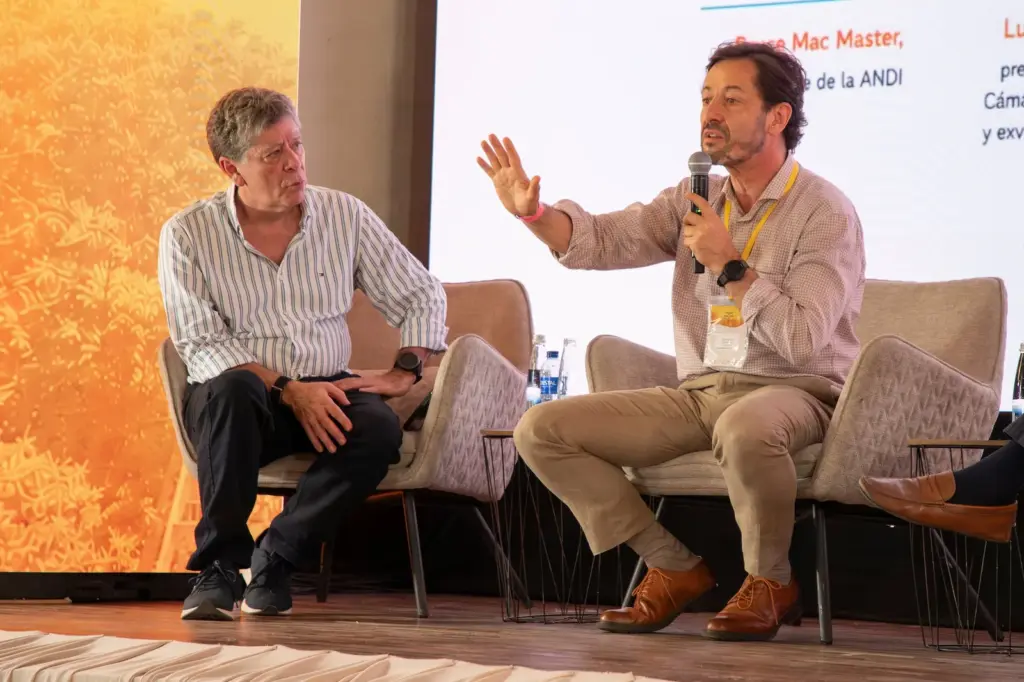
The open scenario in Venezuela following the capture of President Nicolás Maduro brings a path of growth opportunities for the Colombian economy. This idea was shared this Saturday by Bruce Mac-Master, director of ANDI; Luis Felipe Quintero, representative of the Colombian-Venezuelan Chamber, and Oliver Wack, regional director of Control Risk, during a conversation within the framework of the second edition of the Prisa Media Thought Festival, held in Santa Fe de Antioquia between May 21 and 23.
Read more The Navy strikes Los Chapitos with 13 arrests in southern Sinaloa
In the panel Post-Maduro Venezuela: opportunities and risks for Colombia, moderated by María Martín, EL PAÍS correspondent for the Andean region, Mac Master celebrated the fall of the dictator: “It is very good news that Maduro is no longer there,” he said amid applause. “It is a regime that is much less autocratic, less authoritarian than the previous one, because they feel they have a leader, but it is still a regime. Democracy has not returned there.” The head of the Colombian business association recognized the growth opportunities but was cautious about the dangers due to the lack of clear rules for foreign investors. “There could be a significant increase in the market and economic activity, especially for Colombian companies that want to export their products. However, before entering, the exchange, regulatory, normative, and security terms must be carefully reviewed.”
The latest DANE data on binational trade between Colombia and Venezuela show that exports and imports reached 255.1 million dollars in the first quarter of 2026, a decrease of 8.4% compared to the same period in 2025. Of that total, Colombia’s exports to Venezuela in the quarter amounted to US$229.8 million, a reduction of 7.2% compared to the same period in 2025. Imports from Venezuela to Colombia in the same quarter were US$25.3 million, a drop of 18%. This outlook is far from the best moments of the commercial relationship between the two nations. However, experts say it could increase in the coming months thanks to changes in the Chavista government.
Quintero, who was in Caracas a few months ago, agrees that the outlook has improved. “Venezuelans have regained their smile. There is enthusiasm,” he said when asked about the mood on the other side of the border. The representative of the Colombian-Venezuelan Chamber insisted on what he calls cautious optimism. “There has been a fundamental change in the hydrocarbons law and the mining law that opens the doors to foreign investment in the Orinoco Belt.” According to geological studies, that territory has large reserves of rare earths necessary for the energy transition and could be a new development focus.
Read more ‘Fjord’, by Cristian Mungiu, wins the Palme d’Or at the Cannes Film Festival
In addition to these internal changes in Venezuelan laws, recent decisions by the United States to grant exploitation licenses to multinational companies are key to encouraging investment. “The US State Department has removed Venezuelan state-owned banks from the Clinton list. This will allow financial relations with other countries to be regularized,” says Quintero. He also concludes that the return of mining and oil exploration to the neighboring country is a significant possibility for Colombian companies. “They can sell products and provide services to large international companies. There is already a pipe company doing business with Chevron,” he explains.
Oliver Wack, from Control Risks, disagrees with Mac Master on the idea that there has been a regime change but agrees that new business windows are opening in the new scenario. “They only changed the puppet’s head. Today there is someone smarter, but it is the same regime in all its facets that has been entrenched in power for 26 years,” says Wack. However, he insists that the economic potential is detached from a democratic transformation.
Mac Master also questioned the fact that there are still no legal guarantees for investment due to the postponement of free elections. “The United States does not seem interested in democracy in Venezuela,” said the former high-ranking official of Juan Manuel Santos’s government. He concluded his intervention with a hypothesis about Maduro’s capture. “What happened on January 3 was a preliminary step to be able to attack Iran. Trump needed to have control of Venezuela’s oil to confront Iran.” Quintero, for his part, acknowledged that although there is still a long way to go for the neighboring country to fully recover democracy, the current situation can already encourage employment for Colombian professionals. “There are many companies in Venezuela that have neither working capital nor human resources. That can be a job opportunity for many Colombians in the process of rebuilding the economy.” He also mentioned that 25 companies from different sectors agreed to meet in June to reduce uncertainties.